
Atomic Structure and Properties - AP Chemistry
Card 1 of 1924
Which of the following set of quantum numbers are not allowed: (a) n = 3, l = 2, ml = 0
(b) n = 2, l = 4, ml = –1 (c) n = 2.5, l = 1, ml = –1?
Which of the following set of quantum numbers are not allowed: (a) n = 3, l = 2, ml = 0
(b) n = 2, l = 4, ml = –1 (c) n = 2.5, l = 1, ml = –1?
Tap to reveal answer
The sets of quantum numbers needs to follow the following rules: n (principal quantum
number) needs to be a positive integer, l can have any integral value from 0 to n – 1, and ml can range from –l to l. The only quantum numbers that follows these rules are (a).
The sets of quantum numbers needs to follow the following rules: n (principal quantum
number) needs to be a positive integer, l can have any integral value from 0 to n – 1, and ml can range from –l to l. The only quantum numbers that follows these rules are (a).
← Didn't Know|Knew It →
What does the azimuthal quantum number reveal about the quantum mechanical model of an atom?
What does the azimuthal quantum number reveal about the quantum mechanical model of an atom?
Tap to reveal answer
The azimuthal quantum number is the second quantum number, designated by the letter l. It gives the shape and number of subshells in a principal energy level (shell).
The azimuthal quantum number is the second quantum number, designated by the letter l. It gives the shape and number of subshells in a principal energy level (shell).
← Didn't Know|Knew It →
If an electron falls from the energy level of n = 5 to the ground state of n = 1, what is most likely to occur?
If an electron falls from the energy level of n = 5 to the ground state of n = 1, what is most likely to occur?
Tap to reveal answer
There is not enough information given in the question stem to determine if the velocity of the electron is changed. We can definitively determine, however, the electron will lose energy and a photon will be emitted.
There is not enough information given in the question stem to determine if the velocity of the electron is changed. We can definitively determine, however, the electron will lose energy and a photon will be emitted.
← Didn't Know|Knew It →
In terms of the principal quantum number,  , how many electrons can be accommodated in a given energy level?
In terms of the principal quantum number,
Tap to reveal answer
For any n, the energy level can hold 2n2 electrons, since there are two electrons for each orbital.
For any n, the energy level can hold 2n2 electrons, since there are two electrons for each orbital.
← Didn't Know|Knew It →
Which is the most stable electron configuration of Fe (II) ion?
Which is the most stable electron configuration of Fe (II) ion?
Tap to reveal answer
A fully filled orbital is generally more stable than a half-filled orbital. The splitting of the energy levels is also dependent on the geometry of the compound that one is analyzing. The 4s electrons are of higher energy than the 3d electrons, thus are lost first, leaving half filled d orbitals, which is the most stable configuration.
A fully filled orbital is generally more stable than a half-filled orbital. The splitting of the energy levels is also dependent on the geometry of the compound that one is analyzing. The 4s electrons are of higher energy than the 3d electrons, thus are lost first, leaving half filled d orbitals, which is the most stable configuration.
← Didn't Know|Knew It →
How does energy vary as the quantum number (n) of an orbital changes?
How does energy vary as the quantum number (n) of an orbital changes?
Tap to reveal answer
The energy of an electron is related to the quantum number by the equation E = -R/n2, where R is constant. The negative charge make it so that as n increases, the numerical value of the energy becomes less negative, approaching zero. Thus the energy increases as n increases.
The energy of an electron is related to the quantum number by the equation E = -R/n2, where R is constant. The negative charge make it so that as n increases, the numerical value of the energy becomes less negative, approaching zero. Thus the energy increases as n increases.
← Didn't Know|Knew It →
Which atomic subshell fills with electrons first: 3d or 4s?
Which atomic subshell fills with electrons first: 3d or 4s?
Tap to reveal answer
For the 3d subshell, n (principal quantum number) = 3 and l (azimuthal quantum number) = 2, so n + l = 5. For the 4s subshell, n = 4 and l = 0, so n+l = 4. From this information, we can see that the 4s subshell has lower energy and will fill with electrons first.
For the 3d subshell, n (principal quantum number) = 3 and l (azimuthal quantum number) = 2, so n + l = 5. For the 4s subshell, n = 4 and l = 0, so n+l = 4. From this information, we can see that the 4s subshell has lower energy and will fill with electrons first.
← Didn't Know|Knew It →
Which is the correct orbital notation for Copper?
Which is the correct orbital notation for Copper?
Tap to reveal answer
The elements in copper's group will fill the d orbital at the expense of having a half filled s orbital. This is because this configuration is more stable than a full s orbital and d orbital with 9/10 spots filled.
The elements in copper's group will fill the d orbital at the expense of having a half filled s orbital. This is because this configuration is more stable than a full s orbital and d orbital with 9/10 spots filled.
← Didn't Know|Knew It →
What is the electron configuration for Chromium?
What is the electron configuration for Chromium?
Tap to reveal answer
6 more electrons are present in chromium than argon. It's more stable for d orbitals to be half-filled. Thus, one electron will fill each of the 5 d orbitals.
6 more electrons are present in chromium than argon. It's more stable for d orbitals to be half-filled. Thus, one electron will fill each of the 5 d orbitals.
← Didn't Know|Knew It →
What is the angular momentum quantum number for the highest energy orbital in the ground state Manganese atom?
What is the angular momentum quantum number for the highest energy orbital in the ground state Manganese atom?
Tap to reveal answer
First, we will write out the electron configuration for the ground state Manganese atom, considering only the valence electrons:
![[Ar]4s^23d^5](https://vt-vtwa-assets.varsitytutors.com/vt-vtwa/uploads/formula_image/image/20029/gif.latex)
The orbitals highest in energy will be filled last, so our highest energy orbitals are  orbitals.
The angular momentum quantum number describes the shape of the orbital, with  orbitals corresponding to
  ,
,  orbitals corresponding with
  , and
, and  orbitals corresponding to
  , and so on.
We are considering a  orbital, so
  .
.
First, we will write out the electron configuration for the ground state Manganese atom, considering only the valence electrons:
The orbitals highest in energy will be filled last, so our highest energy orbitals are
The angular momentum quantum number describes the shape of the orbital, with
We are considering a
← Didn't Know|Knew It →
What is the electron configuration for  ?
?
What is the electron configuration for
Tap to reveal answer
First, we will write down the electronic configuration for the ground state of Cobalt:
![[Ar]4s^23d^7](https://vt-vtwa-assets.varsitytutors.com/vt-vtwa/uploads/formula_image/image/20077/gif.latex)
Remember that a half-filled  orbital is very stable, and when it is possible for an ion to have a
  electron configuration it will. In order to attain this, two electrons will be removed from the
  orbitals and one will be removed from the
  orbital, yielding:
![[Ar]4s^13d^5](https://vt-vtwa-assets.varsitytutors.com/vt-vtwa/uploads/formula_image/image/20082/gif.latex)
First, we will write down the electronic configuration for the ground state of Cobalt:
Remember that a half-filled
← Didn't Know|Knew It →
A ground state monovalent cation has the following electron configuration:

What is the cation?
A ground state monovalent cation has the following electron configuration:
What is the cation?
Tap to reveal answer
Since this is a monovalent cation, the non-ionic electron configuration will be  (note that the electron was removed from the s shell and not the d shell, as this is a transition metal). This electron configuration corresponds to iron, so the cation must be
  .
.
Since this is a monovalent cation, the non-ionic electron configuration will be
← Didn't Know|Knew It →
Below are the data for ionization energies of three elements X, Y, and Z. These elements are in the third period of the periodic table. The first four ionization energies for elements X, Y, and Z are given below in values of kJ/mol.
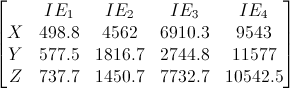
Figure 1: Ionization energies in kJ/mol for selected elements.
What is the electron configuration for element X?
Below are the data for ionization energies of three elements X, Y, and Z. These elements are in the third period of the periodic table. The first four ionization energies for elements X, Y, and Z are given below in values of kJ/mol.
Figure 1: Ionization energies in kJ/mol for selected elements.
What is the electron configuration for element X?
Tap to reveal answer
We discover that element X is sodium, due to the masive jump after the first ionization energy. Sodium has filled 1s and 2s orbitals, and a half filled 3s orbital. We know that sodium will have the base configuation of \[Ne\], with one additional electron in the third shell, due to its position in the third period. This leads us to our answer of 1s22s22p63s1.
We discover that element X is sodium, due to the masive jump after the first ionization energy. Sodium has filled 1s and 2s orbitals, and a half filled 3s orbital. We know that sodium will have the base configuation of \[Ne\], with one additional electron in the third shell, due to its position in the third period. This leads us to our answer of 1s22s22p63s1.
← Didn't Know|Knew It →
What is the element with the ground electron configuration  ?
?
What is the element with the ground electron configuration
Tap to reveal answer
Electron configurations can easily be figured out by using the periodic table. It is important to memorize the order that the orbitals become filled; then, you can simply follow the periodic table, adding one electron as you move from one element to the next. To make things easier, you can also remember that the first period ends with 1s, the second ends with 2p, and the third ends with 3p. It gets a little more complicated after that, but knowing those first few periods will let you work quicker.
When given an electronic configuration, you can also add the number of electrons to determine the element's atomic number.
 shows a total of
  electrons. Phosphorous corresponds to atomic number 15.
Electron configurations can easily be figured out by using the periodic table. It is important to memorize the order that the orbitals become filled; then, you can simply follow the periodic table, adding one electron as you move from one element to the next. To make things easier, you can also remember that the first period ends with 1s, the second ends with 2p, and the third ends with 3p. It gets a little more complicated after that, but knowing those first few periods will let you work quicker.
When given an electronic configuration, you can also add the number of electrons to determine the element's atomic number.
← Didn't Know|Knew It →
Which element has a valence shell with five electrons?
Which element has a valence shell with five electrons?
Tap to reveal answer
To find the answer, we would write out the electron configuration for each given choice.
Arsenic has an electron configuration of  , with the fourth shell representing the valence electrons. The valence includes both the 4s and 4p, so it has a total of 5 (
 ). We could also look at the periodic table and see that arsenic is in the same period as nitrogen and phosphorus, meaning it will have five valence electrons.
To find the answer, we would write out the electron configuration for each given choice.
Arsenic has an electron configuration of
← Didn't Know|Knew It →
Which element does not contain electrons in the d orbital?
Which element does not contain electrons in the d orbital?
Tap to reveal answer
The periodic table is designed to organize elements by their orbitals. Electrons only enter the d orbital in the fourth period (row) at the beginning of the transition metals. Scandium is the first element to have an electron enter the d orbital. Calcium is the last element on the table that has up to p orbital electrons, and empty d orbitals.
Calcium: 
Scandium: 
The periodic table is designed to organize elements by their orbitals. Electrons only enter the d orbital in the fourth period (row) at the beginning of the transition metals. Scandium is the first element to have an electron enter the d orbital. Calcium is the last element on the table that has up to p orbital electrons, and empty d orbitals.
Calcium:
Scandium:
← Didn't Know|Knew It →
How many valence orbitals contain one electron in a nitrogen atom?
How many valence orbitals contain one electron in a nitrogen atom?
Tap to reveal answer
Nitrogen is an atom that is beginning to have its p orbitals filled with electrons. According to Hund's rule, electrons will prefer an unoccupied orbital when it is at the same energy level as the other available orbitals. In nitrogen, the 2_s_ orbital has been completely filled. Since there are three p orbitals available, the three remaining electrons will prefer to have their own unoccupied orbitals. As a result, the three p orbitals will each have one electron.

1s ee
2s ee
2p e_ e_ e_
Nitrogen is an atom that is beginning to have its p orbitals filled with electrons. According to Hund's rule, electrons will prefer an unoccupied orbital when it is at the same energy level as the other available orbitals. In nitrogen, the 2_s_ orbital has been completely filled. Since there are three p orbitals available, the three remaining electrons will prefer to have their own unoccupied orbitals. As a result, the three p orbitals will each have one electron.
1s ee
2s ee
2p e_ e_ e_
← Didn't Know|Knew It →
Which of the following sets of quantum numbers could never be used to describe an electron?
Which of the following sets of quantum numbers could never be used to describe an electron?
Tap to reveal answer
The principle quantum number,  , must always be an integer greater than zero.
The angular momentum quantum number,  , can have values from zero up to
  .
.
The magnetic quantum number,  , ranges from
  to
to  .
.
The spin quantum number,  , must be
  or
or  .
.
To total, a set of quantum numbers follows the pattern: 
The only answer option that presents an invalid set of quantum numbers is  . In this option, the angular momentum quantum number,
  , has an illegal value; it must be between zero and
  , and thus cannot be equal to 3.
The principle quantum number,
The angular momentum quantum number,
The magnetic quantum number,
The spin quantum number,
To total, a set of quantum numbers follows the pattern:
The only answer option that presents an invalid set of quantum numbers is
← Didn't Know|Knew It →
How many unpaired electrons occupy the 3p orbitals of  ?
?
How many unpaired electrons occupy the 3p orbitals of
Tap to reveal answer
Atomic sulfur has 16 electrons, yielding 3p orbitals with 2, 1, and 1 electrons as seen below:
 orbital diagram:
1s22s23s23p4
We consider the 3p subshell independently as the lower subshells are filled completely. There are three 3p orbitals, each of which may hold two electrons. Hund's rule tells us that each orbital of a given subshell must be singly filled before any orbital in the subshell is doubly filled.
Following this rule, each of the three orbitals are given one of the four remaining electrons, and one orbital is given a second. The 3p subshell has two orbitals occupied by unpaired electrons in atomic sulfur.
However,  has two additional electrons. As a result, the 3p orbitals are filled completely and the correct answer is 0 unpaired electrons.
 orbital diagram:
1s22s23s23p6
Note: this is identical to the electron configuration of Argon.
Atomic sulfur has 16 electrons, yielding 3p orbitals with 2, 1, and 1 electrons as seen below:
1s22s23s23p4
We consider the 3p subshell independently as the lower subshells are filled completely. There are three 3p orbitals, each of which may hold two electrons. Hund's rule tells us that each orbital of a given subshell must be singly filled before any orbital in the subshell is doubly filled.
Following this rule, each of the three orbitals are given one of the four remaining electrons, and one orbital is given a second. The 3p subshell has two orbitals occupied by unpaired electrons in atomic sulfur.
However,
1s22s23s23p6
Note: this is identical to the electron configuration of Argon.
← Didn't Know|Knew It →
What is the electron configuration for carbon?
What is the electron configuration for carbon?
Tap to reveal answer
Carbon is on the second period and  group of the periodic table. Each time we jump from left to right, we add an electron. Period 1 corresponds to 1s, period 2 corresponds to 2s, 2p and so forth. The first energy shell can hold a maximum of two electrons, and each subsequent shell can hold eight.
Carbon is on the second period and
← Didn't Know|Knew It →