
P-Series
AP Calculus BC · Learn by Concept
Help Questions
AP Calculus BC › P-Series
One of the following infinite series CONVERGES. Which is it?


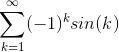
None of the others converge.
Explanation

We start with the equation 


Determine if the series converges or diverges. You do not need to find the sum.

Converges
Diverges
There is not enough information to decide convergence.
Conditionally converges.
Neither converges nor diverges.
Explanation
We can compare this to the series 
To figure this out, let's first compare 


There is a rule in math that if you take the reciprocal of each term in an inequality, you are allowed to flip the signs.
Thus, 

And so, because 
Determine the nature of convergence of the series having the general term:
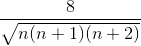
The series is convergent.
The series is divergent.


Explanation
We will use the Limit Comparison Test to establish this result.
We need to note that the following limit

goes to 1 as n goes to infinity.
Therefore the series have the same nature. They either converge or diverge at the same time.
We will focus on the series:

We know that this series is convergent because it is a p-series. (Remember that

By the Limit Comparison Test, we deduce that the series is convergent, and that is what we needed to show.
Does the series 
Converge Conditionally.
Converge Absolutely.
Diverges.
Cannot tell with the given information.
Does not exist.
Explanation
The series converges conditionally.
The absolute values of the series 

However, the the limit of the sequence 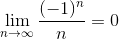
Therefore, by the alternating series test, the series converges conditionally.
True or False, a 
True
False
Explanation
We cannot test for convergence of a 
For the series 

Since this limit is 

Which of the following tests will help determine whether 
Integral Test: The improper integral determines that the harmonic series diverge.
P-Series Test: The summation converges since 
Root Test: Since the limit as 


Explanation
The series 
The Nth term test and the Divergent test may not be used to determine whether this series converges, since this is a special case. The root test also does not apply in this scenario.
According the the P-series Test, 


This leaves us with the Integral Test.

Since the improper integral diverges, so does the series.