
Chain Rule and Implicit Differentiation
AP Calculus BC · Learn by Concept
Help Questions
AP Calculus BC › Chain Rule and Implicit Differentiation

Evaluate 


Explanation
To find 


Plug in 3:


Use implicit differentiation to find the slope of the tangent line to 


Explanation
We must take the derivative 


We include the 


Now we can factor out a 


Doing this gives you

We want to find the slope at 


Evaluate 


Undefined
Explanation
To find 


So

and


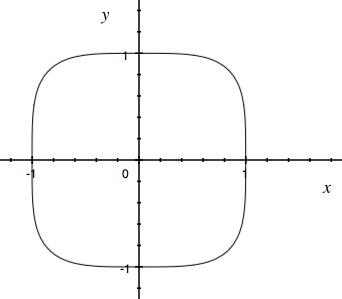
Figure. Squircle of "radius" 1
A squircle is a curve in the xy plane that appears like a rounded square, but whose points satisfy the following equation (analogous to the Pythagorean theorem for a circle)

where the constant 
Using implicit differentiation, obtain an expression for 


Explanation
Differentiate both sides of the equation with respect to 


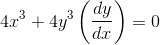
Then solve for 
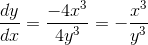
Comparing this to the figure, our answer makes sense, because the slope of the squircle is 


Explanation
According to the chain rule, 


Find 


Explanation
To find 
Taking 

using the following rules:


Note that for every derivative with respect to x of a function with y, the additional term dy/dx appears; this is because of the chain rule, where y=g(x), so to speak, for the function it appears in.
Using algebra, we get

A curve in the xy plane is given implictly by

Calculate the slope of the line tangent to the curve at the point 


Explanation
Differentiate both sides with respect to 

Then solve for 

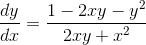
Finally, evaluate 


Find 


Explanation
To find the derivative of 
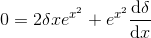
The derivatives were found using the following rules:



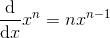
Solving for 
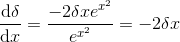
Note that the chain rule was used because of the exponential and because 
Find 



Explanation
The derivative of the function is equal to

and was found using the following rules:

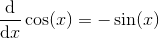
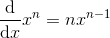
The constant may seem intimidating, but we treat it as another constant!
Find the first derivative of the following function:

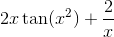
Explanation
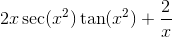
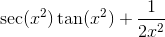
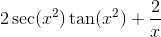
The derivative of the function is equal to

and was found using the following rules:


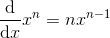
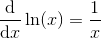
Note that the chain rule was used on the secant function as well as the natural logarithm function.