Integrals - AP Calculus BC
Card 1 of 942
Given
, what is
?
Given
, what is
?
Tap to reveal answer
By the Fundamental Theorem of Calculus, for all functions
that are continuously defined on the interval
with
in
and for all functions
defined by by
, we know that
.
Thus, for
,
.
Therefore,

By the Fundamental Theorem of Calculus, for all functions that are continuously defined on the interval
with
in
and for all functions
defined by by
, we know that
.
Thus, for
,
.
Therefore,
← Didn't Know|Knew It →
Given
, what is
?
Given
, what is
?
Tap to reveal answer
By the Fundamental Theorem of Calculus, for all functions
that are continuously defined on the interval
with
in
and for all functions
defined by by
, we know that
.
Given
, then
.
Therefore,
.
By the Fundamental Theorem of Calculus, for all functions that are continuously defined on the interval
with
in
and for all functions
defined by by
, we know that
.
Given
, then
.
Therefore,
.
← Didn't Know|Knew It →
Evaluate 
Evaluate
Tap to reveal answer

Use the fundamental theorem of calculus to evaluate:
![\frac{1}{3} (6-3)^3 - [ \frac{1}{3}(0-3)^3] = \frac{1}{3} (3)^3 - \frac{1}{3} (-3)^3](https://vt-vtwa-assets.varsitytutors.com/vt-vtwa/uploads/formula_image/image/854677/gif.latex)

Use the fundamental theorem of calculus to evaluate:
← Didn't Know|Knew It →
Tap to reveal answer

Use the Fundamental Theorem of Calculus and evaluate the integral at both endpoints:


Use the Fundamental Theorem of Calculus and evaluate the integral at both endpoints:
← Didn't Know|Knew It →
Suppose we have the function

What is the derivative,
?
Suppose we have the function
What is the derivative, ?
Tap to reveal answer
We can view the function
as a function of
, as so

where
.
We can find the derivative of
using the chain rule:

where
can be found using the fundamental theorem of calculus:

So we get
![\small \small \small \small g'(x)=-\sin x\cdot F'(\cos x)=-\sin x\cdot[1+\sin(\cos x)]](https://vt-vtwa-assets.varsitytutors.com/vt-vtwa/uploads/formula_image/image/375920/gif.latex)
We can view the function as a function of
, as so
where .
We can find the derivative of using the chain rule:
where can be found using the fundamental theorem of calculus:
So we get
← Didn't Know|Knew It →
Evaluate
when
.
Evaluate when
.
Tap to reveal answer
Via the Fundamental Theorem of Calculus, we know that, given a function
,
.
Therefore
.
Via the Fundamental Theorem of Calculus, we know that, given a function,
.
Therefore .
← Didn't Know|Knew It →
Evaluate
when
.
Evaluate when
.
Tap to reveal answer
Via the Fundamental Theorem of Calculus, we know that, given a function
,
. Therefore,
.
Via the Fundamental Theorem of Calculus, we know that, given a function ,
. Therefore,
.
← Didn't Know|Knew It →
The temperature of an oven is increasing at a rate
degrees Fahrenheit per miniute for
minutes. The initial temperature of the oven is
degrees Fahrenheit.
What is the temperture of the oven at
? Round your answer to the nearest tenth.
The temperature of an oven is increasing at a rate degrees Fahrenheit per miniute for
minutes. The initial temperature of the oven is
degrees Fahrenheit.
What is the temperture of the oven at ? Round your answer to the nearest tenth.
Tap to reveal answer
Integrating
over an interval
will tell us the total accumulation, or change, in temperature over that interval. Therefore, we will need to evaluate the integral

to find the change in temperature that occurs during the first five minutes.
A substitution is useful in this case. Let

. We should also express the limits of integration in terms of
. When
, and when
Making these substitutions leads to the integral
.
To evaluate this, you must know the antiderivative of an exponential function.
In general,
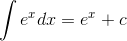
.
Therefore,
.
This tells us that the temperature rose by approximately
degrees during the first five minutes. The last step is to add the initial temperature, which tells us that the temperature at
minutes is
degrees.
Integrating over an interval
will tell us the total accumulation, or change, in temperature over that interval. Therefore, we will need to evaluate the integral
to find the change in temperature that occurs during the first five minutes.
A substitution is useful in this case. Let. We should also express the limits of integration in terms of
. When
, and when
Making these substitutions leads to the integral
.
To evaluate this, you must know the antiderivative of an exponential function.
In general,
.
Therefore,
.
This tells us that the temperature rose by approximately degrees during the first five minutes. The last step is to add the initial temperature, which tells us that the temperature at
minutes is
degrees.
← Didn't Know|Knew It →
Find the equation for the velocity of a particle if the acceleration of the particle is given by:

and the velocity at time
of the particle is
.
Find the equation for the velocity of a particle if the acceleration of the particle is given by:
and the velocity at time of the particle is
.
Tap to reveal answer
In order to find the velocity function, we must integrate the accleration function:

We used the rule
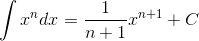
to integrate.
Now, we use the initial condition for the velocity function to solve for C. We were told that

so we plug in zero into the velocity function and solve for C:

C is therefore 30.
Finally, we write out the velocity function, with the integer replacing C:
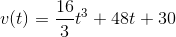
In order to find the velocity function, we must integrate the accleration function:
We used the rule
to integrate.
Now, we use the initial condition for the velocity function to solve for C. We were told that
so we plug in zero into the velocity function and solve for C:
C is therefore 30.
Finally, we write out the velocity function, with the integer replacing C:
← Didn't Know|Knew It →
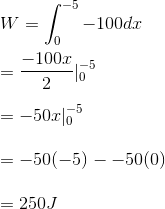
Find the work done by gravity exerting an acceleration of
for a
block down
from its original position with no initial velocity.
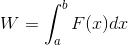
Remember that

, where
is a force measured in
,
is work measured in
, and
and
are initial and final positions respectively.
Find the work done by gravity exerting an acceleration of for a
block down
from its original position with no initial velocity.
Remember that
, where
is a force measured in
,
is work measured in
, and
and
are initial and final positions respectively.
Tap to reveal answer
The force of gravity is proportional to the mass of the object and acceleration of the object.

Since the block fell down 5 meters, its final position is
and initial position is
.

The force of gravity is proportional to the mass of the object and acceleration of the object.
Since the block fell down 5 meters, its final position is and initial position is
.
← Didn't Know|Knew It →
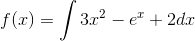
Evaluate the following integral and find the specific function which satisfies the given initial conditions:
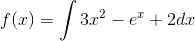

Evaluate the following integral and find the specific function which satisfies the given initial conditions:
Tap to reveal answer
Evaluate the following integral and find the specific function which satisfies the given initial conditions:


To solve this problem,we need to evaluate the given integral, then solve for our constant of integration.
Let's begin by recalling the following integration rules:
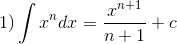
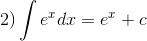
Using these two, we can integrate f(x)
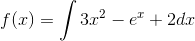

SO, we get:

We are almost there, but we need to find c. To do so, plug in our initial conditions and solve:



So, our answer is:

Evaluate the following integral and find the specific function which satisfies the given initial conditions:
To solve this problem,we need to evaluate the given integral, then solve for our constant of integration.
Let's begin by recalling the following integration rules:
Using these two, we can integrate f(x)
SO, we get:
We are almost there, but we need to find c. To do so, plug in our initial conditions and solve:
So, our answer is:
← Didn't Know|Knew It →
Give the arclength of the graph of the function
on the interval
.
Give the arclength of the graph of the function on the interval
.
Tap to reveal answer
The length of the curve of
on the interval
can be determined by evaluating the integral
.
, so

The integral becomes


Use substitution - set
. Then
, and
. The bounds of integration become
and
, and the integral becomes


The length of the curve of on the interval
can be determined by evaluating the integral
.
, so
The integral becomes
Use substitution - set . Then
, and
. The bounds of integration become
and
, and the integral becomes
← Didn't Know|Knew It →
Give the arclength of the graph of the function
on the interval
.
Give the arclength of the graph of the function on the interval
.
Tap to reveal answer
The length of the curve of
on the interval
can be determined by evaluating the integral
.

so
.
The above integral becomes


Substitute
. Then
,
, and the integral becomes


The length of the curve of on the interval
can be determined by evaluating the integral
.
so
.
The above integral becomes
Substitute . Then
,
, and the integral becomes
← Didn't Know|Knew It →
Determine the length of the following function between 

Determine the length of the following function between
Tap to reveal answer
In order to begin the problem, we must first remember the formula for finding the arc length of a function along any given interval:

where ds is given by the equation below:

We can see from our equation for ds that we must find the derivative of our function, which in our case is dv/dt instead of dy/dx, so we begin by differentiating our function v(t) with respect to t:

Now we can plug this into the given equation to find ds:

Our last step is to plug our value for ds into the equation for arc length, which we can see only involves integrating ds. The interval along which the problem asks for the length of the function gives us our limits of integration, so we simply integrate ds from t=1 to t=4:
![L=\int ds=\int_{1}^{4}\sqrt{t}dt=[\frac{2}{3}t^{\frac{3}{2}}]_{1}^{4}](https://vt-vtwa-assets.varsitytutors.com/vt-vtwa/uploads/formula_image/image/259910/gif.latex)

In order to begin the problem, we must first remember the formula for finding the arc length of a function along any given interval:
where ds is given by the equation below:
We can see from our equation for ds that we must find the derivative of our function, which in our case is dv/dt instead of dy/dx, so we begin by differentiating our function v(t) with respect to t:
Now we can plug this into the given equation to find ds:
Our last step is to plug our value for ds into the equation for arc length, which we can see only involves integrating ds. The interval along which the problem asks for the length of the function gives us our limits of integration, so we simply integrate ds from t=1 to t=4:
← Didn't Know|Knew It →
In physics, the work done on an object is equal to the integral of the force on that object dotted with its displacent.
This looks like
(
is work,
is force, and
is the infinitesimally small displacement vector). For a force whose direction is the line of motion, the equation becomes
.
If the force on an object as a function of displacement is
, what is the work as a function of displacement
? Assume
and the force is in the direction of the object's motion.
In physics, the work done on an object is equal to the integral of the force on that object dotted with its displacent.
This looks like (
is work,
is force, and
is the infinitesimally small displacement vector). For a force whose direction is the line of motion, the equation becomes
.
If the force on an object as a function of displacement is , what is the work as a function of displacement
? Assume
and the force is in the direction of the object's motion.
Tap to reveal answer
, so
.
Both the terms of the force are power terms in the form
, which have the integral
, so the integral of the force is
.
We know
.
This means
.
, so
.
Both the terms of the force are power terms in the form , which have the integral
, so the integral of the force is
.
We know
.
This means
.
← Didn't Know|Knew It →
What is the length of the curve
over the interval
?
What is the length of the curve over the interval
?
Tap to reveal answer
The general formula for finding the length of a curve
over an interval
is 
In this example, the arc length can be found by computing the integral
.
The derivative of
can be found using the power rule,
, which leads to
.
At this point, a substitution is useful.
Let
.
We can also express the limits of integration in terms of
to simplify computation. When
, and when
.
Making these substitutions leads to
.
Now use the power rule, which in general is
, to evaluate the integral.


The general formula for finding the length of a curve over an interval
is
In this example, the arc length can be found by computing the integral
.
The derivative of can be found using the power rule,
, which leads to
.
At this point, a substitution is useful.
Let
.
We can also express the limits of integration in terms of to simplify computation. When
, and when
.
Making these substitutions leads to
.
Now use the power rule, which in general is , to evaluate the integral.
← Didn't Know|Knew It →
Find the total distance traveled by a particle along the curve
from
to
.
Find the total distance traveled by a particle along the curve from
to
.
Tap to reveal answer
To find the required distance, we can use the arc length expression given by
.
Taking the derivative of our function, we have
. Plugging in our
values for our integral bounds, we have
.
As with most arc length integrals, this integral is too difficult (if not, outright impossible) to evaluate explicitly by hand. So we will just leave it this form, or evaluate it with some computer software.
To find the required distance, we can use the arc length expression given by .
Taking the derivative of our function, we have . Plugging in our
values for our integral bounds, we have
.
As with most arc length integrals, this integral is too difficult (if not, outright impossible) to evaluate explicitly by hand. So we will just leave it this form, or evaluate it with some computer software.
← Didn't Know|Knew It →
Solve the separable differential equation

with the condition
.
Solve the separable differential equation
with the condition .
Tap to reveal answer
To solve the separable differential equation, we must separate x and y, dx and dy respectively to opposite sides:

Integrating both sides, we get

The rules of integration used were
, 
The constants of integration merged into one.
Now, we exponentiate both sides of the equation to solve for y, and use the properties of exponents to simplify:

To solve for C, we use our given condition:


Our final answer is

To solve the separable differential equation, we must separate x and y, dx and dy respectively to opposite sides:
Integrating both sides, we get
The rules of integration used were
,
The constants of integration merged into one.
Now, we exponentiate both sides of the equation to solve for y, and use the properties of exponents to simplify:
To solve for C, we use our given condition:
Our final answer is
← Didn't Know|Knew It →
Determine the volume of the solid obtained by rotating the region with the following bounds about the x-axis:


Determine the volume of the solid obtained by rotating the region with the following bounds about the x-axis:
Tap to reveal answer
From calculus, we know the volume of an irregular solid can be determined by evaluating the following integral:

Where A(x) is an equation for the cross-sectional area of the solid at any point x. We know our bounds for the integral are x=1 and x=4, as given in the problem, so now all we need is to find the expression A(x) for the area of our solid.
From the given bounds, we know our unrotated region is bounded by the x-axis (y=0) at the bottom, and by the line y=x^2-4x+5 at the top. Because we are rotating about the x-axis, we know that the radius of our solid at any point x is just the distance y=x^2-4x+5. Now that we have a function that describes the radius of the solid at any point x, we can plug the function into the formula for the area of a circle to give us an expression for the cross-sectional area of our solid at any point:

We now have our equation for the cross-sectional area of the solid, which we can integrate from x=1 to x=4 to find its volume:

![=\pi [\frac{1}{5}x^5-2x^4+\frac{26}{3}x^3-20x^2+25x]_{1}^{4}=\frac{78\pi }{5}](https://vt-vtwa-assets.varsitytutors.com/vt-vtwa/uploads/formula_image/image/265347/gif.latex)
From calculus, we know the volume of an irregular solid can be determined by evaluating the following integral:
Where A(x) is an equation for the cross-sectional area of the solid at any point x. We know our bounds for the integral are x=1 and x=4, as given in the problem, so now all we need is to find the expression A(x) for the area of our solid.
From the given bounds, we know our unrotated region is bounded by the x-axis (y=0) at the bottom, and by the line y=x^2-4x+5 at the top. Because we are rotating about the x-axis, we know that the radius of our solid at any point x is just the distance y=x^2-4x+5. Now that we have a function that describes the radius of the solid at any point x, we can plug the function into the formula for the area of a circle to give us an expression for the cross-sectional area of our solid at any point:
We now have our equation for the cross-sectional area of the solid, which we can integrate from x=1 to x=4 to find its volume:
← Didn't Know|Knew It →
Find the volume of the solid generated by revolving the region bounded by
and the
-axis in the first quadrant about the
-axis.
Find the volume of the solid generated by revolving the region bounded by and the
-axis in the first quadrant about the
-axis.
Tap to reveal answer
Since we are revolving a region of interest around a horizontal line
, we need to express the inner and outer radii in terms of x.
Recall the formula:
![Volume = \pi \int_{b}^{a} [(\textup{outer radius})^{2} - (\textup{inner radius})^{2}]dx](https://vt-vtwa-assets.varsitytutors.com/vt-vtwa/uploads/formula_image/image/343034/gif.latex)
The outer radius is
and the inner radius is
. The x-limits of the region are between
and
. So the volume set-up is:

Using trigonometric identities, we know that:

Hence:

![= \pi \left[\frac{1}{2}x - \frac{1}{4}sin2x\right]_{0}^{\pi} = \frac{1}{2}\pi^2](https://vt-vtwa-assets.varsitytutors.com/vt-vtwa/uploads/formula_image/image/343042/gif.latex)
Since we are revolving a region of interest around a horizontal line , we need to express the inner and outer radii in terms of x.
Recall the formula:
The outer radius is and the inner radius is
. The x-limits of the region are between
and
. So the volume set-up is:
Using trigonometric identities, we know that:
Hence:
← Didn't Know|Knew It →