
Functions, Graphs, and Limits - AP Calculus BC
Card 1 of 1344
Find the vector form of  to
to  .
.
Find the vector form of
Tap to reveal answer
When we are trying to find the vector form we need to remember the formula which states to take the difference between the ending and starting point.
Thus we would get:
Given  and
and 

In our case we have ending point at  and our starting point at
  .
.
Therefore we would set up the following and simplify.

When we are trying to find the vector form we need to remember the formula which states to take the difference between the ending and starting point.
Thus we would get:
Given
In our case we have ending point at
Therefore we would set up the following and simplify.
← Didn't Know|Knew It →

Tap to reveal answer
In general:
If  ,
,
then 
Derivative rules that will be needed here:
- Taking a derivative on a term, or using the power rule, can be done by doing the following:

- Special rule when differentiating an exponential function:
 , where k is a constant.
In this problem, 


Put it all together to get 

In general:
If
then
Derivative rules that will be needed here:
- Taking a derivative on a term, or using the power rule, can be done by doing the following:
- Special rule when differentiating an exponential function:
In this problem,
Put it all together to get
← Didn't Know|Knew It →

Calculate 
Calculate
Tap to reveal answer
Calculate the sum of vectors.
In general,


Solution:


Calculate the sum of vectors.
In general,
Solution:
← Didn't Know|Knew It →
Given points  and
and  , what is the vector form of the distance between the points?
Given points
Tap to reveal answer
In order to derive the vector form of the distance between two points, we must find the difference between the  ,
,  , and
, and  elements of the points.
That is, for any point
 and
and  ,
,
the distance is the vector
 .
.
Subbing in our original points  and
and  , we get:


In order to derive the vector form of the distance between two points, we must find the difference between the
That is, for any point
the distance is the vector
Subbing in our original points
← Didn't Know|Knew It →
Given points  and
and  , what is the vector form of the distance between the points?
Given points
Tap to reveal answer
In order to derive the vector form of the distance between two points, we must find the difference between the , , and elements of the points.
That is, for any point and , the distance is the vector .
Subbing in our original points  and
and  , we get:


In order to derive the vector form of the distance between two points, we must find the difference between the
That is, for any point
Subbing in our original points
← Didn't Know|Knew It →
The graph of the vector function 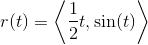 can also be represented by the graph of which of the following functions in rectangular form?
The graph of the vector function
Tap to reveal answer
We can find the graph of 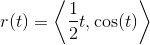 in rectangular form by mapping the parametric coordinates to Cartesian coordinates
  :
:


We can now use this value to solve for  :
:


We can find the graph of
We can now use this value to solve for
← Didn't Know|Knew It →
The graph of the vector function  can also be represented by the graph of which of the following functions in rectangular form?
The graph of the vector function
Tap to reveal answer
We can find the graph of  in rectangular form by mapping the parametric coordinates to Cartesian coordinates :


We can now use this value to solve for :
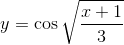
We can find the graph of
We can now use this value to solve for
← Didn't Know|Knew It →
Convert the following parametric equation into rectangular form:

Convert the following parametric equation into rectangular form:
Tap to reveal answer
To convert from parametric form to rectangular form, we must eliminate the parameter:
To do this we will first get t in terms of x.

Now, replace all of the t's in the equation for y:

To convert from parametric form to rectangular form, we must eliminate the parameter:
To do this we will first get t in terms of x.
Now, replace all of the t's in the equation for y:
← Didn't Know|Knew It →
Convert the following equation from parametric to rectangular form:

Convert the following equation from parametric to rectangular form:
Tap to reveal answer
To convert from parametric to rectangular form, we must eliminate the parameter from one of the equations:

Now, replace all of the t's in the equation for y with the above term:

To convert from parametric to rectangular form, we must eliminate the parameter from one of the equations:
Now, replace all of the t's in the equation for y with the above term:
← Didn't Know|Knew It →
Convert the following parametric equation to rectangular form:

Convert the following parametric equation to rectangular form:
Tap to reveal answer
To convert from parametric to rectangular coordinates, we must eliminate the parameter by finding t in terms of x or y:
We will start by taking the exponential of both sides of the equation  . Recall that
  .
.
Therefore we get,
 .
.
Now, replace t with the above term in the equation for x:

To convert from parametric to rectangular coordinates, we must eliminate the parameter by finding t in terms of x or y:
We will start by taking the exponential of both sides of the equation
Therefore we get,
Now, replace t with the above term in the equation for x:
← Didn't Know|Knew It →
Convert the following parametric equation to rectangular form:

Convert the following parametric equation to rectangular form:
Tap to reveal answer
To convert the equation into parametric form, we must eliminate the parameter by finding t in terms of either x or y:

Now, replace all of the t's in the equation for y with the above term:

To convert the equation into parametric form, we must eliminate the parameter by finding t in terms of either x or y:
Now, replace all of the t's in the equation for y with the above term:
← Didn't Know|Knew It →
Given  and
and  , what is
  in terms of
  (rectangular form)?
Given
Tap to reveal answer
Given  and
and  , let's solve both equations for
  :
:


Since both equations equal  , let's set them equal to each other and solve for
  :
:


Given
Since both equations equal
← Didn't Know|Knew It →
Given  and
and  , what is
  in terms of
  (rectangular form)?
Given
Tap to reveal answer
Given  and
and  , let's solve both equations for :


Since both equations equal , let's set them equal to each other and solve for :


Given
Since both equations equal
← Didn't Know|Knew It →
Given  and
and  , what is
  in terms of
  (rectangular form)?
Given
Tap to reveal answer
Given  and
and  , let's solve both equations for :


Since both equations equal , let's set them equal to each other and solve for :


Given
Since both equations equal
← Didn't Know|Knew It →
When  and
and  , what is
  in terms of
  (rectangular form)?
When
Tap to reveal answer
Given  and
and  , wet's solve both equations for :


Since both equations equal , let's set them equal to each other and solve for :


Given
Since both equations equal
← Didn't Know|Knew It →
When  and
and  , what is
  in terms of
  (rectangular form)?
When
Tap to reveal answer
Given  and
and  , wet's solve both equations for :


Since both equations equal , let's set them equal to each other and solve for :


Given
Since both equations equal
← Didn't Know|Knew It →
Given  and
and  , what is
  in terms of
  ?
?
Given
Tap to reveal answer
Given  and
and  , wlet's solve both equations for :


Since both equations equal , let's set them equal to each other and solve for :


Given
Since both equations equal
← Didn't Know|Knew It →
When  and
and  , what is
  in terms of
  (rectangular form)?
When
Tap to reveal answer
Given  and
and  , wet's solve both equations for :


Since both equations equal , let's set them equal to each other and solve for :


Given
Since both equations equal
← Didn't Know|Knew It →
Given  and
and  , what is
  in terms of
  ?
?
Given
Tap to reveal answer
Given  and
and  , let's solve both equations for :


Since both equations equal , let's set them equal to each other and solve for :


Given
Since both equations equal
← Didn't Know|Knew It →
Write in Cartesian form:

Write in Cartesian form:
Tap to reveal answer
 , so
, so
 .
.
 , so
, so


← Didn't Know|Knew It →