
Derivatives - AP Calculus BC
Card 1 of 2835
Let  on the interval
  . Find a value for the number(s) that satisfies the mean value theorem for this function and interval.
Let
Tap to reveal answer
The mean value theorem states that for a planar arc passing through a starting and endpoint  , there exists at a minimum one point,
  , within the interval
  for which a line tangent to the curve at this point is parallel to the secant passing through the starting and end points.

In other words, if one were to draw a straight line through these start and end points, one could find a point on the curve where the tangent would have the same slope as this line.

Note that the value of the derivative of a function at a point is the function's slope at that point; i.e. the slope of the tangent at said point.
First, find the two function values of  on the interval


Then take the difference of the two and divide by the interval.

Now find the derivative of the function; this will be solved for the value(s) found above.


Since the interval is  ,
,  satisfies the MVT.
The mean value theorem states that for a planar arc passing through a starting and endpoint
In other words, if one were to draw a straight line through these start and end points, one could find a point on the curve where the tangent would have the same slope as this line.
Note that the value of the derivative of a function at a point is the function's slope at that point; i.e. the slope of the tangent at said point.
First, find the two function values of
Then take the difference of the two and divide by the interval.
Now find the derivative of the function; this will be solved for the value(s) found above.
Since the interval is
← Didn't Know|Knew It →
Let  on the interval
  . Find a value for the number(s) that satisfies the mean value theorem for this function and interval.
Let
Tap to reveal answer
The mean value theorem states that for a planar arc passing through a starting and endpoint  , there exists at a minimum one point,
  , within the interval
  for which a line tangent to the curve at this point is parallel to the secant passing through the starting and end points.
In other words, if one were to draw a straight line through these start and end points, one could find a point on the curve where the tangent would have the same slope as this line.

Note that the value of the derivative of a function at a point is the function's slope at that point; i.e. the slope of the tangent at said point.
First, find the two function values of  on the interval


Then take the difference of the two and divide by the interval.

Now find the derivative of the function; this will be solved for the value(s) found above.


Multiple solutions will solve this function, but on the interval  , only
  fits within, satisfying the MVT.
The mean value theorem states that for a planar arc passing through a starting and endpoint
In other words, if one were to draw a straight line through these start and end points, one could find a point on the curve where the tangent would have the same slope as this line.
Note that the value of the derivative of a function at a point is the function's slope at that point; i.e. the slope of the tangent at said point.
First, find the two function values of
Then take the difference of the two and divide by the interval.
Now find the derivative of the function; this will be solved for the value(s) found above.
Multiple solutions will solve this function, but on the interval
← Didn't Know|Knew It →
Let  on the interval
  . Find a value for the number(s) that satisfies the mean value theorem for this function and interval.
Let
Tap to reveal answer
The mean value theorem states that for a planar arc passing through a starting and endpoint  , there exists at a minimum one point,
  , within the interval
  for which a line tangent to the curve at this point is parallel to the secant passing through the starting and end points.
In other words, if one were to draw a straight line through these start and end points, one could find a point on the curve where the tangent would have the same slope as this line.

Note that the value of the derivative of a function at a point is the function's slope at that point; i.e. the slope of the tangent at said point.
First, find the two function values of  on the interval


Then take the difference of the two and divide by the interval.

Now find the derivative of the function; this will be solved for the value(s) found above.


 , which falls within the interval
  , satisfying the MVT.
The mean value theorem states that for a planar arc passing through a starting and endpoint
In other words, if one were to draw a straight line through these start and end points, one could find a point on the curve where the tangent would have the same slope as this line.
Note that the value of the derivative of a function at a point is the function's slope at that point; i.e. the slope of the tangent at said point.
First, find the two function values of
Then take the difference of the two and divide by the interval.
Now find the derivative of the function; this will be solved for the value(s) found above.
← Didn't Know|Knew It →
Let  on the interval
  . Find a value for the number(s) that satisfies the mean value theorem for this function and interval.
Let
Tap to reveal answer
The mean value theorem states that for a planar arc passing through a starting and endpoint  , there exists at a minimum one point,
  , within the interval
  for which a line tangent to the curve at this point is parallel to the secant passing through the starting and end points.
In other words, if one were to draw a straight line through these start and end points, one could find a point on the curve where the tangent would have the same slope as this line.

Note that the value of the derivative of a function at a point is the function's slope at that point; i.e. the slope of the tangent at said point.
First, find the two function values of  on the interval


Then take the difference of the two and divide by the interval.

Now find the derivative of the function; this will be solved for the value(s) found above.


 which falls within the interval
  , satisfying the MVT.
The mean value theorem states that for a planar arc passing through a starting and endpoint
In other words, if one were to draw a straight line through these start and end points, one could find a point on the curve where the tangent would have the same slope as this line.
Note that the value of the derivative of a function at a point is the function's slope at that point; i.e. the slope of the tangent at said point.
First, find the two function values of
Then take the difference of the two and divide by the interval.
Now find the derivative of the function; this will be solved for the value(s) found above.
← Didn't Know|Knew It →
Let  on the interval
  . Find a value for the number(s) that satisfies the mean value theorem for this function and interval.
Let
Tap to reveal answer
The mean value theorem states that for a planar arc passing through a starting and endpoint  , there exists at a minimum one point,
  , within the interval
  for which a line tangent to the curve at this point is parallel to the secant passing through the starting and end points.
In other words, if one were to draw a straight line through these start and end points, one could find a point on the curve where the tangent would have the same slope as this line.

Note that the value of the derivative of a function at a point is the function's slope at that point; i.e. the slope of the tangent at said point.
First, find the two function values of  on the interval


Then take the difference of the two and divide by the interval.

Now find the derivative of the function; this will be solved for the value(s) found above.


 , which falls between
  , satisfying the MVT.
The mean value theorem states that for a planar arc passing through a starting and endpoint
In other words, if one were to draw a straight line through these start and end points, one could find a point on the curve where the tangent would have the same slope as this line.
Note that the value of the derivative of a function at a point is the function's slope at that point; i.e. the slope of the tangent at said point.
First, find the two function values of
Then take the difference of the two and divide by the interval.
Now find the derivative of the function; this will be solved for the value(s) found above.
← Didn't Know|Knew It →
Let  on the interval
  . Find a value for the number(s) that satisfies the mean value theorem for this function and interval.
Let
Tap to reveal answer
The mean value theorem states that for a planar arc passing through a starting and endpoint  , there exists at a minimum one point,
  , within the interval
  for which a line tangent to the curve at this point is parallel to the secant passing through the starting and end points.
In other words, if one were to draw a straight line through these start and end points, one could find a point on the curve where the tangent would have the same slope as this line.

Note that the value of the derivative of a function at a point is the function's slope at that point; i.e. the slope of the tangent at said point.
First, find the two function values of  on the interval


Then take the difference of the two and divide by the interval.

Now find the derivative of the function; this will be solved for the value(s) found above.


 which falls within the interval
  satisfying the mean value theorem.
The mean value theorem states that for a planar arc passing through a starting and endpoint
In other words, if one were to draw a straight line through these start and end points, one could find a point on the curve where the tangent would have the same slope as this line.
Note that the value of the derivative of a function at a point is the function's slope at that point; i.e. the slope of the tangent at said point.
First, find the two function values of
Then take the difference of the two and divide by the interval.
Now find the derivative of the function; this will be solved for the value(s) found above.
← Didn't Know|Knew It →
Let  on the interval
  . Find a value for the number(s) that satisfies the mean value theorem for this function and interval.
Let
Tap to reveal answer
The mean value theorem states that for a planar arc passing through a starting and endpoint , there exists at a minimum one point, , within the interval for which a line tangent to the curve at this point is parallel to the secant passing through the starting and end points.
In other words, if one were to draw a straight line through these start and end points, one could find a point on the curve where the tangent would have the same slope as this line.
Note that the value of the derivative of a function at a point is the function's slope at that point; i.e. the slope of the tangent at said point.
First, find the two function values of  on the interval


Then take the difference of the two and divide by the interval.

Now find the derivative of the function; this will be solved for the value(s) found above.


There are multiple solutions; within the interval  ,
,  satisfies the mean value theorem.
The mean value theorem states that for a planar arc passing through a starting and endpoint
In other words, if one were to draw a straight line through these start and end points, one could find a point on the curve where the tangent would have the same slope as this line.
Note that the value of the derivative of a function at a point is the function's slope at that point; i.e. the slope of the tangent at said point.
First, find the two function values of
Then take the difference of the two and divide by the interval.
Now find the derivative of the function; this will be solved for the value(s) found above.
There are multiple solutions; within the interval
← Didn't Know|Knew It →
Let  on the interval
  . Find a value for the number(s) that satisfies the mean value theorem for this function and interval.
Let
Tap to reveal answer
The mean value theorem states that for a planar arc passing through a starting and endpoint , there exists at a minimum one point, , within the interval for which a line tangent to the curve at this point is parallel to the secant passing through the starting and end points.
In other words, if one were to draw a straight line through these start and end points, one could find a point on the curve where the tangent would have the same slope as this line.
Note that the value of the derivative of a function at a point is the function's slope at that point; i.e. the slope of the tangent at said point.
First, find the two function values of  on the interval


Then take the difference of the two and divide by the interval.

Now find the derivative of the function; this will be solved for the value(s) found above.


This solution falls within  , validating the mean value theorem.
The mean value theorem states that for a planar arc passing through a starting and endpoint
In other words, if one were to draw a straight line through these start and end points, one could find a point on the curve where the tangent would have the same slope as this line.
Note that the value of the derivative of a function at a point is the function's slope at that point; i.e. the slope of the tangent at said point.
First, find the two function values of
Then take the difference of the two and divide by the interval.
Now find the derivative of the function; this will be solved for the value(s) found above.
This solution falls within
← Didn't Know|Knew It →
Let  on the interval
  . Find a value for the number(s) that satisfies the mean value theorem for this function and interval.
Let
Tap to reveal answer
The mean value theorem states that for a planar arc passing through a starting and endpoint , there exists at a minimum one point, , within the interval for which a line tangent to the curve at this point is parallel to the secant passing through the starting and end points.
In other words, if one were to draw a straight line through these start and end points, one could find a point on the curve where the tangent would have the same slope as this line.
Note that the value of the derivative of a function at a point is the function's slope at that point; i.e. the slope of the tangent at said point.
First, find the two function values of  on the interval


Then take the difference of the two and divide by the interval.

Now find the derivative of the function; this will be solved for the value(s) found above.
Derivative of an exponential:

Derivative of a natural log:
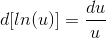
Product rule: 


Using a calculator, we find the solution  , which fits within the interval
  , satisfying the mean value theorem.
The mean value theorem states that for a planar arc passing through a starting and endpoint
In other words, if one were to draw a straight line through these start and end points, one could find a point on the curve where the tangent would have the same slope as this line.
Note that the value of the derivative of a function at a point is the function's slope at that point; i.e. the slope of the tangent at said point.
First, find the two function values of
Then take the difference of the two and divide by the interval.
Now find the derivative of the function; this will be solved for the value(s) found above.
Derivative of an exponential:
Derivative of a natural log:
Product rule:
Using a calculator, we find the solution
← Didn't Know|Knew It →
Find  if
if  .
.
Find
Tap to reveal answer
This function is implicit, because y is not defined directly in terms of only x. We could try to solve for y, but that would be difficult, if not impossible. The easier solution would be to employ implicit differentiation. Our strategy will be to differentiate the left and right sides by x, apply the rules of differentiation (such as Chain and Product Rules), group dy/dx terms, and solve for dy/dx in terms of both x and y.


We will need to apply both the Product Rule and Chain Rule to both the xlny and the  terms.
According to the Product Rule, if f(x) and g(x) are functions, then  .
.
And according to the Chain Rule,


Now we will group the dy/dx terms and move everything else to the opposite side.

Then, we can solve for dy/dx.

To remove the compound fraction, we can multiply the top and bottom of the fraction by y.


The (ugly) answer is  .
.
This function is implicit, because y is not defined directly in terms of only x. We could try to solve for y, but that would be difficult, if not impossible. The easier solution would be to employ implicit differentiation. Our strategy will be to differentiate the left and right sides by x, apply the rules of differentiation (such as Chain and Product Rules), group dy/dx terms, and solve for dy/dx in terms of both x and y.
We will need to apply both the Product Rule and Chain Rule to both the xlny and the
According to the Product Rule, if f(x) and g(x) are functions, then
And according to the Chain Rule,
Now we will group the dy/dx terms and move everything else to the opposite side.
Then, we can solve for dy/dx.
To remove the compound fraction, we can multiply the top and bottom of the fraction by y.
The (ugly) answer is
← Didn't Know|Knew It →

Give  .
.
Give
Tap to reveal answer
 , and the derivative of a constant is 0, so


← Didn't Know|Knew It →

Give  .
.
Give
Tap to reveal answer
 , and the derivative of a constant is 0, so


← Didn't Know|Knew It →
Differentiate  .
.
Differentiate
Tap to reveal answer
 , so
, so

← Didn't Know|Knew It →
Give the second derivative of  .
.
Give the second derivative of
Tap to reveal answer
Find the derivative of  , then find the derivative of that expression.
, so


Find the derivative of
← Didn't Know|Knew It →

Give  .
.
Give
Tap to reveal answer
First, find the derivative  of
of  .
.
, and the derivative of a constant is 0, so


Now, differentiate  to get
  .
.


First, find the derivative
Now, differentiate
← Didn't Know|Knew It →

Give  .
.
Give
Tap to reveal answer
First, find the derivative of  .
.
Recall that , and the derivative of a constant is 0.


Now, differentiate to get  .
.


First, find the derivative
Recall that
Now, differentiate
← Didn't Know|Knew It →
Find the derivative of: 
Find the derivative of:
Tap to reveal answer
The derivative of inverse cosine is:

The derivative of cosine is:

Combine the two terms into one term.


The derivative of inverse cosine is:
The derivative of cosine is:
Combine the two terms into one term.
← Didn't Know|Knew It →
What is the rate of change of the function  at the point
  ?
?
What is the rate of change of the function
Tap to reveal answer
The rate of change of a function at a point is the value of the derivative at that point. First, take the derivative of f(x) using the power rule for each term.
Remember that the power rule is
 , and that the derivative of a constant is zero.

Next, notice that the x-value of the point (1,6) is 1, so substitute 1 for x in the derivative.

Therefore, the rate of change of f(x) at the point (1,6) is 14.
The rate of change of a function at a point is the value of the derivative at that point. First, take the derivative of f(x) using the power rule for each term.
Remember that the power rule is
Next, notice that the x-value of the point (1,6) is 1, so substitute 1 for x in the derivative.
Therefore, the rate of change of f(x) at the point (1,6) is 14.
← Didn't Know|Knew It →
Find the derivative of the function 
Find the derivative of the function
Tap to reveal answer
We can use the (first part of) the Fundemental Theorem of Calculus to "cancel out" the integral.
 . Start
 . Take the derivative of both sides with respect to
  .
.
To "cancel out" the integral and the derivative sign, verify that the lower bound on the integral is a constant (It's  in this case), and that the upper limit of the integral is a function of
  , (it's
  in this case).
Afterward, plug  in for
  , and ultilize the Chain Rule to complete using the Fundemental Theorem of Calculus.
 .
.
We can use the (first part of) the Fundemental Theorem of Calculus to "cancel out" the integral.
To "cancel out" the integral and the derivative sign, verify that the lower bound on the integral is a constant (It's
Afterward, plug
← Didn't Know|Knew It →
Find the derivative of the function 
Find the derivative of the function
Tap to reveal answer
To find the derivative of this function, we need to use the Fundemental Theorem of Calculus Part 1 (As opposed to the 2nd part, which is what's usually used to evaluate definite integrals)
 . Start
 . Take derivatives of both sides.
 . "Cancel" the integral and the derivative. (Make sure that the upper bound on the integral is a function of
  , and that the lower bound is a constant before you cancel, otherwise you may need to use some manipulation of the bounds to make it so.)
To find the derivative of this function, we need to use the Fundemental Theorem of Calculus Part 1 (As opposed to the 2nd part, which is what's usually used to evaluate definite integrals)
← Didn't Know|Knew It →