
Spatial Calculus - AP Calculus AB
Card 0 of 14378
Suppose the acceleration of a particle is two at  . The acceleration of the particle is three when
  . What is the velocity at
  if the velocity at
  is zero?
Suppose the acceleration of a particle is two at
By knowing the two accelerations at two different times, it is possible to find the acceleration function. Use the slope and slope-intercept equation to determine the acceleration function. The two points, where acceleration is the dependent variable  , are
, are  and
and  .
.
Find the slope.

Find the y-intercept of the acceleration function and choose a point for substitution.


The acceleration function is:

Integrate this function to obtain the velocity.

Substitute the initial condition where velocity is zero when the time is at zero.


Write the velocity function.

Substitute  into the velocity function.

By knowing the two accelerations at two different times, it is possible to find the acceleration function. Use the slope and slope-intercept equation to determine the acceleration function. The two points, where acceleration is the dependent variable
Find the slope.
Find the y-intercept of the acceleration function and choose a point for substitution.
The acceleration function is:
Integrate this function to obtain the velocity.
Substitute the initial condition where velocity is zero when the time is at zero.
Write the velocity function.
Substitute
Compare your answer with the correct one above
Find the velocity of the particle if the acceleration of the particle is given by the following function:

Find the velocity of the particle if the acceleration of the particle is given by the following function:
To find the velocity function from the acceleration function, we must integrate:

The integral was performed using the following rule:

To find the velocity function from the acceleration function, we must integrate:
The integral was performed using the following rule:
Compare your answer with the correct one above
Find velocity at  given the following position function.

Find velocity at
To find velocity, simply differentiate the position function and then plug in  . Thus,


To find velocity, simply differentiate the position function and then plug in
Compare your answer with the correct one above
Find the velocity function  if the position function is

Find the velocity function
In order to find the velocity function from the position function we must derive the position function

When taking the derivative we use the power rule which states

Applying this rule term by term we get


As such

In order to find the velocity function from the position function we must derive the position function
When taking the derivative we use the power rule which states
Applying this rule term by term we get
As such
Compare your answer with the correct one above
Find the acceleration function  if the position function is
  .
.
Find the acceleration function
Acceleration is equal to the second derivative of position with respect to time.
Recall the following rules to help solve the problem.
Power Rule:

Differentiation rules for sine and cosine:
) = abcos(bt)\ \frac{\mathrm{d} }{\mathrm{d} t}(acos(bt)) = -absin(bt)\")
Therefore the acceleration function, by the differentiation rule for cosine and the power rule, is

Acceleration is equal to the second derivative of position with respect to time.
Recall the following rules to help solve the problem.
Power Rule:
Differentiation rules for sine and cosine:
Therefore the acceleration function, by the differentiation rule for cosine and the power rule, is
Compare your answer with the correct one above
Find velocity at  given the following position equation.

Find velocity at
To solve, simply differentiate using the power rule and then plug in  .
.
Recall the power rule:


Thus,


To solve, simply differentiate using the power rule and then plug in
Recall the power rule:
Thus,
Compare your answer with the correct one above
Find the average acceleration on the interval  if the velocity function is
  .
.
Find the average acceleration on the interval
Average acceleration is defined as  .
.
Therefore, on the interval  ,
,

Average acceleration is defined as
Therefore, on the interval
Compare your answer with the correct one above
If during the first 15 seconds of its flight the displacement of a spacecraft is given by the equation 21.25x + x2 feet, what is its velocity at 10 seconds, given that its initial velocity is 0?
If during the first 15 seconds of its flight the displacement of a spacecraft is given by the equation 21.25x + x2 feet, what is its velocity at 10 seconds, given that its initial velocity is 0?
To find the velocity function based on displacement, use the first derivative of f(x) = 21.25x + x2. f'(x) = 1.25 * ln(2) * 21.25x + 2x
The velocity at x = 10 would therefore be: f'(10) = 1.25 * log(2) * 21.25 * 10 + 2 * 10 = 1.25 * 212.5 * log(2) + 20 feet/second
To find the velocity function based on displacement, use the first derivative of f(x) = 21.25x + x2. f'(x) = 1.25 * ln(2) * 21.25x + 2x
The velocity at x = 10 would therefore be: f'(10) = 1.25 * log(2) * 21.25 * 10 + 2 * 10 = 1.25 * 212.5 * log(2) + 20 feet/second
Compare your answer with the correct one above
The position of a particle is represented by f(t) = 4t3 – 3t + 15
What is its instantaneous velocity at time t = 3?
The position of a particle is represented by f(t) = 4t3 – 3t + 15
What is its instantaneous velocity at time t = 3?
First we must find the simple derivative:
f'(t) = 12t2 – 3
The instantaneous velocity is f'(3) or 12 * 3 * 3 – 3 = 105
First we must find the simple derivative:
f'(t) = 12t2 – 3
The instantaneous velocity is f'(3) or 12 * 3 * 3 – 3 = 105
Compare your answer with the correct one above
What is the instantaneous velocity at time t = π/2 of a particle whose positional equation is represented by s(t) = 12tan(t/2 + π)?
What is the instantaneous velocity at time t = π/2 of a particle whose positional equation is represented by s(t) = 12tan(t/2 + π)?
The instantaneous velocity is represented by the first derivative of the positional equation.
v(t) = s'(t) = 12 * (1/2) sec2(t/2 + π) = 6sec2(t/2 + π) = 6/cos2(t/2 + π) = 6/((–1)2 cos2(t/2)) = 6/cos2(t/2)
Based on the nature of the cosine, we know that 6/cos2(t/2 + π) = 6/((–1)2 cos2(t/2)) = 6/cos2(t/2)
To solve, v(π/2) = 6/cos2(t/2) = 6/((1/√2)2) = 6/(1/2) = 12
The instantaneous velocity is represented by the first derivative of the positional equation.
v(t) = s'(t) = 12 * (1/2) sec2(t/2 + π) = 6sec2(t/2 + π) = 6/cos2(t/2 + π) = 6/((–1)2 cos2(t/2)) = 6/cos2(t/2)
Based on the nature of the cosine, we know that 6/cos2(t/2 + π) = 6/((–1)2 cos2(t/2)) = 6/cos2(t/2)
To solve, v(π/2) = 6/cos2(t/2) = 6/((1/√2)2) = 6/(1/2) = 12
Compare your answer with the correct one above
What is the instantaneous velocity at time t=π/2 of a particle whose positional equation is represented by s(t) = 12cos2(t/2 + π)?
What is the instantaneous velocity at time t=π/2 of a particle whose positional equation is represented by s(t) = 12cos2(t/2 + π)?
The instantaneous velocity is represented by the first derivative of the positional equation. This is found by using the chain rule both on the square of the cosine function and the function itself.
v(t) = s'(t) = 12 * 2 cos(t/2 + π) * (–sin(t/2 + π)) * (1/2) = –12cos(t/2 + π)sin(t/2 + π)
Given what we know about the cosine and sine functions, we know cos(t/2 + π) = –cos(t/2) and sin(t/2 + π) = –sin(t/2)
Therefore, v(t) = –12(–sin(t/2))(–cos(t/2)) = –12sin(t/2)cos(t/2)
v(π/2) = –12sin(π/4)cos(π/4) = –12(1/√2)(1/√2) = –12 * (1/2) = –6
The instantaneous velocity is represented by the first derivative of the positional equation. This is found by using the chain rule both on the square of the cosine function and the function itself.
v(t) = s'(t) = 12 * 2 cos(t/2 + π) * (–sin(t/2 + π)) * (1/2) = –12cos(t/2 + π)sin(t/2 + π)
Given what we know about the cosine and sine functions, we know cos(t/2 + π) = –cos(t/2) and sin(t/2 + π) = –sin(t/2)
Therefore, v(t) = –12(–sin(t/2))(–cos(t/2)) = –12sin(t/2)cos(t/2)
v(π/2) = –12sin(π/4)cos(π/4) = –12(1/√2)(1/√2) = –12 * (1/2) = –6
Compare your answer with the correct one above
A weight hanging from a spring is stretched down 3 units beyond its rest position and released at time t=0 to bob up and down. Its position at any later time t is

What is its velocity at time  ?
?
A weight hanging from a spring is stretched down 3 units beyond its rest position and released at time t=0 to bob up and down. Its position at any later time t is
What is its velocity at time

Compare your answer with the correct one above
The position  of a particle at time
  is given by
  . What is the particle's velocity at time
The position
The velocity function is given by the derivative of the position function. So here  . Plugging 3 in for
  gives 16.
The velocity function is given by the derivative of the position function. So here
Compare your answer with the correct one above
The position of a particle is given by 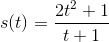 . Find the velocity at
  .
.
The position of a particle is given by
The velocity is given as the derivative of the position function, or
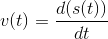 .
.
We can use the quotient rule to find the derivative of the position function and then evaluate that at  . The quotient rule states that
 .
.
In this case,  and
and  .
.
We can now substitute these values in to get
 .
.
Evalusting this at  gives us
  .
.
So the answer is  .
.
The velocity is given as the derivative of the position function, or
We can use the quotient rule to find the derivative of the position function and then evaluate that at
In this case,
We can now substitute these values in to get
Evalusting this at
So the answer is
Compare your answer with the correct one above
Find the velocity function if the position function is given as:  .
.
Find the velocity function if the position function is given as:
There are three terms in this problem that has to be derived. The derivative of the position function, or the velocity function, represents the slope of the position function.
The derivative of  can be solved by using the power rule, which is:

Therefore. the derivative of  is
is  .
.
The derivative of  is
is  by using the constant multiple rule.
The derivative of  is
is  since derivatives of constants equal to zero.

There are three terms in this problem that has to be derived. The derivative of the position function, or the velocity function, represents the slope of the position function.
The derivative of
Therefore. the derivative of
The derivative of
The derivative of
Compare your answer with the correct one above
Find the velocity function given the position function: 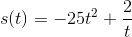 .
.
Find the velocity function given the position function:
The derivatives can be solved term by term.
First, find the derivative of  . This can be done by the power rule.

Find the derivative of  . Rewrite this as
  to compute by power rule.


Therefore, the velocity function is: 
The derivatives can be solved term by term.
First, find the derivative of
Find the derivative of
Therefore, the velocity function is:
Compare your answer with the correct one above
Find the velocity of a function if the acceleration is:  .
.
Find the velocity of a function if the acceleration is:
To find the velocity given the acceleration function, we will need to integrate the acceleration function.

To find the velocity given the acceleration function, we will need to integrate the acceleration function.
Compare your answer with the correct one above
Find the velocity at  if the acceleration function is:
  .
.
Find the velocity at
The velocity function can be obtained by integrating the acceleration function.

Since we are finding the velocity at  , substitute this into the velocity function.

The velocity function can be obtained by integrating the acceleration function.
Since we are finding the velocity at
Compare your answer with the correct one above
Find the velocity at  if the position function of a spring is:
  .
.
Find the velocity at
To find the velocity function, take the derivative of the position function.

Substitute  into the velocity function.

To find the velocity function, take the derivative of the position function.
Substitute
Compare your answer with the correct one above
Find the velocity of a function if the acceleration is: 
Find the velocity of a function if the acceleration is:
To find the velocity, we integrate the acceleration equation


To find the velocity, we integrate the acceleration equation
Compare your answer with the correct one above