Integrals - AP Calculus AB
Card 1 of 3487
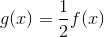
Define 
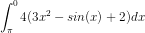
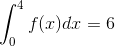
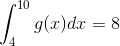
Evaluate
.
Define
Evaluate .
Tap to reveal answer
has different definitions on
and
, so the integral must be rewritten as the sum of two separate integrals:


Calculate the integrals separately, then add:


has different definitions on
and
, so the integral must be rewritten as the sum of two separate integrals:
Calculate the integrals separately, then add:
← Didn't Know|Knew It →
Define 
Evaluate
.
Define
Evaluate .
Tap to reveal answer
has different definitions on
and
, so the integral must be rewritten as the sum of two separate integrals:


Calculate the integrals separately, then add:


has different definitions on
and
, so the integral must be rewritten as the sum of two separate integrals:
Calculate the integrals separately, then add:
← Didn't Know|Knew It →
Define 
Evaluate
.
Define
Evaluate .
Tap to reveal answer
has different definitions on
and
, so the integral must be rewritten as the sum of two separate integrals:


Calculate the integrals separately, then add:


has different definitions on
and
, so the integral must be rewritten as the sum of two separate integrals:
Calculate the integrals separately, then add:
← Didn't Know|Knew It →
Define 
Evaluate
.
Define
Evaluate .
Tap to reveal answer
has different definitions on
and
, so the integral must be rewritten as the sum of two separate integrals:


Calculate the integrals separately, then add:


has different definitions on
and
, so the integral must be rewritten as the sum of two separate integrals:
Calculate the integrals separately, then add:
← Didn't Know|Knew It →
Define 
Evaluate
.
Define
Evaluate .
Tap to reveal answer
has different definitions on
and
, so the integral must be rewritten as the sum of two separate integrals:


Calculate the integrals separately, then add:


has different definitions on
and
, so the integral must be rewritten as the sum of two separate integrals:
Calculate the integrals separately, then add:
← Didn't Know|Knew It →
Define 
Evaluate
.
Define
Evaluate .
Tap to reveal answer
has different definitions on
and
, so the integral must be rewritten as the sum of two separate integrals:


Calculate the integrals separately, then add:


has different definitions on
and
, so the integral must be rewritten as the sum of two separate integrals:
Calculate the integrals separately, then add:
← Didn't Know|Knew It →
Define 
Evaluate
.
Define
Evaluate .
Tap to reveal answer
has different definitions on
and
, so the integral must be rewritten as the sum of two separate integrals:


Calculate the integrals separately, then add:


has different definitions on
and
, so the integral must be rewritten as the sum of two separate integrals:
Calculate the integrals separately, then add:
← Didn't Know|Knew It →
Define 
Evaluate
.
Define
Evaluate .
Tap to reveal answer
has different definitions on
and
, so the integral must be rewritten as the sum of two separate integrals:


Calculate the integrals separately, then add:


has different definitions on
and
, so the integral must be rewritten as the sum of two separate integrals:
Calculate the integrals separately, then add:
← Didn't Know|Knew It →
Define 
Evaluate
.
Define
Evaluate .
Tap to reveal answer
has different definitions on
and
, so the integral must be rewritten as the sum of two separate integrals:


Calculate the integrals separately, then add:


has different definitions on
and
, so the integral must be rewritten as the sum of two separate integrals:
Calculate the integrals separately, then add:
← Didn't Know|Knew It →
Define 
Evaluate
.
Define
Evaluate .
Tap to reveal answer
has different definitions on
and
, so the integral must be rewritten as the sum of two separate integrals:


Calculate the integrals separately, then add:


has different definitions on
and
, so the integral must be rewritten as the sum of two separate integrals:
Calculate the integrals separately, then add:
← Didn't Know|Knew It →
Define 
Evaluate
.
Define
Evaluate .
Tap to reveal answer
has different definitions on
and
, so the integral must be rewritten as the sum of two separate integrals:


Calculate the integrals separately, then add:


has different definitions on
and
, so the integral must be rewritten as the sum of two separate integrals:
Calculate the integrals separately, then add:
← Didn't Know|Knew It →
Evaluate the integral 
Evaluate the integral
Tap to reveal answer
To evaluate a definite integral, that is to say an integral with an upper bound and lower bound, we will use the 2nd Fundamental Theorem of Calculus, which states,
, where
is the integral of
.
We will first integrate just like with any integration.
We will integrate each term individually.

First, the integral of the cosine is the sine. Doing this, we get
![[\sin(x)]|_0^{\pi/2} - \int_0^{\pi/2}2\sin(2x)dx](https://vt-vtwa-assets.varsitytutors.com/vt-vtwa/uploads/formula_image/image/1052613/gif.latex)
The
is just notation for "evaluated from
to
". It is simply a reminder to apply the 2nd Fundamental Theorem of Calculus. The
is the
from the theorem. Before moving to the second integral, we can apply this theorem.


So far, we have the following expression for the entire problem

The basic integral form for the remaining integral is ![\int_a^b \sin(u)du =[ -\cos(u)]|_0^{\pi/2}](https://vt-vtwa-assets.varsitytutors.com/vt-vtwa/uploads/formula_image/image/1052624/gif.latex)
Set
, since that is what is inside our sine. The derivative of this is
.
This perfectly accounts for the
in in front of the sine. Thus we can immediatly replace the entire integral with its basic integral form's result.
![1- [-\cos(2x)]|_0^{\pi/2}](https://vt-vtwa-assets.varsitytutors.com/vt-vtwa/uploads/formula_image/image/1052629/gif.latex)
Now we apply the 2nd Fundamental Theorem of Calculus again.
Plug in
. Plug in
and subtract.
![1- \{[-\cos(2\cdot \pi/2)]-[-\cos(2\cdot0)]\}](https://vt-vtwa-assets.varsitytutors.com/vt-vtwa/uploads/formula_image/image/1052632/gif.latex)
![1-\{[-\cos(\pi)]-[-\cos(0)]\}](https://vt-vtwa-assets.varsitytutors.com/vt-vtwa/uploads/formula_image/image/1052633/gif.latex)
![1- \{[-(-1)]-[-(1)]\}](https://vt-vtwa-assets.varsitytutors.com/vt-vtwa/uploads/formula_image/image/1052634/gif.latex)


This is our answer.
To evaluate a definite integral, that is to say an integral with an upper bound and lower bound, we will use the 2nd Fundamental Theorem of Calculus, which states,
, where
is the integral of
.
We will first integrate just like with any integration.
We will integrate each term individually.
First, the integral of the cosine is the sine. Doing this, we get
The is just notation for "evaluated from
to
". It is simply a reminder to apply the 2nd Fundamental Theorem of Calculus. The
is the
from the theorem. Before moving to the second integral, we can apply this theorem.
So far, we have the following expression for the entire problem
The basic integral form for the remaining integral is
Set , since that is what is inside our sine. The derivative of this is
.
This perfectly accounts for the in in front of the sine. Thus we can immediatly replace the entire integral with its basic integral form's result.
Now we apply the 2nd Fundamental Theorem of Calculus again.
Plug in . Plug in
and subtract.
This is our answer.
← Didn't Know|Knew It →
Evaluate the integral 
Evaluate the integral
Tap to reveal answer
To evaluate a definite integral, that is to say an integral with an upper bound and lower bound, we will use the 2nd Fundamental Theorem of Calculus, which states,
, where
is the integral of
.
We will first integrate just like with any integration.
We will integrate each term individually.

First, the integral of the cosine is the sine. Doing this, we get
![[\sin(x)]|_0^{\pi/2} - \int_0^{\pi/2}2\sin(2x)dx](https://vt-vtwa-assets.varsitytutors.com/vt-vtwa/uploads/formula_image/image/1052613/gif.latex)
The
is just notation for "evaluated from
to
". It is simply a reminder to apply the 2nd Fundamental Theorem of Calculus. The
is the
from the theorem. Before moving to the second integral, we can apply this theorem.


So far, we have the following expression for the entire problem

The basic integral form for the remaining integral is ![\int_a^b \sin(u)du =[ -\cos(u)]|_0^{\pi/2}](https://vt-vtwa-assets.varsitytutors.com/vt-vtwa/uploads/formula_image/image/1052624/gif.latex)
Set
, since that is what is inside our sine. The derivative of this is
.
This perfectly accounts for the
in in front of the sine. Thus we can immediatly replace the entire integral with its basic integral form's result.
![1- [-\cos(2x)]|_0^{\pi/2}](https://vt-vtwa-assets.varsitytutors.com/vt-vtwa/uploads/formula_image/image/1052629/gif.latex)
Now we apply the 2nd Fundamental Theorem of Calculus again.
Plug in
. Plug in
and subtract.
![1- \{[-\cos(2\cdot \pi/2)]-[-\cos(2\cdot0)]\}](https://vt-vtwa-assets.varsitytutors.com/vt-vtwa/uploads/formula_image/image/1052632/gif.latex)
![1-\{[-\cos(\pi)]-[-\cos(0)]\}](https://vt-vtwa-assets.varsitytutors.com/vt-vtwa/uploads/formula_image/image/1052633/gif.latex)
![1- \{[-(-1)]-[-(1)]\}](https://vt-vtwa-assets.varsitytutors.com/vt-vtwa/uploads/formula_image/image/1052634/gif.latex)


This is our answer.
To evaluate a definite integral, that is to say an integral with an upper bound and lower bound, we will use the 2nd Fundamental Theorem of Calculus, which states,
, where
is the integral of
.
We will first integrate just like with any integration.
We will integrate each term individually.
First, the integral of the cosine is the sine. Doing this, we get
The is just notation for "evaluated from
to
". It is simply a reminder to apply the 2nd Fundamental Theorem of Calculus. The
is the
from the theorem. Before moving to the second integral, we can apply this theorem.
So far, we have the following expression for the entire problem
The basic integral form for the remaining integral is
Set , since that is what is inside our sine. The derivative of this is
.
This perfectly accounts for the in in front of the sine. Thus we can immediatly replace the entire integral with its basic integral form's result.
Now we apply the 2nd Fundamental Theorem of Calculus again.
Plug in . Plug in
and subtract.
This is our answer.
← Didn't Know|Knew It →
Evaluate the integral 
Evaluate the integral
Tap to reveal answer
To evaluate a definite integral, that is to say an integral with an upper bound and lower bound, we will use the 2nd Fundamental Theorem of Calculus, which states,
, where
is the integral of
.
We will first integrate just like with any integration.
We will integrate each term individually.

First, the integral of the cosine is the sine. Doing this, we get
![[\sin(x)]|_0^{\pi/2} - \int_0^{\pi/2}2\sin(2x)dx](https://vt-vtwa-assets.varsitytutors.com/vt-vtwa/uploads/formula_image/image/1052613/gif.latex)
The
is just notation for "evaluated from
to
". It is simply a reminder to apply the 2nd Fundamental Theorem of Calculus. The
is the
from the theorem. Before moving to the second integral, we can apply this theorem.


So far, we have the following expression for the entire problem

The basic integral form for the remaining integral is ![\int_a^b \sin(u)du =[ -\cos(u)]|_0^{\pi/2}](https://vt-vtwa-assets.varsitytutors.com/vt-vtwa/uploads/formula_image/image/1052624/gif.latex)
Set
, since that is what is inside our sine. The derivative of this is
.
This perfectly accounts for the
in in front of the sine. Thus we can immediatly replace the entire integral with its basic integral form's result.
![1- [-\cos(2x)]|_0^{\pi/2}](https://vt-vtwa-assets.varsitytutors.com/vt-vtwa/uploads/formula_image/image/1052629/gif.latex)
Now we apply the 2nd Fundamental Theorem of Calculus again.
Plug in
. Plug in
and subtract.
![1- \{[-\cos(2\cdot \pi/2)]-[-\cos(2\cdot0)]\}](https://vt-vtwa-assets.varsitytutors.com/vt-vtwa/uploads/formula_image/image/1052632/gif.latex)
![1-\{[-\cos(\pi)]-[-\cos(0)]\}](https://vt-vtwa-assets.varsitytutors.com/vt-vtwa/uploads/formula_image/image/1052633/gif.latex)
![1- \{[-(-1)]-[-(1)]\}](https://vt-vtwa-assets.varsitytutors.com/vt-vtwa/uploads/formula_image/image/1052634/gif.latex)


This is our answer.
To evaluate a definite integral, that is to say an integral with an upper bound and lower bound, we will use the 2nd Fundamental Theorem of Calculus, which states,
, where
is the integral of
.
We will first integrate just like with any integration.
We will integrate each term individually.
First, the integral of the cosine is the sine. Doing this, we get
The is just notation for "evaluated from
to
". It is simply a reminder to apply the 2nd Fundamental Theorem of Calculus. The
is the
from the theorem. Before moving to the second integral, we can apply this theorem.
So far, we have the following expression for the entire problem
The basic integral form for the remaining integral is
Set , since that is what is inside our sine. The derivative of this is
.
This perfectly accounts for the in in front of the sine. Thus we can immediatly replace the entire integral with its basic integral form's result.
Now we apply the 2nd Fundamental Theorem of Calculus again.
Plug in . Plug in
and subtract.
This is our answer.
← Didn't Know|Knew It →
Evaluate the integral 
Evaluate the integral
Tap to reveal answer
To evaluate a definite integral, that is to say an integral with an upper bound and lower bound, we will use the 2nd Fundamental Theorem of Calculus, which states,
, where
is the integral of
.
We will first integrate just like with any integration.
We will integrate each term individually.

First, the integral of the cosine is the sine. Doing this, we get
![[\sin(x)]|_0^{\pi/2} - \int_0^{\pi/2}2\sin(2x)dx](https://vt-vtwa-assets.varsitytutors.com/vt-vtwa/uploads/formula_image/image/1052613/gif.latex)
The
is just notation for "evaluated from
to
". It is simply a reminder to apply the 2nd Fundamental Theorem of Calculus. The
is the
from the theorem. Before moving to the second integral, we can apply this theorem.


So far, we have the following expression for the entire problem

The basic integral form for the remaining integral is ![\int_a^b \sin(u)du =[ -\cos(u)]|_0^{\pi/2}](https://vt-vtwa-assets.varsitytutors.com/vt-vtwa/uploads/formula_image/image/1052624/gif.latex)
Set
, since that is what is inside our sine. The derivative of this is
.
This perfectly accounts for the
in in front of the sine. Thus we can immediatly replace the entire integral with its basic integral form's result.
![1- [-\cos(2x)]|_0^{\pi/2}](https://vt-vtwa-assets.varsitytutors.com/vt-vtwa/uploads/formula_image/image/1052629/gif.latex)
Now we apply the 2nd Fundamental Theorem of Calculus again.
Plug in
. Plug in
and subtract.
![1- \{[-\cos(2\cdot \pi/2)]-[-\cos(2\cdot0)]\}](https://vt-vtwa-assets.varsitytutors.com/vt-vtwa/uploads/formula_image/image/1052632/gif.latex)
![1-\{[-\cos(\pi)]-[-\cos(0)]\}](https://vt-vtwa-assets.varsitytutors.com/vt-vtwa/uploads/formula_image/image/1052633/gif.latex)
![1- \{[-(-1)]-[-(1)]\}](https://vt-vtwa-assets.varsitytutors.com/vt-vtwa/uploads/formula_image/image/1052634/gif.latex)


This is our answer.
To evaluate a definite integral, that is to say an integral with an upper bound and lower bound, we will use the 2nd Fundamental Theorem of Calculus, which states,
, where
is the integral of
.
We will first integrate just like with any integration.
We will integrate each term individually.
First, the integral of the cosine is the sine. Doing this, we get
The is just notation for "evaluated from
to
". It is simply a reminder to apply the 2nd Fundamental Theorem of Calculus. The
is the
from the theorem. Before moving to the second integral, we can apply this theorem.
So far, we have the following expression for the entire problem
The basic integral form for the remaining integral is
Set , since that is what is inside our sine. The derivative of this is
.
This perfectly accounts for the in in front of the sine. Thus we can immediatly replace the entire integral with its basic integral form's result.
Now we apply the 2nd Fundamental Theorem of Calculus again.
Plug in . Plug in
and subtract.
This is our answer.
← Didn't Know|Knew It →
Evaluate the integral 
Evaluate the integral
Tap to reveal answer
To evaluate a definite integral, that is to say an integral with an upper bound and lower bound, we will use the 2nd Fundamental Theorem of Calculus, which states,
, where
is the integral of
.
We will first integrate just like with any integration.
We will integrate each term individually.

First, the integral of the cosine is the sine. Doing this, we get
![[\sin(x)]|_0^{\pi/2} - \int_0^{\pi/2}2\sin(2x)dx](https://vt-vtwa-assets.varsitytutors.com/vt-vtwa/uploads/formula_image/image/1052613/gif.latex)
The
is just notation for "evaluated from
to
". It is simply a reminder to apply the 2nd Fundamental Theorem of Calculus. The
is the
from the theorem. Before moving to the second integral, we can apply this theorem.


So far, we have the following expression for the entire problem

The basic integral form for the remaining integral is ![\int_a^b \sin(u)du =[ -\cos(u)]|_0^{\pi/2}](https://vt-vtwa-assets.varsitytutors.com/vt-vtwa/uploads/formula_image/image/1052624/gif.latex)
Set
, since that is what is inside our sine. The derivative of this is
.
This perfectly accounts for the
in in front of the sine. Thus we can immediatly replace the entire integral with its basic integral form's result.
![1- [-\cos(2x)]|_0^{\pi/2}](https://vt-vtwa-assets.varsitytutors.com/vt-vtwa/uploads/formula_image/image/1052629/gif.latex)
Now we apply the 2nd Fundamental Theorem of Calculus again.
Plug in
. Plug in
and subtract.
![1- \{[-\cos(2\cdot \pi/2)]-[-\cos(2\cdot0)]\}](https://vt-vtwa-assets.varsitytutors.com/vt-vtwa/uploads/formula_image/image/1052632/gif.latex)
![1-\{[-\cos(\pi)]-[-\cos(0)]\}](https://vt-vtwa-assets.varsitytutors.com/vt-vtwa/uploads/formula_image/image/1052633/gif.latex)
![1- \{[-(-1)]-[-(1)]\}](https://vt-vtwa-assets.varsitytutors.com/vt-vtwa/uploads/formula_image/image/1052634/gif.latex)


This is our answer.
To evaluate a definite integral, that is to say an integral with an upper bound and lower bound, we will use the 2nd Fundamental Theorem of Calculus, which states,
, where
is the integral of
.
We will first integrate just like with any integration.
We will integrate each term individually.
First, the integral of the cosine is the sine. Doing this, we get
The is just notation for "evaluated from
to
". It is simply a reminder to apply the 2nd Fundamental Theorem of Calculus. The
is the
from the theorem. Before moving to the second integral, we can apply this theorem.
So far, we have the following expression for the entire problem
The basic integral form for the remaining integral is
Set , since that is what is inside our sine. The derivative of this is
.
This perfectly accounts for the in in front of the sine. Thus we can immediatly replace the entire integral with its basic integral form's result.
Now we apply the 2nd Fundamental Theorem of Calculus again.
Plug in . Plug in
and subtract.
This is our answer.
← Didn't Know|Knew It →
Evaluate the integral 
Evaluate the integral
Tap to reveal answer
To evaluate a definite integral, that is to say an integral with an upper bound and lower bound, we will use the 2nd Fundamental Theorem of Calculus, which states,
, where
is the integral of
.
We will first integrate just like with any integration.
We will integrate each term individually.

First, the integral of the cosine is the sine. Doing this, we get
![[\sin(x)]|_0^{\pi/2} - \int_0^{\pi/2}2\sin(2x)dx](https://vt-vtwa-assets.varsitytutors.com/vt-vtwa/uploads/formula_image/image/1052613/gif.latex)
The
is just notation for "evaluated from
to
". It is simply a reminder to apply the 2nd Fundamental Theorem of Calculus. The
is the
from the theorem. Before moving to the second integral, we can apply this theorem.


So far, we have the following expression for the entire problem

The basic integral form for the remaining integral is ![\int_a^b \sin(u)du =[ -\cos(u)]|_0^{\pi/2}](https://vt-vtwa-assets.varsitytutors.com/vt-vtwa/uploads/formula_image/image/1052624/gif.latex)
Set
, since that is what is inside our sine. The derivative of this is
.
This perfectly accounts for the
in in front of the sine. Thus we can immediatly replace the entire integral with its basic integral form's result.
![1- [-\cos(2x)]|_0^{\pi/2}](https://vt-vtwa-assets.varsitytutors.com/vt-vtwa/uploads/formula_image/image/1052629/gif.latex)
Now we apply the 2nd Fundamental Theorem of Calculus again.
Plug in
. Plug in
and subtract.
![1- \{[-\cos(2\cdot \pi/2)]-[-\cos(2\cdot0)]\}](https://vt-vtwa-assets.varsitytutors.com/vt-vtwa/uploads/formula_image/image/1052632/gif.latex)
![1-\{[-\cos(\pi)]-[-\cos(0)]\}](https://vt-vtwa-assets.varsitytutors.com/vt-vtwa/uploads/formula_image/image/1052633/gif.latex)
![1- \{[-(-1)]-[-(1)]\}](https://vt-vtwa-assets.varsitytutors.com/vt-vtwa/uploads/formula_image/image/1052634/gif.latex)


This is our answer.
To evaluate a definite integral, that is to say an integral with an upper bound and lower bound, we will use the 2nd Fundamental Theorem of Calculus, which states,
, where
is the integral of
.
We will first integrate just like with any integration.
We will integrate each term individually.
First, the integral of the cosine is the sine. Doing this, we get
The is just notation for "evaluated from
to
". It is simply a reminder to apply the 2nd Fundamental Theorem of Calculus. The
is the
from the theorem. Before moving to the second integral, we can apply this theorem.
So far, we have the following expression for the entire problem
The basic integral form for the remaining integral is
Set , since that is what is inside our sine. The derivative of this is
.
This perfectly accounts for the in in front of the sine. Thus we can immediatly replace the entire integral with its basic integral form's result.
Now we apply the 2nd Fundamental Theorem of Calculus again.
Plug in . Plug in
and subtract.
This is our answer.
← Didn't Know|Knew It →
Evaluate the integral 
Evaluate the integral
Tap to reveal answer
To evaluate a definite integral, that is to say an integral with an upper bound and lower bound, we will use the 2nd Fundamental Theorem of Calculus, which states,
, where
is the integral of
.
We will first integrate just like with any integration.
We will integrate each term individually.

First, the integral of the cosine is the sine. Doing this, we get
![[\sin(x)]|_0^{\pi/2} - \int_0^{\pi/2}2\sin(2x)dx](https://vt-vtwa-assets.varsitytutors.com/vt-vtwa/uploads/formula_image/image/1052613/gif.latex)
The
is just notation for "evaluated from
to
". It is simply a reminder to apply the 2nd Fundamental Theorem of Calculus. The
is the
from the theorem. Before moving to the second integral, we can apply this theorem.


So far, we have the following expression for the entire problem

The basic integral form for the remaining integral is ![\int_a^b \sin(u)du =[ -\cos(u)]|_0^{\pi/2}](https://vt-vtwa-assets.varsitytutors.com/vt-vtwa/uploads/formula_image/image/1052624/gif.latex)
Set
, since that is what is inside our sine. The derivative of this is
.
This perfectly accounts for the
in in front of the sine. Thus we can immediatly replace the entire integral with its basic integral form's result.
![1- [-\cos(2x)]|_0^{\pi/2}](https://vt-vtwa-assets.varsitytutors.com/vt-vtwa/uploads/formula_image/image/1052629/gif.latex)
Now we apply the 2nd Fundamental Theorem of Calculus again.
Plug in
. Plug in
and subtract.
![1- \{[-\cos(2\cdot \pi/2)]-[-\cos(2\cdot0)]\}](https://vt-vtwa-assets.varsitytutors.com/vt-vtwa/uploads/formula_image/image/1052632/gif.latex)
![1-\{[-\cos(\pi)]-[-\cos(0)]\}](https://vt-vtwa-assets.varsitytutors.com/vt-vtwa/uploads/formula_image/image/1052633/gif.latex)
![1- \{[-(-1)]-[-(1)]\}](https://vt-vtwa-assets.varsitytutors.com/vt-vtwa/uploads/formula_image/image/1052634/gif.latex)


This is our answer.
To evaluate a definite integral, that is to say an integral with an upper bound and lower bound, we will use the 2nd Fundamental Theorem of Calculus, which states,
, where
is the integral of
.
We will first integrate just like with any integration.
We will integrate each term individually.
First, the integral of the cosine is the sine. Doing this, we get
The is just notation for "evaluated from
to
". It is simply a reminder to apply the 2nd Fundamental Theorem of Calculus. The
is the
from the theorem. Before moving to the second integral, we can apply this theorem.
So far, we have the following expression for the entire problem
The basic integral form for the remaining integral is
Set , since that is what is inside our sine. The derivative of this is
.
This perfectly accounts for the in in front of the sine. Thus we can immediatly replace the entire integral with its basic integral form's result.
Now we apply the 2nd Fundamental Theorem of Calculus again.
Plug in . Plug in
and subtract.
This is our answer.
← Didn't Know|Knew It →
Evaluate the integral 
Evaluate the integral
Tap to reveal answer
To evaluate a definite integral, that is to say an integral with an upper bound and lower bound, we will use the 2nd Fundamental Theorem of Calculus, which states,
, where
is the integral of
.
We will first integrate just like with any integration.
We will integrate each term individually.

First, the integral of the cosine is the sine. Doing this, we get
![[\sin(x)]|_0^{\pi/2} - \int_0^{\pi/2}2\sin(2x)dx](https://vt-vtwa-assets.varsitytutors.com/vt-vtwa/uploads/formula_image/image/1052613/gif.latex)
The
is just notation for "evaluated from
to
". It is simply a reminder to apply the 2nd Fundamental Theorem of Calculus. The
is the
from the theorem. Before moving to the second integral, we can apply this theorem.


So far, we have the following expression for the entire problem

The basic integral form for the remaining integral is ![\int_a^b \sin(u)du =[ -\cos(u)]|_0^{\pi/2}](https://vt-vtwa-assets.varsitytutors.com/vt-vtwa/uploads/formula_image/image/1052624/gif.latex)
Set
, since that is what is inside our sine. The derivative of this is
.
This perfectly accounts for the
in in front of the sine. Thus we can immediatly replace the entire integral with its basic integral form's result.
![1- [-\cos(2x)]|_0^{\pi/2}](https://vt-vtwa-assets.varsitytutors.com/vt-vtwa/uploads/formula_image/image/1052629/gif.latex)
Now we apply the 2nd Fundamental Theorem of Calculus again.
Plug in
. Plug in
and subtract.
![1- \{[-\cos(2\cdot \pi/2)]-[-\cos(2\cdot0)]\}](https://vt-vtwa-assets.varsitytutors.com/vt-vtwa/uploads/formula_image/image/1052632/gif.latex)
![1-\{[-\cos(\pi)]-[-\cos(0)]\}](https://vt-vtwa-assets.varsitytutors.com/vt-vtwa/uploads/formula_image/image/1052633/gif.latex)
![1- \{[-(-1)]-[-(1)]\}](https://vt-vtwa-assets.varsitytutors.com/vt-vtwa/uploads/formula_image/image/1052634/gif.latex)


This is our answer.
To evaluate a definite integral, that is to say an integral with an upper bound and lower bound, we will use the 2nd Fundamental Theorem of Calculus, which states,
, where
is the integral of
.
We will first integrate just like with any integration.
We will integrate each term individually.
First, the integral of the cosine is the sine. Doing this, we get
The is just notation for "evaluated from
to
". It is simply a reminder to apply the 2nd Fundamental Theorem of Calculus. The
is the
from the theorem. Before moving to the second integral, we can apply this theorem.
So far, we have the following expression for the entire problem
The basic integral form for the remaining integral is
Set , since that is what is inside our sine. The derivative of this is
.
This perfectly accounts for the in in front of the sine. Thus we can immediatly replace the entire integral with its basic integral form's result.
Now we apply the 2nd Fundamental Theorem of Calculus again.
Plug in . Plug in
and subtract.
This is our answer.
← Didn't Know|Knew It →
Evaluate the integral 
Evaluate the integral
Tap to reveal answer
To evaluate a definite integral, that is to say an integral with an upper bound and lower bound, we will use the 2nd Fundamental Theorem of Calculus, which states,
, where
is the integral of
.
We will first integrate just like with any integration.
We will integrate each term individually.

First, the integral of the cosine is the sine. Doing this, we get
![[\sin(x)]|_0^{\pi/2} - \int_0^{\pi/2}2\sin(2x)dx](https://vt-vtwa-assets.varsitytutors.com/vt-vtwa/uploads/formula_image/image/1052613/gif.latex)
The
is just notation for "evaluated from
to
". It is simply a reminder to apply the 2nd Fundamental Theorem of Calculus. The
is the
from the theorem. Before moving to the second integral, we can apply this theorem.


So far, we have the following expression for the entire problem

The basic integral form for the remaining integral is ![\int_a^b \sin(u)du =[ -\cos(u)]|_0^{\pi/2}](https://vt-vtwa-assets.varsitytutors.com/vt-vtwa/uploads/formula_image/image/1052624/gif.latex)
Set
, since that is what is inside our sine. The derivative of this is
.
This perfectly accounts for the
in in front of the sine. Thus we can immediatly replace the entire integral with its basic integral form's result.
![1- [-\cos(2x)]|_0^{\pi/2}](https://vt-vtwa-assets.varsitytutors.com/vt-vtwa/uploads/formula_image/image/1052629/gif.latex)
Now we apply the 2nd Fundamental Theorem of Calculus again.
Plug in
. Plug in
and subtract.
![1- \{[-\cos(2\cdot \pi/2)]-[-\cos(2\cdot0)]\}](https://vt-vtwa-assets.varsitytutors.com/vt-vtwa/uploads/formula_image/image/1052632/gif.latex)
![1-\{[-\cos(\pi)]-[-\cos(0)]\}](https://vt-vtwa-assets.varsitytutors.com/vt-vtwa/uploads/formula_image/image/1052633/gif.latex)
![1- \{[-(-1)]-[-(1)]\}](https://vt-vtwa-assets.varsitytutors.com/vt-vtwa/uploads/formula_image/image/1052634/gif.latex)


This is our answer.
To evaluate a definite integral, that is to say an integral with an upper bound and lower bound, we will use the 2nd Fundamental Theorem of Calculus, which states,
, where
is the integral of
.
We will first integrate just like with any integration.
We will integrate each term individually.
First, the integral of the cosine is the sine. Doing this, we get
The is just notation for "evaluated from
to
". It is simply a reminder to apply the 2nd Fundamental Theorem of Calculus. The
is the
from the theorem. Before moving to the second integral, we can apply this theorem.
So far, we have the following expression for the entire problem
The basic integral form for the remaining integral is
Set , since that is what is inside our sine. The derivative of this is
.
This perfectly accounts for the in in front of the sine. Thus we can immediatly replace the entire integral with its basic integral form's result.
Now we apply the 2nd Fundamental Theorem of Calculus again.
Plug in . Plug in
and subtract.
This is our answer.
← Didn't Know|Knew It →