
Graphing Functions - AP Calculus AB
Card 0 of 3836

On which interval is the function shown in the above graph strictly decreasing?
On which interval is the function shown in the above graph strictly decreasing?
A function  is strictly decreasing on an inverval if, for any
  in the interval,
  (i.e the slope is always less than zero)
Interval E is the only interval on which the function shows this property.
A function
Interval E is the only interval on which the function shows this property.
Compare your answer with the correct one above
Let  .
.
On which open interval(s) is  decreasing?
Let
On which open interval(s) is
 is decreasing on intervals where
  .
.
First, differentiate  .
.

Then, find the values for x for which the derivative is negative by solving


 .
.
Next, test the intervals.


Test them by substituting values for x:

Substitute -2,

 .
.
The function is increasing on this interval since the derivative is positive on this interval.

Substitute 0,

 .
.
The function is deecreasing on this interval since the derivative is negative on this interval.

Substitute 2,

 .
.
The function is increasing on this interval since the derivative is positive on this interval.
Thus,  is the only interval on which the function is decreasing.
First, differentiate
Then, find the values for x for which the derivative is negative by solving
Next, test the intervals.
Test them by substituting values for x:
Substitute -2,
The function is increasing on this interval since the derivative is positive on this interval.
Substitute 0,
The function is deecreasing on this interval since the derivative is negative on this interval.
Substitute 2,
The function is increasing on this interval since the derivative is positive on this interval.
Thus,
Compare your answer with the correct one above
For which values of  is the function
  decreasing?
For which values of
To determine where the function is decreasing, differentiate it:

What we are interested in are the points where  . To determine these points, factor the equation:
 this has solutions at
This splits the graph into 4 regions, and we can test points in each to determine if  is greater than or less than 0. If it is less than zero, the function is decreasing.
 negative/decreasing
 positive/increasing
 negative/decreasing
 positive/increasing
To determine where the function is decreasing, differentiate it:
What we are interested in are the points where
This splits the graph into 4 regions, and we can test points in each to determine if
Compare your answer with the correct one above
For which values of  is the function
  decreasing?
For which values of
The function is increasing where  . To determine the regions where this is true, first take the derivative of
  :
:
 .
.
To figure out where this is less than zero, factor and set it equal to zero. This will split the function into intervals where we can test points.
 This has solutions at
  .
.
Test a point in each region to see if the function is increasing or decreasing:
 positive/increasing
 negative/decreasing
 positive/increasing
The function is increasing where
To figure out where this is less than zero, factor and set it equal to zero. This will split the function into intervals where we can test points.
Test a point in each region to see if the function is increasing or decreasing:
Compare your answer with the correct one above
The picture below shows the graph of some function, 

On which interval of  is the function decreasing?
The picture below shows the graph of some function,
On which interval of
A function is decreasing when it has a negative slope. Graphically, this is a region of the curve where the curve decreases as  increases.
On interval D, the curve shows this trait. The curve does not show this trait on any other interval.
Therefore, interval D is the answer.
A function is decreasing when it has a negative slope. Graphically, this is a region of the curve where the curve decreases as
On interval D, the curve shows this trait. The curve does not show this trait on any other interval.
Therefore, interval D is the answer.
Compare your answer with the correct one above
Find the intervals on which the function is decreasing:

Find the intervals on which the function is decreasing:
To determine the intervals on which the function is decreasing, we must find the intervals on which the first derivative of the function is negative.
The first derivative of the function is

and we used the following rule:

Now, we find the point(s) at which the first derivative equals zero - the critical value(s):

Now, we make our intervals on which we see whether the first derivative is positive or negative:

On the first interval, the first derivative is negative, while on the second interval it is positive. Thus, the first interval is the one where the function is decreasing.
To determine the intervals on which the function is decreasing, we must find the intervals on which the first derivative of the function is negative.
The first derivative of the function is
and we used the following rule:
Now, we find the point(s) at which the first derivative equals zero - the critical value(s):
Now, we make our intervals on which we see whether the first derivative is positive or negative:
On the first interval, the first derivative is negative, while on the second interval it is positive. Thus, the first interval is the one where the function is decreasing.
Compare your answer with the correct one above
Given  , find the interval over which
  is decreasing.
Given
To find when a function is decreasing, we must first find where the critical points of the function are. Since we are given the derivative  , we start by first setting the derivative equal to
  and solving for
  .
.


This is our critical point. To evaluate where the function is decreasing, we must check the sign of the derivative on both sides of the critical point. Because  , we can check the left side of the critical point by plugging
  into
into  .
.


Because  , the function is decreasing on the left side of the critical point, on the interval
  .
.
Now we must check the right side of the critical point. Because  , we can check the right side of the critical point by plugging
  into
into  .
.


Because  , the function is increasing on the right side of the critical point, meaning the only interval on which the function is decreasing is
  .
.
To find when a function is decreasing, we must first find where the critical points of the function are. Since we are given the derivative
This is our critical point. To evaluate where the function is decreasing, we must check the sign of the derivative on both sides of the critical point. Because
Because
Now we must check the right side of the critical point. Because
Because
Compare your answer with the correct one above
Determine the intervals on which the given function is decreasing:

Determine the intervals on which the given function is decreasing:
To determine the intervals on which the function is decreasing, we must find the intervals on which the function's first derivative is negative. To do this, we must find the first derivative and the critical value(s) at which the first derivative is equal to zero:

The derivative was found using the following rule:

Now, setting the first derivative equal to zero, we get

So, now we can make our intervals to be analyzed (is the first derivative positive or negative on the interval?), in which c is the upper and lower bound:

Note that at c the first derivative is neither positive nor negative.
On the first interval, the first derivative is always negative, so the function is always decreasing on this interval. On the second interval, the first derivative is always positive, therefore the function is increasing on this interval.
We are concerned with the interval where the function is decreasing, so  is our answer.
To determine the intervals on which the function is decreasing, we must find the intervals on which the function's first derivative is negative. To do this, we must find the first derivative and the critical value(s) at which the first derivative is equal to zero:
The derivative was found using the following rule:
Now, setting the first derivative equal to zero, we get
So, now we can make our intervals to be analyzed (is the first derivative positive or negative on the interval?), in which c is the upper and lower bound:
Note that at c the first derivative is neither positive nor negative.
On the first interval, the first derivative is always negative, so the function is always decreasing on this interval. On the second interval, the first derivative is always positive, therefore the function is increasing on this interval.
We are concerned with the interval where the function is decreasing, so
Compare your answer with the correct one above
Find the interval(s) where the function  is decreasing.
Find the interval(s) where the function
To find the intervals where the function decreases, apply the first derivative test. Find the derivative, set equal to  , and solve to find local extrema.


So  or
or  .
.
Next, test points in each of the intervals delineated by the potential local extrema. For example:
 , so the function increases to the left of
  .
.
 , so the function decreases on the interval
 , so the function increases to the right of
  .
.
To find the intervals where the function decreases, apply the first derivative test. Find the derivative, set equal to
So
Next, test points in each of the intervals delineated by the potential local extrema. For example:
Compare your answer with the correct one above
Find the intervals on which the given function is decreasing:

Find the intervals on which the given function is decreasing:
To determine where the function is decreasing, we must find the intervals on which the first derivative of the function is negative.
First, we must find the first derivative:

The first derivative was found using the following rule:

Now, we set the first derivative equal to zero and solve for the critical values - values at which the first derivative is equal to zero:

Now, using the critical values, we create the intervals in which we see whether the first derivative is positive or negative:

On the first interval, the derivative is positive, on the second it is negative, and on the third interval it is positive (we simply plug in any point in the interval into the first derivative function and check the sign).
So, the function is decreasing on the second interval  .
.
To determine where the function is decreasing, we must find the intervals on which the first derivative of the function is negative.
First, we must find the first derivative:
The first derivative was found using the following rule:
Now, we set the first derivative equal to zero and solve for the critical values - values at which the first derivative is equal to zero:
Now, using the critical values, we create the intervals in which we see whether the first derivative is positive or negative:
On the first interval, the derivative is positive, on the second it is negative, and on the third interval it is positive (we simply plug in any point in the interval into the first derivative function and check the sign).
So, the function is decreasing on the second interval
Compare your answer with the correct one above
Find the interval(s) on which the function is decreasing:

Find the interval(s) on which the function is decreasing:
To determine the intervals on which the function is decreasing, we must find the intervals on which the first derivative of the function is negative.
First, we find the first derivative:

It was found using the following rule:

Now, we must find the critical values - values at which the first derivative is equal to zero:


Now, using the critical values as upper and lower bounds, we create the intervals on which we determine the sign of the first derivative:

On the first interval, the first derivative is always positive, and on the second interval, the first derivative is always positive. (Simply plug in any point in the interval into the first derivative function and check the sign.) Thus, the function is never decreasing.
To determine the intervals on which the function is decreasing, we must find the intervals on which the first derivative of the function is negative.
First, we find the first derivative:
It was found using the following rule:
Now, we must find the critical values - values at which the first derivative is equal to zero:
Now, using the critical values as upper and lower bounds, we create the intervals on which we determine the sign of the first derivative:
On the first interval, the first derivative is always positive, and on the second interval, the first derivative is always positive. (Simply plug in any point in the interval into the first derivative function and check the sign.) Thus, the function is never decreasing.
Compare your answer with the correct one above
Find the interval in which the following function is decreasing.

Find the interval in which the following function is decreasing.
To find decreasing intervals, you must find when the first derivative is less than 0. Differentiate using the power rule:

Thus,

Since 2 is never negative, our first derivative is never negative. Therefore, our function is never decreasing.
To find decreasing intervals, you must find when the first derivative is less than 0. Differentiate using the power rule:
Thus,
Since 2 is never negative, our first derivative is never negative. Therefore, our function is never decreasing.
Compare your answer with the correct one above
One can find local (or absolute) maximum and minimum values of a differentiable function using calculus. Upon taking a function's derrivative, there may be points at which the derrivative is zero. These points indicate critical points (local or absolute max, min or, sometimes, an inflection point).
Where does the function  achieve a local maximum when
  ?
?
One can find local (or absolute) maximum and minimum values of a differentiable function using calculus. Upon taking a function's derrivative, there may be points at which the derrivative is zero. These points indicate critical points (local or absolute max, min or, sometimes, an inflection point).
Where does the function
Take the derivative of the function:


To find critical points, we set dy/dx = 0

or, equivalently,

The first couple points at which this is true are
 .
.
These are both local maxima, but only  fulfils the condition
. Hence,  is our answer.
Take the derivative of the function:
To find critical points, we set dy/dx = 0
or, equivalently,
The first couple points at which this is true are
These are both local maxima, but only
Compare your answer with the correct one above
Find the area bounded by the curve  in the first quadrant.
Find the area bounded by the curve
The curve is in quadrant one over the interval  , which are the bounds of integration. To see this, note that the x-intercepts are 0 and 2 and the parabola opens downward.
The definite integral below is solved by taking the antiderivative of each term of the given polynomial function, evaluating this antiderivative at the bounds of integration, and subtracting the values.
For this particular integral use the rule, 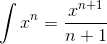 to solve.

The curve is in quadrant one over the interval
The definite integral below is solved by taking the antiderivative of each term of the given polynomial function, evaluating this antiderivative at the bounds of integration, and subtracting the values.
For this particular integral use the rule,
Compare your answer with the correct one above
Tessie kicks a bean bag into the air. Its height at a given time can be given by the following equation:

At what time will the bean bag reach its maximum height?
Tessie kicks a bean bag into the air. Its height at a given time can be given by the following equation:
At what time will the bean bag reach its maximum height?
To find the time at which the bean bag reaches its maximum height, we need to find the time when the velocity of the bean bag is zero.
We can find this by taking the derivative of the height position function with respect to time:

Setting this equal to 0, we can then solve for t:


To find the time at which the bean bag reaches its maximum height, we need to find the time when the velocity of the bean bag is zero.
We can find this by taking the derivative of the height position function with respect to time:
Setting this equal to 0, we can then solve for t:
Compare your answer with the correct one above
The postion of a feather in a windstorm is given by the following equation:

Determine when an extrema in the feather's position occurs  and state whether it is a local minima or maxima.
The postion of a feather in a windstorm is given by the following equation:
Determine when an extrema in the feather's position occurs
The first step into finding when the extrema of a function occurs is to take the derivative and set it equal to zero:


To solve the right side of the equation, we'll need to find its roots. we may either use the quadratic formula:

or see that the equation factors into:

Either way, the only nonnegative root is 2.
To see whether this a local minima or maxima, we'll take the second derivative of our equation and plug in this value of 2:


Since the second derivative is positive, we know that this represents a local minima.
The first step into finding when the extrema of a function occurs is to take the derivative and set it equal to zero:
To solve the right side of the equation, we'll need to find its roots. we may either use the quadratic formula:
or see that the equation factors into:
Either way, the only nonnegative root is 2.
To see whether this a local minima or maxima, we'll take the second derivative of our equation and plug in this value of 2:
Since the second derivative is positive, we know that this represents a local minima.
Compare your answer with the correct one above
Function  gives the velocity of a particle as a function of time.

Which of the following ordered pairs are the coordinates of a critical point of  ?
?
Function
Which of the following ordered pairs are the coordinates of a critical point of
Recall that a function has critcal points where its first derivative is equal to zero or undefined.
So, given  , we need to find v'(t)


Where is this function equal to zero? t=0 for one. We can find the others, but we really just need one. Plug in t=0 into our original equation to find the point (0,0) Which is in this case a saddle point.
Recall that a function has critcal points where its first derivative is equal to zero or undefined.
So, given
Where is this function equal to zero? t=0 for one. We can find the others, but we really just need one. Plug in t=0 into our original equation to find the point (0,0) Which is in this case a saddle point.
Compare your answer with the correct one above
At which point does a local maxima appear in the following function?

At which point does a local maxima appear in the following function?
A local max will occur when the function changes from increasing to decreasing. This means that the derivative of the function will change from positive to negative.
First step is to find the derivative.

Find the critical points (when  is
is  or undefined).

Next, find at which of these two values  changes from positive to negative. Plug in a value in each of the regions into
  .
.
The regions to be tested are  ,
, , and
, and  .
.
A value in the first region, such as  , gives a positive number, and a value in the second range gives a negative number, meaning that
  must be the point where the max occurs.
To find what the  coordinate of this point, plug in
  in to
in to  , not
, not  , to get
  .
.
A local max will occur when the function changes from increasing to decreasing. This means that the derivative of the function will change from positive to negative.
First step is to find the derivative.
Find the critical points (when
Next, find at which of these two values
The regions to be tested are
A value in the first region, such as
To find what the
Compare your answer with the correct one above
What is the maximum value of the function  on the interval
  ?
?
What is the maximum value of the function
First, we need to find the critical points of the function by taking  .
.
This is the derivative of a polynomial, so you can operate term by term.
This gives us,
 .
.
Solving for  by factoring, we get
 .
.
This gives us critical values of 0 and  . Since we are operating on the interval
  , we make sure our endpoints are included and exclude critical values outside this interval. Now we know the maximum could either occur at
  or
or  . As the function is decreasing, we know at the max occurs at
  and that that value is
  .
.
First, we need to find the critical points of the function by taking
This is the derivative of a polynomial, so you can operate term by term.
This gives us,
Solving for
This gives us critical values of 0 and
Compare your answer with the correct one above
Consider the family of curves given by  with
with  . If
. If  is a local maximum, determine
  and
and  .
.
Consider the family of curves given by
Since a local maximum occurs at  , this tells us two pieces of information: the derivative of
  must be zero at
  and the point
  must lie on the graph of this function. Hence we must solve the following two equations:
 .
.
From the first equation we get  or
or  .
.
To find the derivative we apply the quotient rule
 .
.
Solving  , we get
  . Plugging this into the expression for
  gives
gives  .
.
Since a local maximum occurs at
From the first equation we get
To find the derivative we apply the quotient rule
Solving
Compare your answer with the correct one above