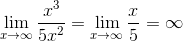
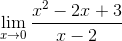
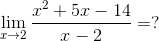
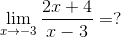
Limits of Functions (including one-sided limits) - AP Calculus AB
Card 0 of 770
Evaluate the limit:

Evaluate the limit:

To evaluate the limit, we must first determine whether the limit is right or left sided; the minus sign exponent indicates we are approaching three from the left, or using values slightly less than three. These correspond to the first part of the piecewise function, whose limit is 9 (substitution).
Compare your answer with the correct one above

Which of the following is equal to
?
Which of the following is equal to ?
The limit of a function as
approaches a value
exists if and only if the limit from the left is equal to the limit from the right; the actual value of
is irrelevant. Since the function is piecewise-defined, we can determine whether these limits are equal by finding the limits of the individual expressions. These are both polynomials, so the limits can be calculated using straightforward substitution:


, so
.
The limit of a function as approaches a value
exists if and only if the limit from the left is equal to the limit from the right; the actual value of
is irrelevant. Since the function is piecewise-defined, we can determine whether these limits are equal by finding the limits of the individual expressions. These are both polynomials, so the limits can be calculated using straightforward substitution:
, so
.
Compare your answer with the correct one above

Which of the following is equal to
?
Which of the following is equal to ?
The limit of a function as
approaches a value
exists if and only if the limit from the left is equal to the limit from the right; the actual value of
is irrelevant. Since the function is piecewise-defined, we can determine whether these limits are equal by finding the limits of the individual expressions. These are both polynomials, so the limits can be calculated using straightforward substitution:


, so
.
The limit of a function as approaches a value
exists if and only if the limit from the left is equal to the limit from the right; the actual value of
is irrelevant. Since the function is piecewise-defined, we can determine whether these limits are equal by finding the limits of the individual expressions. These are both polynomials, so the limits can be calculated using straightforward substitution:
, so
.
Compare your answer with the correct one above
Evaluate the limit:

Evaluate the limit:
To evaluate the limit, we must first determine whether the limit is right or left sided; the minus sign exponent indicates we are approaching three from the left, or using values slightly less than three. These correspond to the first part of the piecewise function, whose limit is 9 (substitution).
Compare your answer with the correct one above

Which of the following is equal to
?
Which of the following is equal to ?
The limit of a function as
approaches a value
exists if and only if the limit from the left is equal to the limit from the right; the actual value of
is irrelevant. Since the function is piecewise-defined, we can determine whether these limits are equal by finding the limits of the individual expressions. These are both polynomials, so the limits can be calculated using straightforward substitution:


, so
.
The limit of a function as approaches a value
exists if and only if the limit from the left is equal to the limit from the right; the actual value of
is irrelevant. Since the function is piecewise-defined, we can determine whether these limits are equal by finding the limits of the individual expressions. These are both polynomials, so the limits can be calculated using straightforward substitution:
, so
.
Compare your answer with the correct one above

Which of the following is equal to
?
Which of the following is equal to ?
The limit of a function as
approaches a value
exists if and only if the limit from the left is equal to the limit from the right; the actual value of
is irrelevant. Since the function is piecewise-defined, we can determine whether these limits are equal by finding the limits of the individual expressions. These are both polynomials, so the limits can be calculated using straightforward substitution:


, so
.
The limit of a function as approaches a value
exists if and only if the limit from the left is equal to the limit from the right; the actual value of
is irrelevant. Since the function is piecewise-defined, we can determine whether these limits are equal by finding the limits of the individual expressions. These are both polynomials, so the limits can be calculated using straightforward substitution:
, so
.
Compare your answer with the correct one above
Evaluate the limit:

Evaluate the limit:
To evaluate the limit, we must first determine whether the limit is right or left sided; the minus sign exponent indicates we are approaching three from the left, or using values slightly less than three. These correspond to the first part of the piecewise function, whose limit is 9 (substitution).
Compare your answer with the correct one above
Evaluate the limit:

Evaluate the limit:
To evaluate the limit, we must first determine whether the limit is right or left sided; the minus sign exponent indicates we are approaching three from the left, or using values slightly less than three. These correspond to the first part of the piecewise function, whose limit is 9 (substitution).
Compare your answer with the correct one above

Which of the following is equal to
?
Which of the following is equal to ?
The limit of a function as
approaches a value
exists if and only if the limit from the left is equal to the limit from the right; the actual value of
is irrelevant. Since the function is piecewise-defined, we can determine whether these limits are equal by finding the limits of the individual expressions. These are both polynomials, so the limits can be calculated using straightforward substitution:


, so
.
The limit of a function as approaches a value
exists if and only if the limit from the left is equal to the limit from the right; the actual value of
is irrelevant. Since the function is piecewise-defined, we can determine whether these limits are equal by finding the limits of the individual expressions. These are both polynomials, so the limits can be calculated using straightforward substitution:
, so
.
Compare your answer with the correct one above
Evaluate the limit:

Evaluate the limit:
To evaluate the limit, we must first determine whether the limit is right or left sided; the minus sign exponent indicates we are approaching three from the left, or using values slightly less than three. These correspond to the first part of the piecewise function, whose limit is 9 (substitution).
Compare your answer with the correct one above

Which of the following is equal to
?
Which of the following is equal to ?
The limit of a function as
approaches a value
exists if and only if the limit from the left is equal to the limit from the right; the actual value of
is irrelevant. Since the function is piecewise-defined, we can determine whether these limits are equal by finding the limits of the individual expressions. These are both polynomials, so the limits can be calculated using straightforward substitution:


, so
.
The limit of a function as approaches a value
exists if and only if the limit from the left is equal to the limit from the right; the actual value of
is irrelevant. Since the function is piecewise-defined, we can determine whether these limits are equal by finding the limits of the individual expressions. These are both polynomials, so the limits can be calculated using straightforward substitution:
, so
.
Compare your answer with the correct one above
Evaluate the limit:

Evaluate the limit:
To evaluate the limit, we must first determine whether the limit is right or left sided; the minus sign exponent indicates we are approaching three from the left, or using values slightly less than three. These correspond to the first part of the piecewise function, whose limit is 9 (substitution).
Compare your answer with the correct one above

Which of the following is equal to
?
Which of the following is equal to ?
The limit of a function as
approaches a value
exists if and only if the limit from the left is equal to the limit from the right; the actual value of
is irrelevant. Since the function is piecewise-defined, we can determine whether these limits are equal by finding the limits of the individual expressions. These are both polynomials, so the limits can be calculated using straightforward substitution:


, so
.
The limit of a function as approaches a value
exists if and only if the limit from the left is equal to the limit from the right; the actual value of
is irrelevant. Since the function is piecewise-defined, we can determine whether these limits are equal by finding the limits of the individual expressions. These are both polynomials, so the limits can be calculated using straightforward substitution:
, so
.
Compare your answer with the correct one above

Which of the following is equal to
?
Which of the following is equal to ?
The limit of a function as
approaches a value
exists if and only if the limit from the left is equal to the limit from the right; the actual value of
is irrelevant. Since the function is piecewise-defined, we can determine whether these limits are equal by finding the limits of the individual expressions. These are both polynomials, so the limits can be calculated using straightforward substitution:


, so
.
The limit of a function as approaches a value
exists if and only if the limit from the left is equal to the limit from the right; the actual value of
is irrelevant. Since the function is piecewise-defined, we can determine whether these limits are equal by finding the limits of the individual expressions. These are both polynomials, so the limits can be calculated using straightforward substitution:
, so
.
Compare your answer with the correct one above
Evaluate the limit:

Evaluate the limit:
To evaluate the limit, we must first determine whether the limit is right or left sided; the minus sign exponent indicates we are approaching three from the left, or using values slightly less than three. These correspond to the first part of the piecewise function, whose limit is 9 (substitution).
Compare your answer with the correct one above

Which of the following is equal to
?
Which of the following is equal to ?
The limit of a function as
approaches a value
exists if and only if the limit from the left is equal to the limit from the right; the actual value of
is irrelevant. Since the function is piecewise-defined, we can determine whether these limits are equal by finding the limits of the individual expressions. These are both polynomials, so the limits can be calculated using straightforward substitution:


, so
.
The limit of a function as approaches a value
exists if and only if the limit from the left is equal to the limit from the right; the actual value of
is irrelevant. Since the function is piecewise-defined, we can determine whether these limits are equal by finding the limits of the individual expressions. These are both polynomials, so the limits can be calculated using straightforward substitution:
, so
.
Compare your answer with the correct one above
Evaluate the limit:

Evaluate the limit:
To evaluate the limit, we must first determine whether the limit is right or left sided; the minus sign exponent indicates we are approaching three from the left, or using values slightly less than three. These correspond to the first part of the piecewise function, whose limit is 9 (substitution).
Compare your answer with the correct one above

Which of the following is equal to
?
Which of the following is equal to ?
The limit of a function as
approaches a value
exists if and only if the limit from the left is equal to the limit from the right; the actual value of
is irrelevant. Since the function is piecewise-defined, we can determine whether these limits are equal by finding the limits of the individual expressions. These are both polynomials, so the limits can be calculated using straightforward substitution:


, so
.
The limit of a function as approaches a value
exists if and only if the limit from the left is equal to the limit from the right; the actual value of
is irrelevant. Since the function is piecewise-defined, we can determine whether these limits are equal by finding the limits of the individual expressions. These are both polynomials, so the limits can be calculated using straightforward substitution:
, so
.
Compare your answer with the correct one above
Evaluate the limit:

Evaluate the limit:
To evaluate the limit, we must first determine whether the limit is right or left sided; the minus sign exponent indicates we are approaching three from the left, or using values slightly less than three. These correspond to the first part of the piecewise function, whose limit is 9 (substitution).
Compare your answer with the correct one above

Which of the following is equal to
?
Which of the following is equal to ?
The limit of a function as
approaches a value
exists if and only if the limit from the left is equal to the limit from the right; the actual value of
is irrelevant. Since the function is piecewise-defined, we can determine whether these limits are equal by finding the limits of the individual expressions. These are both polynomials, so the limits can be calculated using straightforward substitution:


, so
.
The limit of a function as approaches a value
exists if and only if the limit from the left is equal to the limit from the right; the actual value of
is irrelevant. Since the function is piecewise-defined, we can determine whether these limits are equal by finding the limits of the individual expressions. These are both polynomials, so the limits can be calculated using straightforward substitution:
, so
.
Compare your answer with the correct one above