
Asymptotic and Unbounded Behavior - AP Calculus AB
Card 1 of 1419
Evaluate

Evaluate
Tap to reveal answer
The equation  will have a horizontal asymptote y=4.
We can find the horizontal asymptote by looking at the terms with the highest power.
The terms with the highest power here are  in the numerator and
  in the denominator. These terms will "take over" the function as x approaches infinity. That means the limit will reach the ratio of the two terms.
The ratio is 
The equation
We can find the horizontal asymptote by looking at the terms with the highest power.
The terms with the highest power here are
The ratio is
← Didn't Know|Knew It →

Tap to reveal answer
For this infinity limit, we need to consider the leading terms of both the numerator and the denominator. In our problem, the leading term of the numerator is larger than the leading term of the denominator. Therefore, it will be growing at a faster rate.

Now, simply input the limit value, and interpret the results.

For this infinity limit, we need to consider the leading terms of both the numerator and the denominator. In our problem, the leading term of the numerator is larger than the leading term of the denominator. Therefore, it will be growing at a faster rate.
Now, simply input the limit value, and interpret the results.
← Didn't Know|Knew It →

Tap to reveal answer
For infinity limits, we need only consider the leading term in both the numerator and the denominator. Here, we have the case that the exponents are equal in the leading terms. Therefore, the limit at infinity is simply the ratio of the coefficients of the leading terms.

For infinity limits, we need only consider the leading term in both the numerator and the denominator. Here, we have the case that the exponents are equal in the leading terms. Therefore, the limit at infinity is simply the ratio of the coefficients of the leading terms.
← Didn't Know|Knew It →

Tap to reveal answer
Infinity limits can be found by only considering the leading term in both the numerator and the denominator. In this problem, the numerator has a higher exponent than the denominator. Therefore, it will keep increasing and increasing at a much faster rate. These limits always tend to infinity.


Infinity limits can be found by only considering the leading term in both the numerator and the denominator. In this problem, the numerator has a higher exponent than the denominator. Therefore, it will keep increasing and increasing at a much faster rate. These limits always tend to infinity.
← Didn't Know|Knew It →

Tap to reveal answer
For infinity limits, we only consider the leading term in both the numerator and the denominator. Then, we need to consider the exponents of the leading terms. Here, the denominator has a higher degree than the numerator. Therefore, we have a bottom heavy fraction. Even though we are evaluating the limit at negative infinity, this will still tend to zero because the denominator is growing at a faster rate. You can convince yourself of this by plugging in larger and larger negative values. You will just get a longer and smaller decimal.


For infinity limits, we only consider the leading term in both the numerator and the denominator. Then, we need to consider the exponents of the leading terms. Here, the denominator has a higher degree than the numerator. Therefore, we have a bottom heavy fraction. Even though we are evaluating the limit at negative infinity, this will still tend to zero because the denominator is growing at a faster rate. You can convince yourself of this by plugging in larger and larger negative values. You will just get a longer and smaller decimal.
← Didn't Know|Knew It →


Tap to reveal answer

← Didn't Know|Knew It →


Tap to reveal answer

← Didn't Know|Knew It →


Tap to reveal answer

← Didn't Know|Knew It →


Tap to reveal answer

← Didn't Know|Knew It →


Tap to reveal answer

← Didn't Know|Knew It →


Tap to reveal answer

← Didn't Know|Knew It →


Tap to reveal answer

← Didn't Know|Knew It →


Tap to reveal answer

← Didn't Know|Knew It →


Tap to reveal answer

← Didn't Know|Knew It →


Tap to reveal answer

← Didn't Know|Knew It →


Tap to reveal answer

← Didn't Know|Knew It →


Tap to reveal answer

← Didn't Know|Knew It →
Compute 
Compute
Tap to reveal answer
Firstly, recall the rules for evaluating the limits of rational expressions as they go to infinity:
If the degree on the top is greater than the degree on the bottom, the limit does not exist.
If the degree on the top is less than the degree on the bottom, the limit is 0.
If the degrees in both the numerator and denominator are equal, the limit is the ratio of the leading coefficients.
These rules follow from how the function grows as the inputs get larger, ignoring everything but the leading terms.
Then, note that, while the numerator is not written in the correct order for you, that the highest power in the numerator is 5. Likewise, the highest power in the denominator is 5. Thus, the limit will be the ratio of the coefficients on the  terms, which is
  .
.
Firstly, recall the rules for evaluating the limits of rational expressions as they go to infinity:
If the degree on the top is greater than the degree on the bottom, the limit does not exist.
If the degree on the top is less than the degree on the bottom, the limit is 0.
If the degrees in both the numerator and denominator are equal, the limit is the ratio of the leading coefficients.
These rules follow from how the function grows as the inputs get larger, ignoring everything but the leading terms.
Then, note that, while the numerator is not written in the correct order for you, that the highest power in the numerator is 5. Likewise, the highest power in the denominator is 5. Thus, the limit will be the ratio of the coefficients on the
← Didn't Know|Knew It →
Find  .
.
Find
Tap to reveal answer
First step for finding limits: evaluate the function at the limit.
 which is an Indeterminate Form.
This got us nowhere. However, since we have an indeterminate form, we can use L'Hopital's Rule (take the derivative of the top and bottom and the limit's value won't change).

This is something we can evaluate:
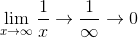
The value of this limit is  .
.
First step for finding limits: evaluate the function at the limit.
This got us nowhere. However, since we have an indeterminate form, we can use L'Hopital's Rule (take the derivative of the top and bottom and the limit's value won't change).
This is something we can evaluate:
The value of this limit is
← Didn't Know|Knew It →
Assume that a population of bunnies grows at a rate of 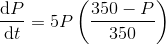 where
where  is the number of bunnies in the population at time
  . If the population begins with 14 bunnies, given unlimited time to grow, how many bunnies do you expect there to be in the population?
Note: No integration is required for this problem.
Assume that a population of bunnies grows at a rate of
Note: No integration is required for this problem.
Tap to reveal answer
The equation given is a model of logistic growth. Note that one of the other common forms this equation might be given in is 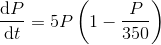 . What we want to know is what the population will be given unlimited time, or what
  is.
is.
Looking at the form of the derivative above, note that if we start with 14 bunnies, we get a positive derivative. This means that the population is increasing. As our function is continuous, the population will keep growing until the derivative hits 0. When does this occur?
In the above form, it should be more clear that the derivative is only 0 at  and
and  . Thus, the population will keep growing, but never go above 350, because if it were to hit 350, the derivative would be 0 and growth would stop. (Alternatively, if the population were above 350, you can see the derivative would be negative and that the population would shrink back down to 350. Indeed, it wasn't necessary to tell you we started with 14 bunnies -- the limit will be the same for any positive starting value.)
The equation given is a model of logistic growth. Note that one of the other common forms this equation might be given in is
Looking at the form of the derivative above, note that if we start with 14 bunnies, we get a positive derivative. This means that the population is increasing. As our function is continuous, the population will keep growing until the derivative hits 0. When does this occur?
In the above form, it should be more clear that the derivative is only 0 at
← Didn't Know|Knew It →