Functions, Graphs, and Limits - AP Calculus AB
Card 1 of 2277
Evaluate the following limit:
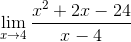
Evaluate the following limit:
Tap to reveal answer
Factor x-4 out of the numerator and simplify:
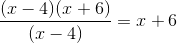
Evaluate the limit for x=4:

Although there is a discontinuity at x=4, the limit at x=4 is 10 because the function approaches ten from the left and right side.
Factor x-4 out of the numerator and simplify:
Evaluate the limit for x=4:
Although there is a discontinuity at x=4, the limit at x=4 is 10 because the function approaches ten from the left and right side.
← Didn't Know|Knew It →
when
and
when 
At
the funciton described above is:
when
and
when
At the funciton described above is:
Tap to reveal answer
The answer is both.
If graphed the student will see that the two graphs are continuous at
. There is no gap in the graph or no uneven transitions. If the graph is continuous then it is differentiable so it must be both.
The answer is both.
If graphed the student will see that the two graphs are continuous at . There is no gap in the graph or no uneven transitions. If the graph is continuous then it is differentiable so it must be both.
← Didn't Know|Knew It →
Which of the following functions contains a removeable discontinuity?
Tap to reveal answer
A removeable discontinuity occurs whenever there is a hole in a graph that could be fixed (or "removed") by filling in a single point. Put another way, if there is a removeable discontinuity at
, then the limit as
approaches
exists, but the value of
does not.
For example, the function
contains a removeable discontinuity at
. Notice that we could simplify
as follows:
, where
.
Thus, we could say that
.
As we can see, the limit of
exists at
, even though
is undefined.
What this means is that
will look just like the parabola with the equation
EXCEPT when
, where there will be a hole in the graph. However, if we were to just define
, then we could essentially "remove" this discontinuity. Therefore, we can say that there is a removeable discontinuty at
.
The functions
, and

have discontinuities, but these discontinuities occur as vertical asymptotes, not holes, and thus are not considered removeable.
The functions
and
are continuous over all the real values of
; they have no discontinuities of any kind.
The answer is
.
A removeable discontinuity occurs whenever there is a hole in a graph that could be fixed (or "removed") by filling in a single point. Put another way, if there is a removeable discontinuity at , then the limit as
approaches
exists, but the value of
does not.
For example, the function contains a removeable discontinuity at
. Notice that we could simplify
as follows:
, where
.
Thus, we could say that .
As we can see, the limit of exists at
, even though
is undefined.
What this means is that will look just like the parabola with the equation
EXCEPT when
, where there will be a hole in the graph. However, if we were to just define
, then we could essentially "remove" this discontinuity. Therefore, we can say that there is a removeable discontinuty at
.
The functions
, and
have discontinuities, but these discontinuities occur as vertical asymptotes, not holes, and thus are not considered removeable.
The functions
and
are continuous over all the real values of
; they have no discontinuities of any kind.
The answer is
.
← Didn't Know|Knew It →
Consider the function
. Which Reimann sum calculation would give the best approximation of the integral from
to
?
Consider the function . Which Reimann sum calculation would give the best approximation of the integral from
to
?
Tap to reveal answer
The mid-point Reimann sum is given by this formula:
, where
, and
is the number of
intervals. Thus, if the region from
to
is divided into twenty intervals,
and 
. For ten intervals,
and
. For five internals,
and 
. The higher the number of intervals, the more precise the estimation. Thus, when
(and hence 
), the estimation is the most accurate.
The mid-point Reimann sum is given by this formula:
, where
, and
is the number of
intervals. Thus, if the region from to
is divided into twenty intervals,
and
. For ten intervals,
and
. For five internals,
and
. The higher the number of intervals, the more precise the estimation. Thus, when
(and hence
), the estimation is the most accurate.
← Didn't Know|Knew It →
Is the following piecewise function continuous for all
? If not, state where it is discontinuous.

Is the following piecewise function continuous for all ? If not, state where it is discontinuous.
Tap to reveal answer
To check if the piecewise function is continuous, all we need to do is check that the values at 3 and 5 line up.
At
, this means checking that
and
have the same value. More formally, we are checking to see that
, as to be continuous at a point, a function's left and right limits must both equal the function value at that point.
Plugging 3 into both, we see that both of them are 12 at
. Thus, they meet up smoothly.
Next, for
, we have
and
. Plugging in 5, we get 22 for both equations.
As all three equations are polynomials, we know they will be continuous everywhere else, and they meet up smoothly at the piecewise bounds, thus ensuring that the function is continuous everywhere.
Note, there are sharp turns at
and
, but this only means the function isn't differentiable at these points -- we're only concerned with continuity, which is if the equations meet up. Thus, the function is continuous.
To check if the piecewise function is continuous, all we need to do is check that the values at 3 and 5 line up.
At , this means checking that
and
have the same value. More formally, we are checking to see that
, as to be continuous at a point, a function's left and right limits must both equal the function value at that point.
Plugging 3 into both, we see that both of them are 12 at . Thus, they meet up smoothly.
Next, for , we have
and
. Plugging in 5, we get 22 for both equations.
As all three equations are polynomials, we know they will be continuous everywhere else, and they meet up smoothly at the piecewise bounds, thus ensuring that the function is continuous everywhere.
Note, there are sharp turns at and
, but this only means the function isn't differentiable at these points -- we're only concerned with continuity, which is if the equations meet up. Thus, the function is continuous.
← Didn't Know|Knew It →

is differentiable for which of the following values of
?

is differentiable for which of the following values of
?
Tap to reveal answer
is not differentiable at
and
because the values are discontinuities.
is not differentiable at
because that point is a corner, indicating that the one-side limits at
are different.
is differentiable:the one side limits are the same and the point is continuous.
is not differentiable at
and
because the values are discontinuities.
is not differentiable at
because that point is a corner, indicating that the one-side limits at
are different.
is differentiable:the one side limits are the same and the point is continuous.
← Didn't Know|Knew It →


Consider the graph of
above. What can we say about
when
?

Consider the graph of above. What can we say about
when
?
Tap to reveal answer
Note that
, indicating that there is a horizontal tangent on
at
. More specifically, the derivative is the slope of the tangent line. If the slope of the tangent line is 0, then the tangent is horizontal.
The other two are incorrect because sharp turns only apply when we want to take the derivative of something. The derivative of a function at a sharp turn is undefined, meaning the graph of the derivative will be discontinuous at the sharp turn. (To see why, ask yourself if the slope at
is positive 1 or negative 1?) On the other hand, integration is less picky than differentiation: We do not need a smooth function to take an integral.
In this case, to get from
to
, we took an integral, so it didn't matter that there was a sharp turn at the specified point. Thus, neither function had any discontinuities.
Note that , indicating that there is a horizontal tangent on
at
. More specifically, the derivative is the slope of the tangent line. If the slope of the tangent line is 0, then the tangent is horizontal.
The other two are incorrect because sharp turns only apply when we want to take the derivative of something. The derivative of a function at a sharp turn is undefined, meaning the graph of the derivative will be discontinuous at the sharp turn. (To see why, ask yourself if the slope at is positive 1 or negative 1?) On the other hand, integration is less picky than differentiation: We do not need a smooth function to take an integral.
In this case, to get from to
, we took an integral, so it didn't matter that there was a sharp turn at the specified point. Thus, neither function had any discontinuities.
← Didn't Know|Knew It →
If
exists,
If exists,
Tap to reveal answer
Unless we are explicitly told so, via graph, information, or otherwise, we cannot assume
is continuous at
unless
, which is required for
to be continuous at
.
We cannot assume anything about the existence of
, because we do not know what
is, or its end behavior.
Unless we are explicitly told so, via graph, information, or otherwise, we cannot assume is continuous at
unless
, which is required for
to be continuous at
.
We cannot assume anything about the existence of , because we do not know what
is, or its end behavior.
← Didn't Know|Knew It →
Determine any points of discontinuity for the function:

Determine any points of discontinuity for the function:
Tap to reveal answer
For a function to be continuous the following criteria must be met:
- The function must exist at the point (no division by zero, asymptotic behavior, negative logs, or negative radicals).
- The limit must exist.
- The point must equal the limit. (Symbolically,
).
It is easiest to first find any points where the function is undefined. Since our function involves a fraction and a natural log, we must find all points in the domain such that the natural log is less than or equal to zero, or points where the denominator is equal to zero.
To find the values that cause the natural log to be negative we set


Therefore, those x values will yield our points of discontinuity. Normally, we would find values where the natural log is negative; however, for all
the function is positive.
For a function to be continuous the following criteria must be met:
- The function must exist at the point (no division by zero, asymptotic behavior, negative logs, or negative radicals).
- The limit must exist.
- The point must equal the limit. (Symbolically,
).
It is easiest to first find any points where the function is undefined. Since our function involves a fraction and a natural log, we must find all points in the domain such that the natural log is less than or equal to zero, or points where the denominator is equal to zero.
To find the values that cause the natural log to be negative we set
Therefore, those x values will yield our points of discontinuity. Normally, we would find values where the natural log is negative; however, for all the function is positive.
← Didn't Know|Knew It →
Calculate 
Calculate
Tap to reveal answer
You can substitute
to write this as:


Note that as
, 
, since the fraction becomes indeterminate, we need to take the derivative of both the top and bottom of the fraction.


, which is the correct choice.
You can substitute to write this as:
Note that as ,
, since the fraction becomes indeterminate, we need to take the derivative of both the top and bottom of the fraction.

, which is the correct choice.
← Didn't Know|Knew It →
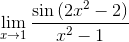
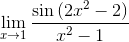
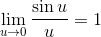
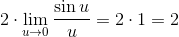
Calculate
.
Calculate .
Tap to reveal answer
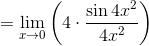
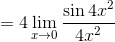
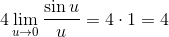
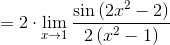
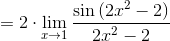
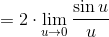
Substitute
to rewrite this limit in terms of u instead of x. Multiply the top and bottom of the fraction by 2 in order to make this substitution:
(Note that as
,
.)


, so
, which is therefore the correct answer choice.
Substitute to rewrite this limit in terms of u instead of x. Multiply the top and bottom of the fraction by 2 in order to make this substitution:
(Note that as ,
.)
, so
, which is therefore the correct answer choice.
← Didn't Know|Knew It →
Evaluate the following limit:
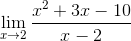
Evaluate the following limit:
Tap to reveal answer
Factor the numerator and simplify the expression.
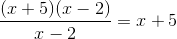
Evaluate the function at x=2.

There is a discontinuity at x=2, but since it the limit as x approaches 2 from the right is equal to the limit as x approaches 2 from the left, the limit exists.
Factor the numerator and simplify the expression.
Evaluate the function at x=2.
There is a discontinuity at x=2, but since it the limit as x approaches 2 from the right is equal to the limit as x approaches 2 from the left, the limit exists.
← Didn't Know|Knew It →
Evaluate the following limit:
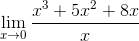
Evaluate the following limit:
Tap to reveal answer
Factor the numerator to evaluate the limit:

Evaluate the limit:

There is a discontinuity at x=0 but the limit is equal to 8 because the limit from the right is equal to the limit from the left.
Factor the numerator to evaluate the limit:
Evaluate the limit:
There is a discontinuity at x=0 but the limit is equal to 8 because the limit from the right is equal to the limit from the left.
← Didn't Know|Knew It →
Evaluate the following limit:
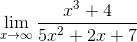
Evaluate the following limit:
Tap to reveal answer
As x approaches infinity, the x values that are raised to the highest power dominate the function and all other values become negligible. In this limit, x3 has the highest order in the numerator and 5x2 has the highest power of all the values in the denominator. We can simplify the limit to the following:
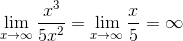
After factoring out x2 it is easy to see that the limit diverges to infinity.
As x approaches infinity, the x values that are raised to the highest power dominate the function and all other values become negligible. In this limit, x3 has the highest order in the numerator and 5x2 has the highest power of all the values in the denominator. We can simplify the limit to the following:
After factoring out x2 it is easy to see that the limit diverges to infinity.
← Didn't Know|Knew It →
Calculate 
Calculate
Tap to reveal answer
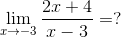
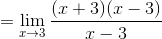
First we notice that substituting 5 in for x will give us a 0 in the denominator.
So we simplify the equation by noticing the numerator is the difference of two squares.

Now we can substitute 5 in for x, and we arrive at our answer of 10.
First we notice that substituting 5 in for x will give us a 0 in the denominator.
So we simplify the equation by noticing the numerator is the difference of two squares.
Now we can substitute 5 in for x, and we arrive at our answer of 10.
← Didn't Know|Knew It →
Tap to reveal answer
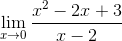
The first step to evaluating limits is always attempt to direct substitute the value into the function. In this case, that is all you need to do.

The first step to evaluating limits is always attempt to direct substitute the value into the function. In this case, that is all you need to do.
← Didn't Know|Knew It →
Tap to reveal answer
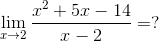
To start this problem, we need to factor the quadratic equation. This will result in a hole at
, which will allow us to directly substitute the limit value into the resulting function to determine the limit.


To start this problem, we need to factor the quadratic equation. This will result in a hole at , which will allow us to directly substitute the limit value into the resulting function to determine the limit.
← Didn't Know|Knew It →
Tap to reveal answer
To evaluate this limit, we need to direct substitute the value in question into our function. Note, this value is in the domain of the function, so direct substitution is the only method we need here.

To evaluate this limit, we need to direct substitute the value in question into our function. Note, this value is in the domain of the function, so direct substitution is the only method we need here.
← Didn't Know|Knew It →
Evaluate 
Evaluate
Tap to reveal answer
This limit can't be evaluated by a simple substitution;
is not defined at
, so some simplification is in order first.
. (Start)
. (Factor the numerator)
. (Cancel the
terms)
. (Substitute in the
)
.
This limit can't be evaluated by a simple substitution; is not defined at
, so some simplification is in order first.
. (Start)
. (Factor the numerator)
. (Cancel the
terms)
. (Substitute in the
)
.
← Didn't Know|Knew It →
Tap to reveal answer
← Didn't Know|Knew It →