
Answering other questions about fourteenth- through sixteenth-century 2D art - AP Art History
Card 1 of 120
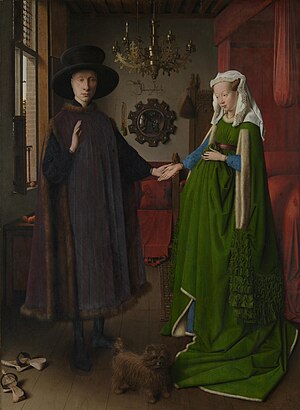
Pictured above is the Arnolfini Portrait, and can be found at the Website of National Gallery, London.
The function of the painting is to .
Pictured above is the Arnolfini Portrait, and can be found at the Website of National Gallery, London.
The function of the painting is to .
Tap to reveal answer
The work depicts a newlywed couple, and it is meant to honor their marriage through artistic depiction.
The work depicts a newlywed couple, and it is meant to honor their marriage through artistic depiction.
← Didn't Know|Knew It →
Renaissance art made a dramatic departure from medieval art by .
Renaissance art made a dramatic departure from medieval art by .
Tap to reveal answer
During the Renaissance, with a renewed focus on classical art and scientific understanding, visual arts underwent a significant change. In particular, religious themes dwindled in importance in comparison to classical subjects, and deeper, more varied colors were used to represent more realistic depictions of the human form.
During the Renaissance, with a renewed focus on classical art and scientific understanding, visual arts underwent a significant change. In particular, religious themes dwindled in importance in comparison to classical subjects, and deeper, more varied colors were used to represent more realistic depictions of the human form.
← Didn't Know|Knew It →
What figure from Greek mythology is prominently featured in Sandro Botticelli's most famous work?
What figure from Greek mythology is prominently featured in Sandro Botticelli's most famous work?
Tap to reveal answer
Sandro Botticelli's The Birth of Venus is one of the signature paintings of Early Renaissance art from Italy, and as such deals with many themes prominent in the era. Botticelli chose the ancient goddess of love, appearing nude and fully formed from the ocean on a clam shell, instead of a Christian theme. Additionally, the picture's symbolism and color focus more on Platonic ideals than the Christian symbolism that was so prevalent in late Medieval art.
Sandro Botticelli's The Birth of Venus is one of the signature paintings of Early Renaissance art from Italy, and as such deals with many themes prominent in the era. Botticelli chose the ancient goddess of love, appearing nude and fully formed from the ocean on a clam shell, instead of a Christian theme. Additionally, the picture's symbolism and color focus more on Platonic ideals than the Christian symbolism that was so prevalent in late Medieval art.
← Didn't Know|Knew It →
Southern European nations are more likely to possess pre-Renaissance religious art because .
Southern European nations are more likely to possess pre-Renaissance religious art because .
Tap to reveal answer
In Europe, the Renaissance and the Protestant Reformation occurred essentially simultaneously, with a revolution in art taking place at the same time as an upheaval in religion. The religious turmoil often affected art made before the time period, however, because many Protestants were iconoclasts who sought to destroy all religious imagery, especially those of saints and other intermediaries.
In Europe, the Renaissance and the Protestant Reformation occurred essentially simultaneously, with a revolution in art taking place at the same time as an upheaval in religion. The religious turmoil often affected art made before the time period, however, because many Protestants were iconoclasts who sought to destroy all religious imagery, especially those of saints and other intermediaries.
← Didn't Know|Knew It →
Pictured above is the Arnolfini Portrait, and can be found at the Website of National Gallery, London.
The medium of the work is .
Pictured above is the Arnolfini Portrait, and can be found at the Website of National Gallery, London.
The medium of the work is .
Tap to reveal answer
As is common in the Northern Renaissance tradition, Van Eyck takes advantage of the slow drying time of oil to get the level of detail he achieves.
As is common in the Northern Renaissance tradition, Van Eyck takes advantage of the slow drying time of oil to get the level of detail he achieves.
← Didn't Know|Knew It →
Pictured above is the Arnolfini Portrait, and can be found at the Website of National Gallery, London.
The image depicts a .
Pictured above is the Arnolfini Portrait, and can be found at the Website of National Gallery, London.
The image depicts a .
Tap to reveal answer
The figures are arranged in a standard pose of a newly-married couple, and the poses of each as well as the adornment on the woman's head suggest they are wed.
The figures are arranged in a standard pose of a newly-married couple, and the poses of each as well as the adornment on the woman's head suggest they are wed.
← Didn't Know|Knew It →
Pictured above is the Arnolfini Portrait, and can be found at the Website of National Gallery, London.
The house in which the couple resides is located in .
Pictured above is the Arnolfini Portrait, and can be found at the Website of National Gallery, London.
The house in which the couple resides is located in .
Tap to reveal answer
The painting is of Netherlandish Renaissance style and was painted by Jan van Eyck, who is from the Netherlands.
The painting is of Netherlandish Renaissance style and was painted by Jan van Eyck, who is from the Netherlands.
← Didn't Know|Knew It →
Pictured above is the Arnolfini Portrait, and can be found at the Website of National Gallery, London.
The work depicts all of the following except .
Pictured above is the Arnolfini Portrait, and can be found at the Website of National Gallery, London.
The work depicts all of the following except .
Tap to reveal answer
Jan van Eyck signed his painting above the mirror. As well, the placement of the wife near the bed suggests submission to the power of the man, while the stiff pose and dress is tradition for the time. There is nothing religious, though, about the painting.
Jan van Eyck signed his painting above the mirror. As well, the placement of the wife near the bed suggests submission to the power of the man, while the stiff pose and dress is tradition for the time. There is nothing religious, though, about the painting.
← Didn't Know|Knew It →
Pictured above is the Arnolfini Portrait, and can be found at the Website of National Gallery, London.
The painting reflects van Eyck's interest in .
Pictured above is the Arnolfini Portrait, and can be found at the Website of National Gallery, London.
The painting reflects van Eyck's interest in .
Tap to reveal answer
This painting represents a tradition of Netherlandish weddings, and it reflects the traditions of that society.
This painting represents a tradition of Netherlandish weddings, and it reflects the traditions of that society.
← Didn't Know|Knew It →
Pictured above is the Arnolfini Portrait, and can be found at the Website of National Gallery, London.
The painting's audience was likely .
Pictured above is the Arnolfini Portrait, and can be found at the Website of National Gallery, London.
The painting's audience was likely .
Tap to reveal answer
The painting was commissioned by Giovanni Arnolfini for the purpose of private viewing in his house.
The painting was commissioned by Giovanni Arnolfini for the purpose of private viewing in his house.
← Didn't Know|Knew It →
Pictured above is the Arnolfini Portrait, and can be found at the Website of National Gallery, London.
The painting displays symbols of .
Pictured above is the Arnolfini Portrait, and can be found at the Website of National Gallery, London.
The painting displays symbols of .
Tap to reveal answer
Both figures are richly dressed, adorned with the latest fashions of the time, which is very much a symbol of wealth and status. While it is a marriage portrait, love has little enough to do with marriage in the Northern Europe of the fifteenth century.
Both figures are richly dressed, adorned with the latest fashions of the time, which is very much a symbol of wealth and status. While it is a marriage portrait, love has little enough to do with marriage in the Northern Europe of the fifteenth century.
← Didn't Know|Knew It →
All of the following statements about European humanism and its influence on visual art of the Fourteenth and Fifteenth Centuries are true except .
All of the following statements about European humanism and its influence on visual art of the Fourteenth and Fifteenth Centuries are true except .
Tap to reveal answer
While Plato's _Republic_is a work of literature from Classical Antiquity, it is not so largely influential on the overall movement of Renaissance Humanism in literature and in art to be accurately described as the philosophical system at Humanism's core. Humanism was too broad a movement to have its fundamental basis attributed to any one work.
While Plato's _Republic_is a work of literature from Classical Antiquity, it is not so largely influential on the overall movement of Renaissance Humanism in literature and in art to be accurately described as the philosophical system at Humanism's core. Humanism was too broad a movement to have its fundamental basis attributed to any one work.
← Didn't Know|Knew It →
The fifteenth century invention of the printing press with moveable type saw which of the following developments in the visual arts?
The fifteenth century invention of the printing press with moveable type saw which of the following developments in the visual arts?
Tap to reveal answer
The invention of the printing press gave way to an explosion in the manufacturing of books, many of which required illustrations to accompany the written word. This allowed for great expansion in the arts of printmaking and greatly increased the popularity of the medium, with its methods such relief (woodblock) printing, intaglio, etc.
The invention of the printing press gave way to an explosion in the manufacturing of books, many of which required illustrations to accompany the written word. This allowed for great expansion in the arts of printmaking and greatly increased the popularity of the medium, with its methods such relief (woodblock) printing, intaglio, etc.
← Didn't Know|Knew It →
Near the end of the Italian High Renaissance, a unique artistic style emerged. It focused on asymmetry, unnatural elongation or exaggeration of human characteristics, and tension within the composition. Although this style lasted less than a century in Italy, its adoption in other, more northern European countries lasted well into the seventeenth century.
What artistic style is the above paragraph describing?
Near the end of the Italian High Renaissance, a unique artistic style emerged. It focused on asymmetry, unnatural elongation or exaggeration of human characteristics, and tension within the composition. Although this style lasted less than a century in Italy, its adoption in other, more northern European countries lasted well into the seventeenth century.
What artistic style is the above paragraph describing?
Tap to reveal answer
Mannerism lasted in Italy from the 1520s until the 1580s, but was practiced for a much longer amount of time in European countries north of Italy. Mannerist paintings portray subjects with purposefully elongated proportions and stylized poses. It was a step away from the harmonious, symmetrical, and rational subjects of Renaissance art.
Mannerism lasted in Italy from the 1520s until the 1580s, but was practiced for a much longer amount of time in European countries north of Italy. Mannerist paintings portray subjects with purposefully elongated proportions and stylized poses. It was a step away from the harmonious, symmetrical, and rational subjects of Renaissance art.
← Didn't Know|Knew It →
It has been speculated that the Bubonic Plague, also known as the Black Death, which occurred during the mid-14th century and claimed the lives of 30% to 60% of Europeans, sparked which artistic and scientific movement in its aftermath?
It has been speculated that the Bubonic Plague, also known as the Black Death, which occurred during the mid-14th century and claimed the lives of 30% to 60% of Europeans, sparked which artistic and scientific movement in its aftermath?
Tap to reveal answer
It is speculated that in the aftermath of the Bubonic Plague, the citizens of Europe, and especially Italy, which was particularly devastated by the Plageu, began to think of life, spirituality, art, science, and the afterlife in a new way. This particularly traumatic event caused a social and economic upheaval in many parts of Europe, which changed the way of life and opportunities of many citizens.
These social, economic, religious and scientific changes in European culture may have sparked what is now known as the Renaissance.
It is speculated that in the aftermath of the Bubonic Plague, the citizens of Europe, and especially Italy, which was particularly devastated by the Plageu, began to think of life, spirituality, art, science, and the afterlife in a new way. This particularly traumatic event caused a social and economic upheaval in many parts of Europe, which changed the way of life and opportunities of many citizens.
These social, economic, religious and scientific changes in European culture may have sparked what is now known as the Renaissance.
← Didn't Know|Knew It →

A work of art such as the Annunciation Triptych by the Workshop of Robert Campin was traditionally displayed .
A work of art such as the Annunciation Triptych by the Workshop of Robert Campin was traditionally displayed .
Tap to reveal answer
The Annunciation Triptych, also known as the Mérode Altarpiece, is typical of a late medieval, early renaissance religious work of art that was designed to fit across the altar in a church. Usually paid for and commissioned by the civic leaders, such a work of art both held religious significance and demonstrated the wealth and prestige of the city. Robert Campin, and his Workshop, would have created the piece both as a matter of artistic skill and to show religious meaning.
Image is in the public domain, accessed through Wikipedia Media Commons: https://commons.wikimedia.org/wiki/File:Robert\_Campin\_-\_Triptych\_with\_the\_Annunciation,\_known\_as\_the\_%22Merode\_Altarpiece%22\_-\_Google\_Art\_Project.jpg
The Annunciation Triptych, also known as the Mérode Altarpiece, is typical of a late medieval, early renaissance religious work of art that was designed to fit across the altar in a church. Usually paid for and commissioned by the civic leaders, such a work of art both held religious significance and demonstrated the wealth and prestige of the city. Robert Campin, and his Workshop, would have created the piece both as a matter of artistic skill and to show religious meaning.
Image is in the public domain, accessed through Wikipedia Media Commons: https://commons.wikimedia.org/wiki/File:Robert\_Campin\_-\_Triptych\_with\_the\_Annunciation,\_known\_as\_the\_%22Merode\_Altarpiece%22\_-\_Google\_Art\_Project.jpg
← Didn't Know|Knew It →
Based on the style of the work, it was created in .
Based on the style of the work, it was created in .
Tap to reveal answer
Two significant, but very separate, movements pushed European painting forward in the fifteenth century. One was the Italian Renaissance, which focused on new methods of perspective and light. By contrast, Early Netherlandish Painting, centered in Flanders and represented by the Annunciation Triptych, used traditional methods of representation and posing, but made technical innovations in color and drawing that created more sharply defined and exquisite paintings. While the two would begin to learn from each other by the sixteenth century, Northern and Southern Europe continued to have separate traditions and styles in painting.
Image is in the public domain, accessed through Wikipedia Media Commons: https://commons.wikimedia.org/wiki/File:Robert\_Campin\_-\_Triptych\_with\_the\_Annunciation,\_known\_as\_the\_%22Merode\_Altarpiece%22\_-\_Google\_Art\_Project.jpg
Two significant, but very separate, movements pushed European painting forward in the fifteenth century. One was the Italian Renaissance, which focused on new methods of perspective and light. By contrast, Early Netherlandish Painting, centered in Flanders and represented by the Annunciation Triptych, used traditional methods of representation and posing, but made technical innovations in color and drawing that created more sharply defined and exquisite paintings. While the two would begin to learn from each other by the sixteenth century, Northern and Southern Europe continued to have separate traditions and styles in painting.
Image is in the public domain, accessed through Wikipedia Media Commons: https://commons.wikimedia.org/wiki/File:Robert\_Campin\_-\_Triptych\_with\_the\_Annunciation,\_known\_as\_the\_%22Merode\_Altarpiece%22\_-\_Google\_Art\_Project.jpg
← Didn't Know|Knew It →

The figure on the left in the work shown here is .
The figure on the left in the work shown here is .
Tap to reveal answer
The Virgin Mary is placed in the left hand portion of this painting, the Madonna and Child with Two Angels by Filippo Lippi. Lippi does many things that are different than traditional portrayals of the Virgin Mary in this work, especially showing her without a shawl on her head and interacting with the Christ child in a more realistic manner. Still, Lippi presents the Virgin Mary in a blue robe, with a halo over her head, and surrounded by angels, all signifiers of the Virgin Mary in art.
Image accessed through Wikipedia Media Commons: https://commons.wikimedia.org/wiki/File:Fra\_Filippo\_Lippi\_-\_Madonna\_and\_Child\_with\_two\_Angels\_-\_Uffizi.jpg
The Virgin Mary is placed in the left hand portion of this painting, the Madonna and Child with Two Angels by Filippo Lippi. Lippi does many things that are different than traditional portrayals of the Virgin Mary in this work, especially showing her without a shawl on her head and interacting with the Christ child in a more realistic manner. Still, Lippi presents the Virgin Mary in a blue robe, with a halo over her head, and surrounded by angels, all signifiers of the Virgin Mary in art.
Image accessed through Wikipedia Media Commons: https://commons.wikimedia.org/wiki/File:Fra\_Filippo\_Lippi\_-\_Madonna\_and\_Child\_with\_two\_Angels\_-\_Uffizi.jpg
← Didn't Know|Knew It →
The medium in which the work shown here was created was .
The medium in which the work shown here was created was .
Tap to reveal answer
Tempera paint, made from water-soluble binders (usually eggs) and color pigments, was the most common paint form in Europe from the Roman era through about 1500. Tempera paint was valued for its quick drying time and its ability to last. This work, Madonna and Child with Two Angels by Filippo Lippi, is from the last era of tempera painting in Italy, as painting on canvases, which were better applied with oil paints, became more popular a few decades after Lippi’s work.
Image accessed through Wikipedia Media Commons: https://commons.wikimedia.org/wiki/File:Fra\_Filippo\_Lippi\_-\_Madonna\_and\_Child\_with\_two\_Angels\_-\_Uffizi.jpg
Tempera paint, made from water-soluble binders (usually eggs) and color pigments, was the most common paint form in Europe from the Roman era through about 1500. Tempera paint was valued for its quick drying time and its ability to last. This work, Madonna and Child with Two Angels by Filippo Lippi, is from the last era of tempera painting in Italy, as painting on canvases, which were better applied with oil paints, became more popular a few decades after Lippi’s work.
Image accessed through Wikipedia Media Commons: https://commons.wikimedia.org/wiki/File:Fra\_Filippo\_Lippi\_-\_Madonna\_and\_Child\_with\_two\_Angels\_-\_Uffizi.jpg
← Didn't Know|Knew It →

This work, Jacopo da Pontormo’s Entombment of Christ is placed in .
This work, Jacopo da Pontormo’s Entombment of Christ is placed in .
Tap to reveal answer
The Entombment of Christ depicts the descent of Christ from the cross, one of the Twelve Stations of the Cross. This particular work hangs in the Capponi Chapel, a sixteenth century addition to the much older Church of Saint Felicita in Florence, which was built by the architect by Filippo Brunelleschi. Pontormo’s work was part of a series depicting the Stations of the Cross, in the then vogue mannerist style, which adorned the walls of the brand new chapel.
Image accessed through Wikipedia Media Commons: https://commons.wikimedia.org/wiki/File:Jacopo\_Pontormo\_004.jpg
The Entombment of Christ depicts the descent of Christ from the cross, one of the Twelve Stations of the Cross. This particular work hangs in the Capponi Chapel, a sixteenth century addition to the much older Church of Saint Felicita in Florence, which was built by the architect by Filippo Brunelleschi. Pontormo’s work was part of a series depicting the Stations of the Cross, in the then vogue mannerist style, which adorned the walls of the brand new chapel.
Image accessed through Wikipedia Media Commons: https://commons.wikimedia.org/wiki/File:Jacopo\_Pontormo\_004.jpg
← Didn't Know|Knew It →