
Sculpture - AP Art History
Card 1 of 776
What was the function of The Stele of Hammurabi?

What was the function of The Stele of Hammurabi?
Tap to reveal answer
The Stele of Hammurabi lists out a code of laws for the people of Babylon to follow. There are over 300 law entries written out in the work.
Image is in the public domain, accessed through Wikipedia Media Commons: https://en.wikipedia.org/wiki/Code\_of\_Hammurabi#/media/File:Milkau\_Oberer\_Teil\_der\_Stele\_mit\_dem\_Text\_von\_Hammurapis\_Gesetzescode\_369-2.png
The Stele of Hammurabi lists out a code of laws for the people of Babylon to follow. There are over 300 law entries written out in the work.
Image is in the public domain, accessed through Wikipedia Media Commons: https://en.wikipedia.org/wiki/Code\_of\_Hammurabi#/media/File:Milkau\_Oberer\_Teil\_der\_Stele\_mit\_dem\_Text\_von\_Hammurapis\_Gesetzescode\_369-2.png
← Didn't Know|Knew It →
Equestrian statues were favored by absolute monarchs in the seventeenth century because .
Equestrian statues were favored by absolute monarchs in the seventeenth century because .
Tap to reveal answer
Equestrian statues, even when life-size, created a portrait of their subjects on massive scales. While commonplace in Rome, they were hardly made after the fall of Rome until the Renaissance, and in the age of absolutism in the seventeenth century, they were made all across Europe to commemorate and celebrate monarchs. These statues made the monarchs depicted in them appear intimidating, grandiose, and worthy of their position as absolute monarchs.
Equestrian statues, even when life-size, created a portrait of their subjects on massive scales. While commonplace in Rome, they were hardly made after the fall of Rome until the Renaissance, and in the age of absolutism in the seventeenth century, they were made all across Europe to commemorate and celebrate monarchs. These statues made the monarchs depicted in them appear intimidating, grandiose, and worthy of their position as absolute monarchs.
← Didn't Know|Knew It →
The most well known type of Olmec art is .
The most well known type of Olmec art is .
Tap to reveal answer
The Olmec civilization dominated what is now Southern Mexico from roughly 1500 BCE to 400 BCE, laying the groundwork for the later civilizations of the Maya and Aztec. The most familiar and most impressive part of their civilization that has survived are basalt sculptures of heads that weigh between 6 and 50 tons, and which took extraordinary coordination to have the stones moved and sculpted into their proper forms.
The Olmec civilization dominated what is now Southern Mexico from roughly 1500 BCE to 400 BCE, laying the groundwork for the later civilizations of the Maya and Aztec. The most familiar and most impressive part of their civilization that has survived are basalt sculptures of heads that weigh between 6 and 50 tons, and which took extraordinary coordination to have the stones moved and sculpted into their proper forms.
← Didn't Know|Knew It →
Arguably the most recognizable piece of artwork from Mesoamerica is the Aztec . This stone was carved in the mid-fifteenth century and presents different worlds of the sun according to Aztec mythology. This stone was once a part of the Templo Mayor of Tenochtitlan.
Arguably the most recognizable piece of artwork from Mesoamerica is the Aztec . This stone was carved in the mid-fifteenth century and presents different worlds of the sun according to Aztec mythology. This stone was once a part of the Templo Mayor of Tenochtitlan.
Tap to reveal answer
The Aztec Sun Stone (also known as the Aztec Calendar Stone) is an elaborately carved stone disk that represents a link between humanity and the divine through the current ruler of the Aztec Empire at the time of its carving. It is not a working calendar. It may also have at some point been anointed with blood sacrifices to please the gods the Aztecs believed in.
The Aztec Sun Stone (also known as the Aztec Calendar Stone) is an elaborately carved stone disk that represents a link between humanity and the divine through the current ruler of the Aztec Empire at the time of its carving. It is not a working calendar. It may also have at some point been anointed with blood sacrifices to please the gods the Aztecs believed in.
← Didn't Know|Knew It →
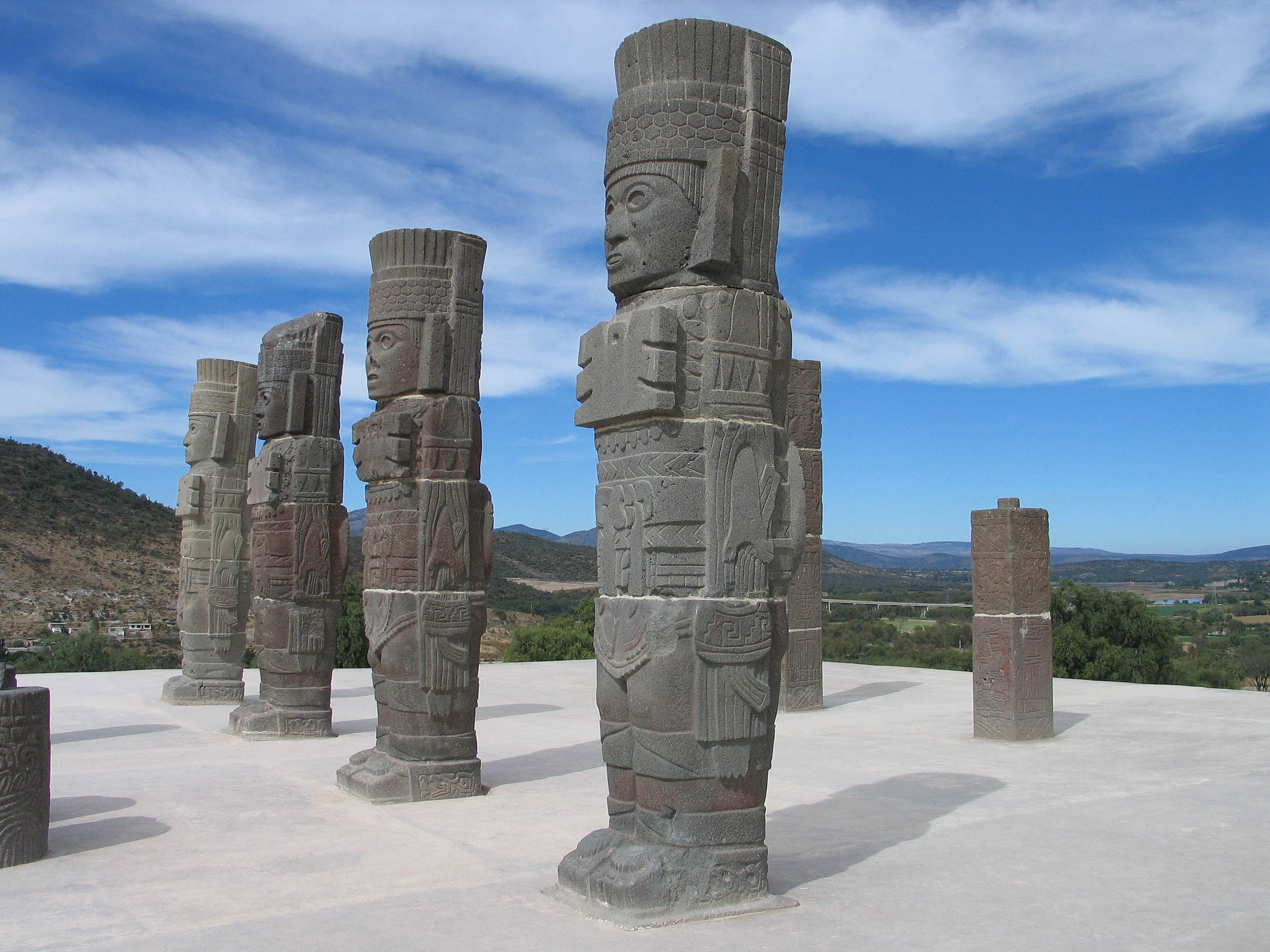
These stone monuments left behind by the Toltec civilization, which occupied what is now Hidalgo, Mexico, are an example of which type of monument frequently found in Pre-Columbian architecture and sculpture?
These stone monuments left behind by the Toltec civilization, which occupied what is now Hidalgo, Mexico, are an example of which type of monument frequently found in Pre-Columbian architecture and sculpture?
Tap to reveal answer
Atlantean figures have been found in various different areas of pre-Columbian Mesoamerica, most notably in Hidalgo, Mexico, which was previously occupied by the Toltecs. Their purpose is generally as support pillars. Atlantean refers to the Titan god Atlas, from Ancient Greek mythology, who was doomed to hold up the heavens for all eternity. They are generally carved to represent fierce, bellicose men. When the Aztecs found these pillars after the Toltecs abandoned their city, they imagined that the pillars represented their own gods, and considered the city divine.
Image accessed at: https://commons.wikimedia.org/wiki/File:Telamones\_Tula.jpg
Photograph by Luidger
Atlantean figures have been found in various different areas of pre-Columbian Mesoamerica, most notably in Hidalgo, Mexico, which was previously occupied by the Toltecs. Their purpose is generally as support pillars. Atlantean refers to the Titan god Atlas, from Ancient Greek mythology, who was doomed to hold up the heavens for all eternity. They are generally carved to represent fierce, bellicose men. When the Aztecs found these pillars after the Toltecs abandoned their city, they imagined that the pillars represented their own gods, and considered the city divine.
Image accessed at: https://commons.wikimedia.org/wiki/File:Telamones\_Tula.jpg
Photograph by Luidger
← Didn't Know|Knew It →
What is included in a pilgrimage type church, such as St. Sernin in Toulouse?
What is included in a pilgrimage type church, such as St. Sernin in Toulouse?
Tap to reveal answer
Pilgrimage type churches housed large crowds on their journey to Compostela or other pilgrimage destinations. Thus, the churches were expanded to accommodate these crowds. The naves were extended; radiating chapels and tribunes were added to house the extra worshippers. Side aisles were doubled, and everything was built on a larger scale.
Pilgrimage type churches housed large crowds on their journey to Compostela or other pilgrimage destinations. Thus, the churches were expanded to accommodate these crowds. The naves were extended; radiating chapels and tribunes were added to house the extra worshippers. Side aisles were doubled, and everything was built on a larger scale.
← Didn't Know|Knew It →
What is a "reliquary"?
What is a "reliquary"?
Tap to reveal answer
"Reliquaries" are the containers of relics, or the fragmented body parts (usually the bone(s) or bodily object(s)) of a saint or other religious figure. "Reliquaries" varied in size and shape, and could range from a small amulet containing a pinkie finger to a large box containing a leg bone. Touch relics -or objects that had come in contact with a saint or other religious figure, such as a piece of clothing- might also be held within a reliquary.
"Reliquaries" are the containers of relics, or the fragmented body parts (usually the bone(s) or bodily object(s)) of a saint or other religious figure. "Reliquaries" varied in size and shape, and could range from a small amulet containing a pinkie finger to a large box containing a leg bone. Touch relics -or objects that had come in contact with a saint or other religious figure, such as a piece of clothing- might also be held within a reliquary.
← Didn't Know|Knew It →
Though was implemented as early as Mesopotamian art, it is a technique that flourished as a part of Byzantine art. It consists of assembling small pieces of glass, stone, metal, and other assorted materials in order to form images and elaborate patterns.
Though was implemented as early as Mesopotamian art, it is a technique that flourished as a part of Byzantine art. It consists of assembling small pieces of glass, stone, metal, and other assorted materials in order to form images and elaborate patterns.
Tap to reveal answer
Mosaics are one of the most important legacies of Byzantine art, and remained the envy of Western European artists for centuries to come. Mosaic art included patterns, abstract symbolism, and more realistic images.
Mosaics are one of the most important legacies of Byzantine art, and remained the envy of Western European artists for centuries to come. Mosaic art included patterns, abstract symbolism, and more realistic images.
← Didn't Know|Knew It →
A "mandorla" in Romanesque sculpture is .
A "mandorla" in Romanesque sculpture is .
Tap to reveal answer
A "mandorla" is an oval of light, typically surrounding the figure of Christ. "Leviathans" (sea monsters) were sometimes depicted in Romanesque Last Judgment scenes, ready to swallow up the condemned. The vertical stone between the portal doors is called a "trumeau."
A "mandorla" is an oval of light, typically surrounding the figure of Christ. "Leviathans" (sea monsters) were sometimes depicted in Romanesque Last Judgment scenes, ready to swallow up the condemned. The vertical stone between the portal doors is called a "trumeau."
← Didn't Know|Knew It →

Pictured above is the Sarcophagus of Junius Bassus, originally from Rome.
The work would have been placed in .
Pictured above is the Sarcophagus of Junius Bassus, originally from Rome.
The work would have been placed in .
Tap to reveal answer
The Christian motif is clear on the work, indicating it would have been on display in a Christian burial place. A sarcophagus would not have been placed in the ground, and this one is not pagan in nature.
The Christian motif is clear on the work, indicating it would have been on display in a Christian burial place. A sarcophagus would not have been placed in the ground, and this one is not pagan in nature.
← Didn't Know|Knew It →
Pictured above is the Sarcophagus of Junius Bassus, originally from Rome.
The time in which this work was produced was also a time of .
Pictured above is the Sarcophagus of Junius Bassus, originally from Rome.
The time in which this work was produced was also a time of .
Tap to reveal answer
The sarcophagus was made in the middle of the fourth century, just as Chrisitanity began to reshape the Roman Empire and split it into two conflicting Christian worlds.
The sarcophagus was made in the middle of the fourth century, just as Chrisitanity began to reshape the Roman Empire and split it into two conflicting Christian worlds.
← Didn't Know|Knew It →
Pictured above is the Sarcophagus of Junius Bassus, originally from Rome.
The figural element reflects which artistic style?
Pictured above is the Sarcophagus of Junius Bassus, originally from Rome.
The figural element reflects which artistic style?
Tap to reveal answer
The figures appear in a Roman style of dress and appearance, although their Christian elements, like the naked Adam and Eve, suggest it is a later Roman style.
The figures appear in a Roman style of dress and appearance, although their Christian elements, like the naked Adam and Eve, suggest it is a later Roman style.
← Didn't Know|Knew It →
Pictured above is the Sarcophagus of Junius Bassus, originally from Rome.
The stylized columns in the work appear to be of what influence?
Pictured above is the Sarcophagus of Junius Bassus, originally from Rome.
The stylized columns in the work appear to be of what influence?
Tap to reveal answer
The Corinthian columns and stylized pediment are orginially from pagan temples and would have been introduced to the Romans by the Greeks.
The Corinthian columns and stylized pediment are orginially from pagan temples and would have been introduced to the Romans by the Greeks.
← Didn't Know|Knew It →
Pictured above is the Sarcophagus of Junius Bassus, originally from Rome.
The work does not demonstrate .
Pictured above is the Sarcophagus of Junius Bassus, originally from Rome.
The work does not demonstrate .
Tap to reveal answer
The work is from the middle of the fourth century and would have predated the height of Byzantium.
The work is from the middle of the fourth century and would have predated the height of Byzantium.
← Didn't Know|Knew It →
Pictured above is the Sarcophagus of Junius Bassus, originally from Rome.
The columns are in what style?
Pictured above is the Sarcophagus of Junius Bassus, originally from Rome.
The columns are in what style?
Tap to reveal answer
The columns sport the leaves of an acanthus plant, which is stylistically representative of the Corinthian order.
The columns sport the leaves of an acanthus plant, which is stylistically representative of the Corinthian order.
← Didn't Know|Knew It →
Pictured above is the Sarcophagus of Junius Bassus, originally from Rome.
The work was comissioned by .
Pictured above is the Sarcophagus of Junius Bassus, originally from Rome.
The work was comissioned by .
Tap to reveal answer
Junius Bassus was a powerful senator, and the owner of this work. He must have had enough wealth and influence to commission such a work for his death, and he must have been Christian to justify the imagery. He was not a Roman Emperor, and certainly not an "ancient" one, which typically refers to a period about a thousand years before Bassus lived.
Junius Bassus was a powerful senator, and the owner of this work. He must have had enough wealth and influence to commission such a work for his death, and he must have been Christian to justify the imagery. He was not a Roman Emperor, and certainly not an "ancient" one, which typically refers to a period about a thousand years before Bassus lived.
← Didn't Know|Knew It →
Pictured above is the Sarcophagus of Junius Bassus, originally from Rome.
All of the following can be found in the work EXCEPT .
Pictured above is the Sarcophagus of Junius Bassus, originally from Rome.
All of the following can be found in the work EXCEPT .
Tap to reveal answer
Female figures have been nude almost since the beginning of figurative art. They are not new to the Romans, although they are seen less often.
Female figures have been nude almost since the beginning of figurative art. They are not new to the Romans, although they are seen less often.
← Didn't Know|Knew It →
Choose the best answer.
Byzantine art, which developed out of , abandoned the concept of perfection, symmetry and idealistic beauty. Instead, the art of the Byzantine Empire focused on symbolism, intricacy and the ornate.
Choose the best answer.
Byzantine art, which developed out of , abandoned the concept of perfection, symmetry and idealistic beauty. Instead, the art of the Byzantine Empire focused on symbolism, intricacy and the ornate.
Tap to reveal answer
Byzantine art evolved from ancient Roman art, although this transition is not superficially obvious. It is important to remember that the Byzantine Empire is at times referred to as the Eastern Roman Empire, and that the Byzantine people considered themselves to be Romans through the Fall of Constantinople in 1453. The evolution of style of Byzantine art occurred due to the fact that the Byzantine Empire and Constantinople were considered the bridge between Eastern and Western European cultures. The clash and intermingling of these cultures and religions is what created the unique style and appearance of Byzantine art.
Byzantine art evolved from ancient Roman art, although this transition is not superficially obvious. It is important to remember that the Byzantine Empire is at times referred to as the Eastern Roman Empire, and that the Byzantine people considered themselves to be Romans through the Fall of Constantinople in 1453. The evolution of style of Byzantine art occurred due to the fact that the Byzantine Empire and Constantinople were considered the bridge between Eastern and Western European cultures. The clash and intermingling of these cultures and religions is what created the unique style and appearance of Byzantine art.
← Didn't Know|Knew It →

the following image is public domain, and can be found at https://en.wikipedia.org/wiki/David\_(Donatello)#/media/File:Florence\_-\_David\_by\_Donatello.jpg
The work is noteworthy for bringing attention to .
the following image is public domain, and can be found at https://en.wikipedia.org/wiki/David\_(Donatello)#/media/File:Florence\_-\_David\_by\_Donatello.jpg
The work is noteworthy for bringing attention to .
Tap to reveal answer
David is the first instance in which there is a genuine blending of the Christian faith and the styles and forms of Classical figural art. Here is the first time that biblical figures are represented in the styles of the Classical masters. Yes, he is not the freestanding nudes we recognize- the Boxer, the Discus Thrower, those trim and muscled figures. David clings to the vestiges of Gothic figures, but he is nude and freestanding and has paved the way for more of his kind.
David is the first instance in which there is a genuine blending of the Christian faith and the styles and forms of Classical figural art. Here is the first time that biblical figures are represented in the styles of the Classical masters. Yes, he is not the freestanding nudes we recognize- the Boxer, the Discus Thrower, those trim and muscled figures. David clings to the vestiges of Gothic figures, but he is nude and freestanding and has paved the way for more of his kind.
← Didn't Know|Knew It →
the following image is public domain, and can be found at https://en.wikipedia.org/wiki/David\_(Donatello)#/media/File:Florence\_-\_David\_by\_Donatello.jpg
The work demonstrates Donatello's interest in .
the following image is public domain, and can be found at https://en.wikipedia.org/wiki/David\_(Donatello)#/media/File:Florence\_-\_David\_by\_Donatello.jpg
The work demonstrates Donatello's interest in .
Tap to reveal answer
Donatello had a clear interest in the human form. Many believed when he unveiled the piece that it had to have been done in life, it was so true to form. He also, though, was the first of his kind to use bronze in a freestanding nude (this hasn't been done since the Classical era). He is finally making a statement of Italian society, and the importance of blending Christian art and modernizing life.
Donatello had a clear interest in the human form. Many believed when he unveiled the piece that it had to have been done in life, it was so true to form. He also, though, was the first of his kind to use bronze in a freestanding nude (this hasn't been done since the Classical era). He is finally making a statement of Italian society, and the importance of blending Christian art and modernizing life.
← Didn't Know|Knew It →