
2D Art - AP Art History
Card 1 of 2380
All of the following characterize Byzantine art except .
All of the following characterize Byzantine art except .
Tap to reveal answer
Key words identifying Byzantine art are flat, floating, frontal, and gold. Rather than the realism and naturalism of Greco-Roman art, Byzantine art is focused on the spiritual or other-worldly. Therefore, it is less realistic, and shows its figures as more floating and unconnected with this world.
Key words identifying Byzantine art are flat, floating, frontal, and gold. Rather than the realism and naturalism of Greco-Roman art, Byzantine art is focused on the spiritual or other-worldly. Therefore, it is less realistic, and shows its figures as more floating and unconnected with this world.
← Didn't Know|Knew It →
This artistic and architectural movement of 1000 BCE to the fourteenth century is responsible for the widespread usage of stained glass in European churches and cathedrals.
This artistic and architectural movement of 1000 BCE to the fourteenth century is responsible for the widespread usage of stained glass in European churches and cathedrals.
Tap to reveal answer
Although there are an unfortunate few surviving examples of Romanesque stained glass, the first examples of stained glass are remnants from the beginning of the Romanesque era. The larger quantities of stained glass from the Romanesque period have been dated to its later years.
Although there are an unfortunate few surviving examples of Romanesque stained glass, the first examples of stained glass are remnants from the beginning of the Romanesque era. The larger quantities of stained glass from the Romanesque period have been dated to its later years.
← Didn't Know|Knew It →
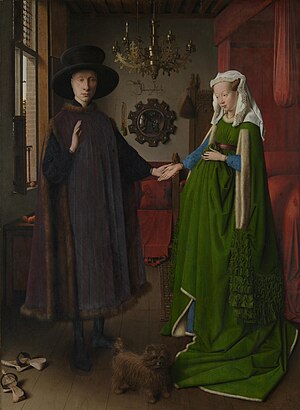
Pictured above is the Arnolfini Portrait, and can be found at the Website of National Gallery, London.
The image depicts a .
Pictured above is the Arnolfini Portrait, and can be found at the Website of National Gallery, London.
The image depicts a .
Tap to reveal answer
The figures are arranged in a standard pose of a newly-married couple, and the poses of each as well as the adornment on the woman's head suggest they are wed.
The figures are arranged in a standard pose of a newly-married couple, and the poses of each as well as the adornment on the woman's head suggest they are wed.
← Didn't Know|Knew It →

The above painting depicts what biblical scene that was a common feature of medieval art?
The above painting depicts what biblical scene that was a common feature of medieval art?
Tap to reveal answer
This painting is by the Medieval artist Fra Angelico and known as the Cortona Annunciation. Painted from 1433-1434, it depicts the archangel Gabriel telling the Virgin Mary that she is pregnant with the Christ child. The Annunciation, as a key moment in the Bible, was a very popular theme in Medieval European art. This particular painting was part of an altarpiece in a church in Cortona, Italy, and painted by a priest.
This painting is by the Medieval artist Fra Angelico and known as the Cortona Annunciation. Painted from 1433-1434, it depicts the archangel Gabriel telling the Virgin Mary that she is pregnant with the Christ child. The Annunciation, as a key moment in the Bible, was a very popular theme in Medieval European art. This particular painting was part of an altarpiece in a church in Cortona, Italy, and painted by a priest.
← Didn't Know|Knew It →
In Medieval art, a man dying with arrows in his sides depicts .
In Medieval art, a man dying with arrows in his sides depicts .
Tap to reveal answer
Saint Sebastian was a martyr of the early Christian church who died in the Diocletian persecutions of the third century CE. He became a popular figure in medieval art, usually shown as being tied to a tree with arrows in his sides. This image was to convey what an appropriate Christian martyr should look like.
Saint Sebastian was a martyr of the early Christian church who died in the Diocletian persecutions of the third century CE. He became a popular figure in medieval art, usually shown as being tied to a tree with arrows in his sides. This image was to convey what an appropriate Christian martyr should look like.
← Didn't Know|Knew It →
The Virgin Mary is usually depicted wearing what color garment in medieval art?
The Virgin Mary is usually depicted wearing what color garment in medieval art?
Tap to reveal answer
As one of the most revered figures in Christianity, the Virgin Mary was a constant theme of medieval religious art. In order to function as a highly visible symbol in a mostly illiterate culture, many different symbols were used to distinguish Mary. Most important was her robe, which was typically a bright blue color, which denoted expensive silks.
As one of the most revered figures in Christianity, the Virgin Mary was a constant theme of medieval religious art. In order to function as a highly visible symbol in a mostly illiterate culture, many different symbols were used to distinguish Mary. Most important was her robe, which was typically a bright blue color, which denoted expensive silks.
← Didn't Know|Knew It →
In Christian hagiography, which figure is depicted as having a stone in his head?
In Christian hagiography, which figure is depicted as having a stone in his head?
Tap to reveal answer
Saint Stephen is traditionally considered the first martyr of Christianity, and his death by stoning is told in the biblical book of Acts. Due to the circumstances of his death, he was usually depicted with a stone implanted in his skull. Thanks to his position as "the first martyr," Saint Stephen very commonly depicted in Medieval art.
Saint Stephen is traditionally considered the first martyr of Christianity, and his death by stoning is told in the biblical book of Acts. Due to the circumstances of his death, he was usually depicted with a stone implanted in his skull. Thanks to his position as "the first martyr," Saint Stephen very commonly depicted in Medieval art.
← Didn't Know|Knew It →
Pictured above is the Arnolfini Portrait, and can be found at the Website of National Gallery, London.
The house in which the couple resides is located in .
Pictured above is the Arnolfini Portrait, and can be found at the Website of National Gallery, London.
The house in which the couple resides is located in .
Tap to reveal answer
The painting is of Netherlandish Renaissance style and was painted by Jan van Eyck, who is from the Netherlands.
The painting is of Netherlandish Renaissance style and was painted by Jan van Eyck, who is from the Netherlands.
← Didn't Know|Knew It →
What well-known Pop Artist was most known for works that resembled, or were in fact taken from, comic books?
What well-known Pop Artist was most known for works that resembled, or were in fact taken from, comic books?
Tap to reveal answer
Roy Lichtenstein's appropriation of decontextualized comic book images remains one of the most lasting elements of the Pop Art movement. Works such as Drowning Girl have sold for massive sums, and are still mass-produced as posters and prints to this day.
Roy Lichtenstein's appropriation of decontextualized comic book images remains one of the most lasting elements of the Pop Art movement. Works such as Drowning Girl have sold for massive sums, and are still mass-produced as posters and prints to this day.
← Didn't Know|Knew It →
is the Pop artist most well known for his use of repetition.
is the Pop artist most well known for his use of repetition.
Tap to reveal answer
Andy Warhol is the Pop Artist best known for his use of repetition. Some of his most famous uses of repetition include prints of the Campbell's soup can and his vividly colored portraits of celebrities.
Andy Warhol is the Pop Artist best known for his use of repetition. Some of his most famous uses of repetition include prints of the Campbell's soup can and his vividly colored portraits of celebrities.
← Didn't Know|Knew It →

The men placed to the right of the central figure in this work of art are .
The men placed to the right of the central figure in this work of art are .
Tap to reveal answer
The Justinian Panel, shown here and placed in the Basilica of San Vitale in Ravena, Italy, portrays the Byzantine Emperor Justinian I surrounded by important officials. To the left of the work (on the Emperor's right hand side) are military and political officials, while to the right of the work (on the left of the Emperor) are religious and church leaders. In addition to their positioning, the figures on the right of the work are clad in white robes with incense, shawls, and sacred texts, all traditional trappings of the clergy.
Image accessed through Wikipedia Media Commons: https://commons.wikimedia.org/wiki/File:Emperor\_Justinian\_%26\_entourage\_in\_St\_Vitale,\_Ravenna.JPG
The Justinian Panel, shown here and placed in the Basilica of San Vitale in Ravena, Italy, portrays the Byzantine Emperor Justinian I surrounded by important officials. To the left of the work (on the Emperor's right hand side) are military and political officials, while to the right of the work (on the left of the Emperor) are religious and church leaders. In addition to their positioning, the figures on the right of the work are clad in white robes with incense, shawls, and sacred texts, all traditional trappings of the clergy.
Image accessed through Wikipedia Media Commons: https://commons.wikimedia.org/wiki/File:Emperor\_Justinian\_%26\_entourage\_in\_St\_Vitale,\_Ravenna.JPG
← Didn't Know|Knew It →
"Byzantine Iconoclasm" refers to a time period in the history of the Byzantine Empire when .
"Byzantine Iconoclasm" refers to a time period in the history of the Byzantine Empire when .
Tap to reveal answer
The term "iconoclasm" in art generally refers to any attempts to ban religious imagery or iconography. In the Byzantine Empire, such a movement occurred in two separate waves, once in the eighth century and again in the early ninth century. This was particularly notable, as the Greek Orthodox Church had traditionally utilized icons in a variety of religious capacities.
The term "iconoclasm" in art generally refers to any attempts to ban religious imagery or iconography. In the Byzantine Empire, such a movement occurred in two separate waves, once in the eighth century and again in the early ninth century. This was particularly notable, as the Greek Orthodox Church had traditionally utilized icons in a variety of religious capacities.
← Didn't Know|Knew It →
The Book of Kells (c. 800) is best known for its .
The Book of Kells (c. 800) is best known for its .
Tap to reveal answer
Likely produced in either Britain or Ireland, this Gospel book is best known for its illuminations and was named after the Abbey of Kells, where it was housed for many centuries. Because of its illuminations, it is often considered the pinnacle example of insular art — an artistic style from the post-Roman British Isles ("island" is insula in Latin)-which is characterized by intricate inter-weaving designs, vibrant colors, and large Celtic crosses.
Likely produced in either Britain or Ireland, this Gospel book is best known for its illuminations and was named after the Abbey of Kells, where it was housed for many centuries. Because of its illuminations, it is often considered the pinnacle example of insular art — an artistic style from the post-Roman British Isles ("island" is insula in Latin)-which is characterized by intricate inter-weaving designs, vibrant colors, and large Celtic crosses.
← Didn't Know|Knew It →
The Bayeux Tapestry depicts scenes from which great medieval battle?
The Bayeux Tapestry depicts scenes from which great medieval battle?
Tap to reveal answer
The Bayeux Tapestry was made in England in the decade following the Battle of Hastings, which was part of the larger Norman Conquest of England spearheaded by William the Conqueror. Depictions of the battle were embroidered onto a cloth over 200 feet in length, which means that it is technically not a tapestry (since it is not woven), though the name stuck. While it was also made in England and not in Bayeux, France, the piece "rediscovered" at Bayeux Cathedral by art historians in the eighteenth century.
The Bayeux Tapestry was made in England in the decade following the Battle of Hastings, which was part of the larger Norman Conquest of England spearheaded by William the Conqueror. Depictions of the battle were embroidered onto a cloth over 200 feet in length, which means that it is technically not a tapestry (since it is not woven), though the name stuck. While it was also made in England and not in Bayeux, France, the piece "rediscovered" at Bayeux Cathedral by art historians in the eighteenth century.
← Didn't Know|Knew It →

The work shown above is in the medium of .
The work shown above is in the medium of .
Tap to reveal answer
This work is one of the most significant tapestries created in Medieval Europe, the Bayeux Tapestry. The Bayeux Tapestry commemorates the invasion of England by William the Conqueror, Duke of Normandy and his eventual defeat of the English King Harold. Housed at Bayeux Cathedral in Normandy, a tapestry was able to show the full story of William's invasion and display it in a prominent place, due to its large scale and durability from being made of cloth.
Image is in the public domain, accessed through Wikipedia Media Commons: https://commons.wikimedia.org/wiki/File:Odo\_bayeux\_tapestry.png
This work is one of the most significant tapestries created in Medieval Europe, the Bayeux Tapestry. The Bayeux Tapestry commemorates the invasion of England by William the Conqueror, Duke of Normandy and his eventual defeat of the English King Harold. Housed at Bayeux Cathedral in Normandy, a tapestry was able to show the full story of William's invasion and display it in a prominent place, due to its large scale and durability from being made of cloth.
Image is in the public domain, accessed through Wikipedia Media Commons: https://commons.wikimedia.org/wiki/File:Odo\_bayeux\_tapestry.png
← Didn't Know|Knew It →
The panel of the work shown is an illustration of .
The panel of the work shown is an illustration of .
Tap to reveal answer
The Bayeux Tapestry depicts the invasion of England by William, Duke of Normandy, and his succession to becoming King of England. The panel shown here is one of the most significant elements, as it depicts the death of Harold II, then King of England. The Latin legend "Hic Haroldus Rex Interfectus Est," meaning "Here King Harold is killed," is placed above an image of a soldier being impaled in the eye with an arrow.
Image is in the public domain, accessed through Wikipedia Media Commons: https://commons.wikimedia.org/wiki/File:Odo\_bayeux\_tapestry.png
The Bayeux Tapestry depicts the invasion of England by William, Duke of Normandy, and his succession to becoming King of England. The panel shown here is one of the most significant elements, as it depicts the death of Harold II, then King of England. The Latin legend "Hic Haroldus Rex Interfectus Est," meaning "Here King Harold is killed," is placed above an image of a soldier being impaled in the eye with an arrow.
Image is in the public domain, accessed through Wikipedia Media Commons: https://commons.wikimedia.org/wiki/File:Odo\_bayeux\_tapestry.png
← Didn't Know|Knew It →
The Lindisfarne Gospels are an important medieval work of art from which region?
The Lindisfarne Gospels are an important medieval work of art from which region?
Tap to reveal answer
The Lindisfarne Gospels are highly detailed, illuminated manuscripts that are highly representative of Hiberno-Saxon Art. Also known as Insular Art, from the Latin for "island," the style of Art flourished in the British Isles between the decline of Roman Britain in 410 to the Norman Conquest in 1066. The Lindisfarne Gospels were created at the monastery of Lindisfarne in the Northern England Kingdom of Northumbria around the year 700.
The Lindisfarne Gospels are highly detailed, illuminated manuscripts that are highly representative of Hiberno-Saxon Art. Also known as Insular Art, from the Latin for "island," the style of Art flourished in the British Isles between the decline of Roman Britain in 410 to the Norman Conquest in 1066. The Lindisfarne Gospels were created at the monastery of Lindisfarne in the Northern England Kingdom of Northumbria around the year 700.
← Didn't Know|Knew It →
The work of art shown here is an example of .
The work of art shown here is an example of .
Tap to reveal answer
This work, known as The Justinian Panel, is placed on a wall inside the Basilica of San Vitale in Ravenna, Italy, depicting the Byzantine Emperor Justinian I. Although the work is in Italy and Justinian was known as "the last Roman" for his desire to reclaim the territory of the Roman Empire, this work is classically Byzantine in composition, style, and especially in its use of mosaic. Mosaic is a work of art which is composed of small pieces of glass or stone placed together to form larger images and was widely used in the late Roman and Byzantine empires in large scale works.
Image accessed through Wikipedia Media Commons: https://commons.wikimedia.org/wiki/File:Emperor\_Justinian\_%26\_entourage\_in\_St\_Vitale,\_Ravenna.JPG
This work, known as The Justinian Panel, is placed on a wall inside the Basilica of San Vitale in Ravenna, Italy, depicting the Byzantine Emperor Justinian I. Although the work is in Italy and Justinian was known as "the last Roman" for his desire to reclaim the territory of the Roman Empire, this work is classically Byzantine in composition, style, and especially in its use of mosaic. Mosaic is a work of art which is composed of small pieces of glass or stone placed together to form larger images and was widely used in the late Roman and Byzantine empires in large scale works.
Image accessed through Wikipedia Media Commons: https://commons.wikimedia.org/wiki/File:Emperor\_Justinian\_%26\_entourage\_in\_St\_Vitale,\_Ravenna.JPG
← Didn't Know|Knew It →
The work of art shown here is located in a .
The work of art shown here is located in a .
Tap to reveal answer
The Justinian Panel, depicting Byzantine Emperor Justinian I, is one of many mosaics placed around the Basilica of San Vitale in Rome, and is one of two depicting royalty, with the other featuring Justinian's wife Theodora. The mosaic is in one of the great Byzantine churches in Italy, which reflects Justinian's two main aims as Emperor: regaining the lost territory of the Western Roman Empire and reinforcing Christianity in the Mediterranean world.
Image accessed through Wikipedia Media Commons: https://commons.wikimedia.org/wiki/File:Emperor\_Justinian\_%26\_entourage\_in\_St\_Vitale,\_Ravenna.JPG
The Justinian Panel, depicting Byzantine Emperor Justinian I, is one of many mosaics placed around the Basilica of San Vitale in Rome, and is one of two depicting royalty, with the other featuring Justinian's wife Theodora. The mosaic is in one of the great Byzantine churches in Italy, which reflects Justinian's two main aims as Emperor: regaining the lost territory of the Western Roman Empire and reinforcing Christianity in the Mediterranean world.
Image accessed through Wikipedia Media Commons: https://commons.wikimedia.org/wiki/File:Emperor\_Justinian\_%26\_entourage\_in\_St\_Vitale,\_Ravenna.JPG
← Didn't Know|Knew It →
In a triptych painting, the piece of art is composed of .
In a triptych painting, the piece of art is composed of .
Tap to reveal answer
The triptych was the most common form of altarpieces in Medieval art, usually being painted by the era's masters. A triptych features three separate panels that can fold up, all on some related theme. Usually, these would feature Jesus Christ in some form, as well as saints, angels, prophets, and even sometimes kings.
The triptych was the most common form of altarpieces in Medieval art, usually being painted by the era's masters. A triptych features three separate panels that can fold up, all on some related theme. Usually, these would feature Jesus Christ in some form, as well as saints, angels, prophets, and even sometimes kings.
← Didn't Know|Knew It →