
Parabolic Functions
Algebra 2 · Learn by Concept
Help Questions
Algebra 2 › Parabolic Functions
Consider the equation:

The vertex of this parabolic function would be located at:


Explanation
For any parabola, the general equation is


For the given problem, the x-coordinate is
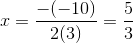
To find the y-coordinate, plug 

Therefore the vertex is at 
What are the 


There are no 
Explanation
To find the x-intercepts of the equation, we set the numerator equal to zero.


What are the
There are no
Explanation
To find the x-intercepts of the equation, we set the numerator equal to zero.
Consider the following two functions:


How is the function 


Explanation
The 


Based on the figure below, which line depicts a quadratic function?

Red line
Blue line
Green line
Purple line
None of them
Explanation
A parabola is one example of a quadratic function, regardless of whether it points upwards or downwards.
The red line represents a quadratic function and will have a formula similar to 
The blue line represents a linear function and will have a formula similar to 
The green line represents an exponential function and will have a formula similar to 
The purple line represents an absolute value function and will have a formula similar to 
Consider the equation:
The vertex of this parabolic function would be located at:
Explanation
For any parabola, the general equation is
For the given problem, the x-coordinate is
To find the y-coordinate, plug
Therefore the vertex is at
Consider the following two functions:
How is the function
Explanation
The
Based on the figure below, which line depicts a quadratic function?
Red line
Blue line
Green line
Purple line
None of them
Explanation
A parabola is one example of a quadratic function, regardless of whether it points upwards or downwards.
The red line represents a quadratic function and will have a formula similar to
The blue line represents a linear function and will have a formula similar to
The green line represents an exponential function and will have a formula similar to
The purple line represents an absolute value function and will have a formula similar to
What is the equation of a parabola with vertex 


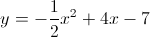
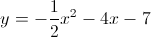
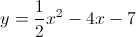
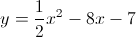
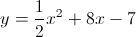
Explanation
From the vertex, we know that the equation of the parabola will take the form 

To calculate that 







Now the equation is 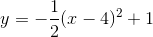
Expand the squared term:

Distribute the fraction through the parentheses:
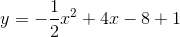
Combine like terms:
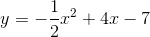
Which of the following functions represents a parabola?



Explanation
A parabola is a curve that can be represented by a quadratic equation. The only quadratic here is represented by the function 