
Other Factorials
Algebra 2 · Learn by Concept
Help Questions
Algebra 2 › Other Factorials
What is the value of 
24
4
10
12
6
Explanation
! is the symbol for factorial, which means the product of the whole numbers less than the given number.
Thus, 
Evaluate:


None of the other choices gives the correct response.
Explanation


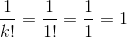

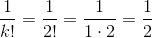

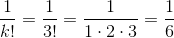


Add the terms:
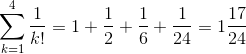
What is 


Explanation
Remember that factorial is defined as:

So using this definition,

And 
So

The 7, 6, 5, 4, 3, 2, and 1 all cancel from both the numerator and denominator. So we're left with just 

Try without a calculator:


None of these
Explanation



and



the correct response.
Multiply:



Explanation
Simplify all the terms in the parentheses first.


This indicates that:


The answer is:

Try without a calculator.

Give the value of 


The inequality has no solution.
Explanation
Given a nonnegative integer 



Multiplying by 8, we find that

Multiplying by 9, we find that

Therefore,

Since only integers may have factorial values, it follows that the only value of 

Compute:


Explanation
Simplify the factorials in the numerator and denominator.

Simplify the terms on the top and bottom.


The answer is:

Simplify:


Explanation
Write out the terms of each factorial in expanded form. The only exception is the zero factorial, which is equal to one.

Simplify the terms. The values in the numerator and denominator cannot cancel out!

The correct answer is:

Try without a calculator:
True or false:

False
True
Explanation


Since 

and

Try without a calculator:
Calculate:


Cannot be determined
Explanation

Therefore,

Since

it follows that 720 is the correct response.