
Simplifying Expressions - Algebra 2
Card 1 of 292
Simplify x(4 – x) – x(3 – x).
Simplify x(4 – x) – x(3 – x).
Tap to reveal answer
You must multiply out the first set of parenthesis (distribute) and you get 4x – x2. Then multiply out the second set and you get –3x + x2. Combine like terms and you get x.
x(4 – x) – x(3 – x)
4x – x2 – x(3 – x)
4x – x2 – (3x – x2)
4x – x2 – 3x + x2 = x
You must multiply out the first set of parenthesis (distribute) and you get 4x – x2. Then multiply out the second set and you get –3x + x2. Combine like terms and you get x.
x(4 – x) – x(3 – x)
4x – x2 – x(3 – x)
4x – x2 – (3x – x2)
4x – x2 – 3x + x2 = x
← Didn't Know|Knew It →
Expand: 
Expand:
Tap to reveal answer
To expand, multiply 8x by both terms in the expression (3x + 7).
8x multiplied by 3x is 24x².
8x multiplied by 7 is 56x.
Therefore, 8x(3x + 7) = 24x² + 56x.
To expand, multiply 8x by both terms in the expression (3x + 7).
8x multiplied by 3x is 24x².
8x multiplied by 7 is 56x.
Therefore, 8x(3x + 7) = 24x² + 56x.
← Didn't Know|Knew It →
Divide  by
by  .
.
Divide
Tap to reveal answer
First, set up the division as the following:

Look at the leading term  in the divisor and
  in the dividend. Divide
  by
by  gives
gives  ; therefore, put
  on the top:

Then take that  and multiply it by the divisor,
  , to get
  . Place that
  under the division sign:

Subtract the dividend by that same  and place the result at the bottom. The new result is
  , which is the new dividend.

Now,  is the new leading term of the dividend. Dividing
  by
by  gives 5. Therefore, put 5 on top:

Multiply that 5 by the divisor and place the result,  , at the bottom:

Perform the usual subtraction:

Therefore the answer is  with a remainder of
  , or
, or  .
.
First, set up the division as the following:
Look at the leading term
Then take that
Subtract the dividend by that same
Now,
Multiply that 5 by the divisor and place the result,
Perform the usual subtraction:
Therefore the answer is
← Didn't Know|Knew It →
Simplify the expression.

Simplify the expression.
Tap to reveal answer
When multiplying exponential components, you must add the powers of each term together.


When multiplying exponential components, you must add the powers of each term together.
← Didn't Know|Knew It →
Simplify the expression.

Simplify the expression.
Tap to reveal answer
When simplifying polynomials, only combine the variables with like terms.
 can be added to
  , giving
  .
.
 can be subtracted from
  to give
  .
.
Combine both of the terms into one expression to find the answer: 
When simplifying polynomials, only combine the variables with like terms.
Combine both of the terms into one expression to find the answer:
← Didn't Know|Knew It →
Simplify:

Simplify:
Tap to reveal answer
First, distribute –5 through the parentheses by multiplying both terms by –5.

Then, combine the like-termed variables (–5x and –3x).

First, distribute –5 through the parentheses by multiplying both terms by –5.
Then, combine the like-termed variables (–5x and –3x).
← Didn't Know|Knew It →
Find the product:

Find the product:
Tap to reveal answer
First, mulitply the mononomial by the first term of the polynomial:

Second, multiply the monomial by the second term of the polynomial:

Add the terms together:

First, mulitply the mononomial by the first term of the polynomial:
Second, multiply the monomial by the second term of the polynomial:
Add the terms together:
← Didn't Know|Knew It →
Evaluate the following to its simplest form:

Evaluate the following to its simplest form:
Tap to reveal answer

First we will foil the first function before distributing.


We will then distribute out the 

We will then distribute out the 

Now the only like terms we have are  and
and  , so our final answer is:

First we will foil the first function before distributing.
We will then distribute out the
We will then distribute out the
Now the only like terms we have are
← Didn't Know|Knew It →
Simplify:

Simplify:
Tap to reveal answer
 . However,
  cannot be simplified any further because the terms have different exponents.
(Like terms are terms that have the same variables with the same exponents. Only like terms can be combined together.)
(Like terms are terms that have the same variables with the same exponents. Only like terms can be combined together.)
← Didn't Know|Knew It →
Find the product: 
Find the product:
Tap to reveal answer
 times
times  gives us
  , while
  times 4 gives us
  . So it equals
  .
.
← Didn't Know|Knew It →
Simplify: 
Simplify:
Tap to reveal answer
 and
and  cancel out, leaving
  in the numerator. 5 and 25 cancel out, leaving 5 in the denominator
← Didn't Know|Knew It →
Simplify the expression: 
Simplify the expression:
Tap to reveal answer
 distributes to
  , multiplying to become
  , and
, and  distributes to
  , multiplying to make
  .
.
← Didn't Know|Knew It →
Distribute:

Distribute:
Tap to reveal answer
Be sure to distribute the  along with its coefficient.
Be sure to distribute the
← Didn't Know|Knew It →
Simplify the following:

Simplify the following:
Tap to reveal answer

First, FOIL the two binomials:

Then distribute the  through the terms in parentheses:

Combine like terms:

First, FOIL the two binomials:
Then distribute the
Combine like terms:
← Didn't Know|Knew It →
Simplify the following:

Simplify the following:
Tap to reveal answer

First we will factor the numerator:

Then factor the denominator:

We can re-write the original fraction with these factors and then cancel an (x-5) term from both parts:

First we will factor the numerator:
Then factor the denominator:
We can re-write the original fraction with these factors and then cancel an (x-5) term from both parts:
← Didn't Know|Knew It →
Simplify the following:

Simplify the following:
Tap to reveal answer

First, let us factor the numerator:

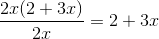
First, let us factor the numerator:
← Didn't Know|Knew It →

Tap to reveal answer
When multiplying polynomials, add the powers of each like-termed variable together.
For x: 5 + 2 = 7
For y: 17 + 2 = 19
Therefore the answer is  .
.
When multiplying polynomials, add the powers of each like-termed variable together.
For x: 5 + 2 = 7
For y: 17 + 2 = 19
Therefore the answer is
← Didn't Know|Knew It →
Simplify the expression:

Simplify the expression:
Tap to reveal answer
When dividing polynomials, subtract the exponent of the variable in the numberator by the exponent of the same variable in the denominator.
If the power is negative, move the variable to the denominator instead.
First move the negative power in the numerator to the denominator:

Then subtract the powers of the like variables:

When dividing polynomials, subtract the exponent of the variable in the numberator by the exponent of the same variable in the denominator.
If the power is negative, move the variable to the denominator instead.
First move the negative power in the numerator to the denominator:
Then subtract the powers of the like variables:
← Didn't Know|Knew It →
Expand:

Expand:
Tap to reveal answer
First, FOIL:

Simplify:

Distribute the  through the parentheses:

Rewrite to make the expression look like one of the answer choices:

First, FOIL:
Simplify:
Distribute the
Rewrite to make the expression look like one of the answer choices:
← Didn't Know|Knew It →
Multiply, expressing the product in simplest form:

Multiply, expressing the product in simplest form:
Tap to reveal answer
Cross-cancel the coefficients by dividing both 15 and 25 by 5, and both 14 and 21 by 7:

Now use the quotient rule on the variables by subtracting exponents:

Cross-cancel the coefficients by dividing both 15 and 25 by 5, and both 14 and 21 by 7:
Now use the quotient rule on the variables by subtracting exponents:
← Didn't Know|Knew It →