
Solving and Graphing Radicals - Algebra 2
Card 1 of 496
State the domain of the function:
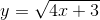
State the domain of the function:
Tap to reveal answer
Since the expression under the radical cannot be negative,
 .
.
Solve for x:

This is the domain, or possible  values, for the function.
Since the expression under the radical cannot be negative,
Solve for x:
This is the domain, or possible
← Didn't Know|Knew It →
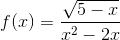
Which of the following choices correctly describes the domain of the graph of the function?
Which of the following choices correctly describes the domain of the graph of the function?
Tap to reveal answer
Because the term  inside the radical in the numerator has to be greater than or equal to zero, there is a restriction on our domain; to describe this restriction we solve the inequality for
  :
:

Add  to both sides, and the resulting inequality is:
 or
or 
Next, we consider the denominator, a quadratic; we know that we cannot divide by zero, so we must find x-values that make the denominator equal zero, and exclude them from our domain:

We factor an  out of both
  and
and  :
:

Finding the zeroes of our expression leaves us with:

Therefore, there are 3 restrictions on the domain of the function:

Because the term
Add
Next, we consider the denominator, a quadratic; we know that we cannot divide by zero, so we must find x-values that make the denominator equal zero, and exclude them from our domain:
We factor an
Finding the zeroes of our expression leaves us with:
Therefore, there are 3 restrictions on the domain of the function:
← Didn't Know|Knew It →
Which of the following is the graph of  ?
?
Which of the following is the graph of 
Tap to reveal answer
The graph of  is:
is:
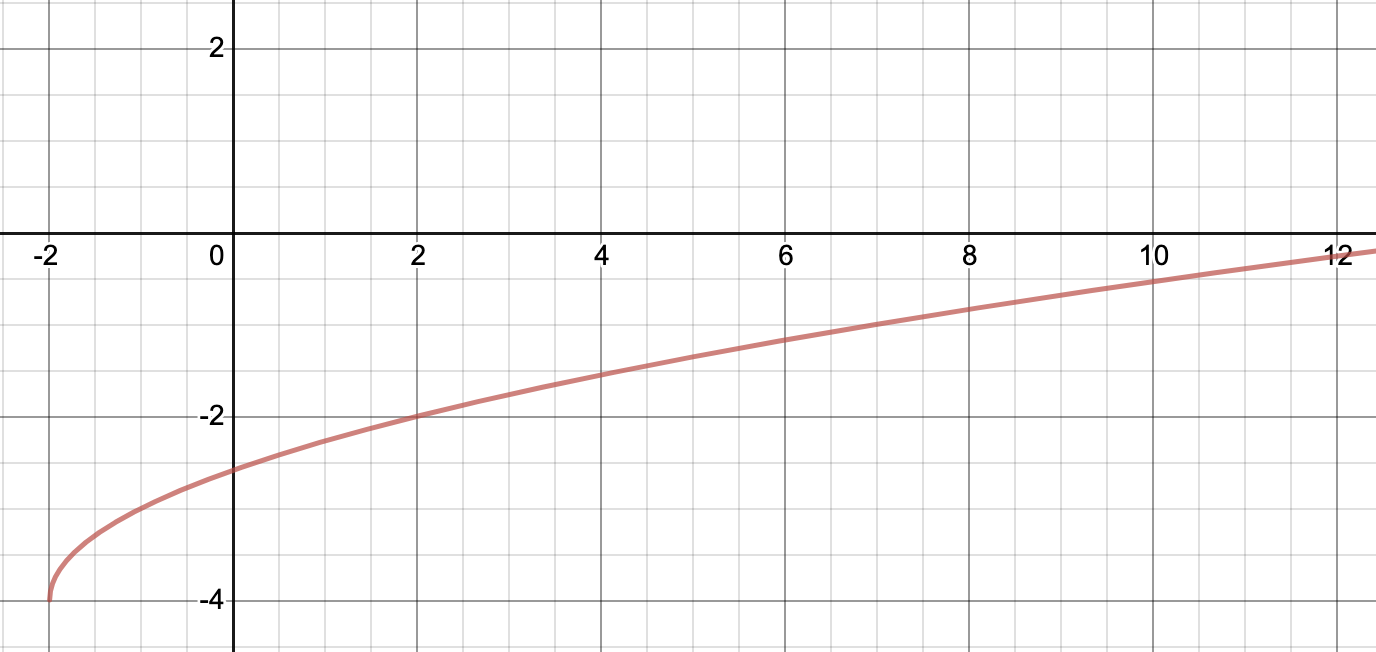
This graph is translated 2 units left and 4 units down from the graph of  , which looks like:
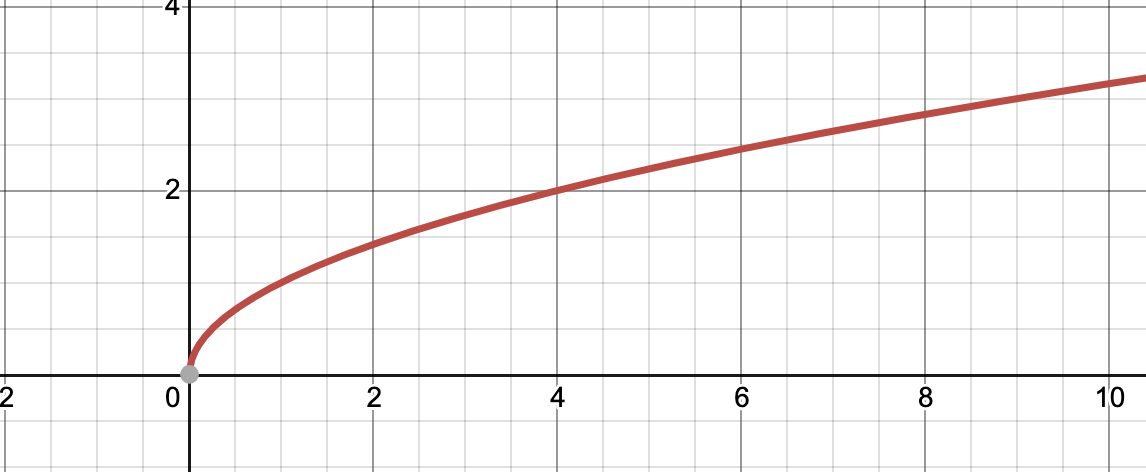
The number 4 and its associated negative sign, which fall outside of the square root, tell us that we need to shift the graph down four units. If you take what's under the square root, set it equal to 0, then solve, you'll get x=-2, which you can interpret as being shifted left two units.
Each of the graphs below that are incorrect either improperly shift the graph right (instead of left), up (instead of down), or both right and up.
The graph of 
This graph is translated 2 units left and 4 units down from the graph of 
The number 4 and its associated negative sign, which fall outside of the square root, tell us that we need to shift the graph down four units. If you take what's under the square root, set it equal to 0, then solve, you'll get x=-2, which you can interpret as being shifted left two units.
Each of the graphs below that are incorrect either improperly shift the graph right (instead of left), up (instead of down), or both right and up.
← Didn't Know|Knew It →
Is the following graph a function?
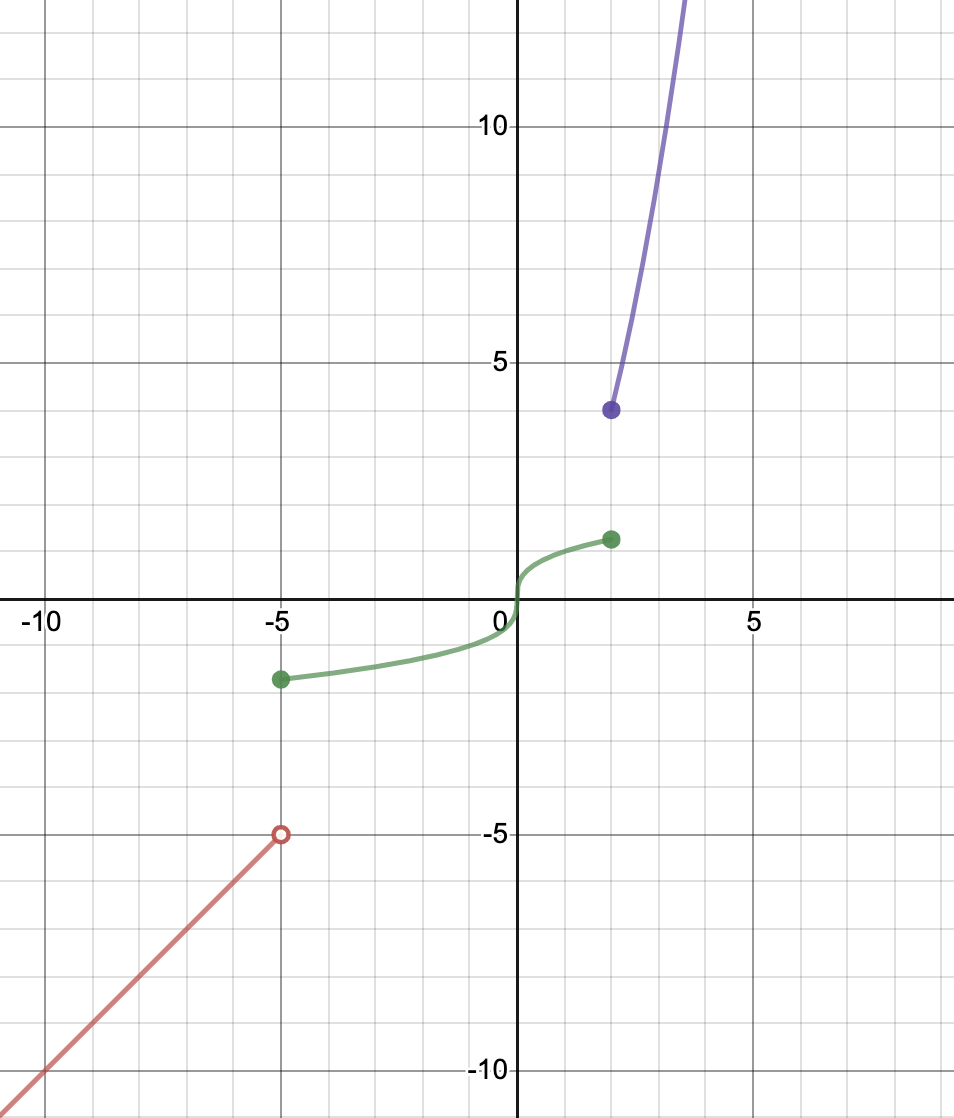
Is the following graph a function?
Tap to reveal answer
The above graph is not a function. In order to be a function, the graph must pass the vertical line test. If you look at x=2, you can see that x=2 is a value on both the green graph and the purple graph. Therefore it fails to pass the vertical line test and is not a function.
The above graph is not a function. In order to be a function, the graph must pass the vertical line test. If you look at x=2, you can see that x=2 is a value on both the green graph and the purple graph. Therefore it fails to pass the vertical line test and is not a function.
← Didn't Know|Knew It →
Is the following graph a function?
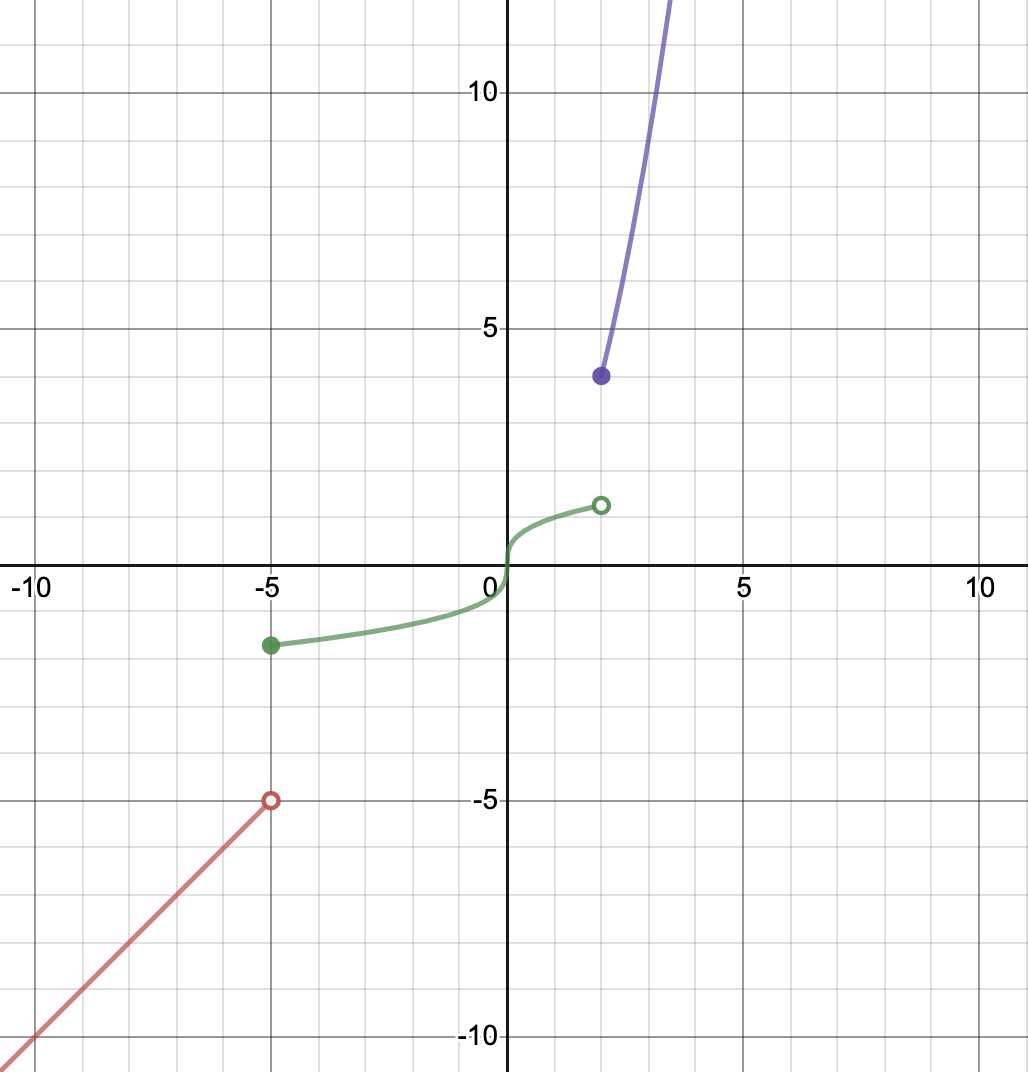
Is the following graph a function?
Tap to reveal answer
This graph is a function. We call this type of function a piecewise (or step) function. This type of function is defined in a certain way for certain x values, and then in a different way for different x values. However, it still passes the vertical line test, so it is a function!
This graph is a function. We call this type of function a piecewise (or step) function. This type of function is defined in a certain way for certain x values, and then in a different way for different x values. However, it still passes the vertical line test, so it is a function!
← Didn't Know|Knew It →
What is the domain and range of this piecewise function?
What is the domain and range of this piecewise function?
Tap to reveal answer
Firstly, this is a function as it passes the vertical line test.
To find the domain, begin at the far left of the graph, starting with the red portion. You can trace along it continuously until you get to the point (-5,-5). At this point, it jumps upward to the green graph. While the y values jump, there is no gap in the x values. You can trace from left to right along the green graph until you get to x=2. Then, the graph jumps up to the purple values. Once again, there is no gap in the x values. The purple graph is continuous and goes onwards to positive infinity. Therefore, the domain of this graph is all real numbers or  .
.
Next, let's start again at the bottom of the graph (in red), this time looking at the y values. We begin at negative infinity and can trace continuously until we get to the point (-5,-5). There is a discontinuity between the red and green graphs' y values. We use the  symbol ("union") to connect the disconnected parts of the graph. The green graph picks up at -1.71 and the y values continue upward until they get to 1.256. Once again, there is a discontinuity in the range, so we again use the union symbol. The y values pick back up at the point (2,4) and continue upwards to infinity. Therefore the range of this function is
  .
.
Firstly, this is a function as it passes the vertical line test.
To find the domain, begin at the far left of the graph, starting with the red portion. You can trace along it continuously until you get to the point (-5,-5). At this point, it jumps upward to the green graph. While the y values jump, there is no gap in the x values. You can trace from left to right along the green graph until you get to x=2. Then, the graph jumps up to the purple values. Once again, there is no gap in the x values. The purple graph is continuous and goes onwards to positive infinity. Therefore, the domain of this graph is all real numbers or 
Next, let's start again at the bottom of the graph (in red), this time looking at the y values. We begin at negative infinity and can trace continuously until we get to the point (-5,-5). There is a discontinuity between the red and green graphs' y values. We use the 
← Didn't Know|Knew It →
Which of the following is the graph of  ?
?
Which of the following is the graph of 
Tap to reveal answer
The graph of  is
is
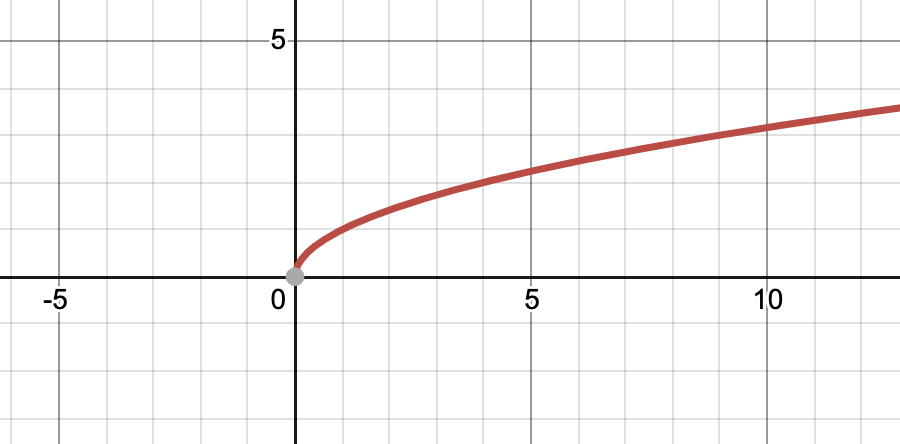
Keep in mind that you cannot put a negative number under a square root and get a real number answer. If we tried to plug in -2 for x, it would be undefined. That is why the graph only shows positive values of x.
The other graphs pictured below are  ,
,  , and
, and  .
.
The graph of 
Keep in mind that you cannot put a negative number under a square root and get a real number answer. If we tried to plug in -2 for x, it would be undefined. That is why the graph only shows positive values of x.
The other graphs pictured below are 

← Didn't Know|Knew It →
Which of the following is the graph of  ?
?
Which of the following is the graph of 
Tap to reveal answer
The graph of  is
is
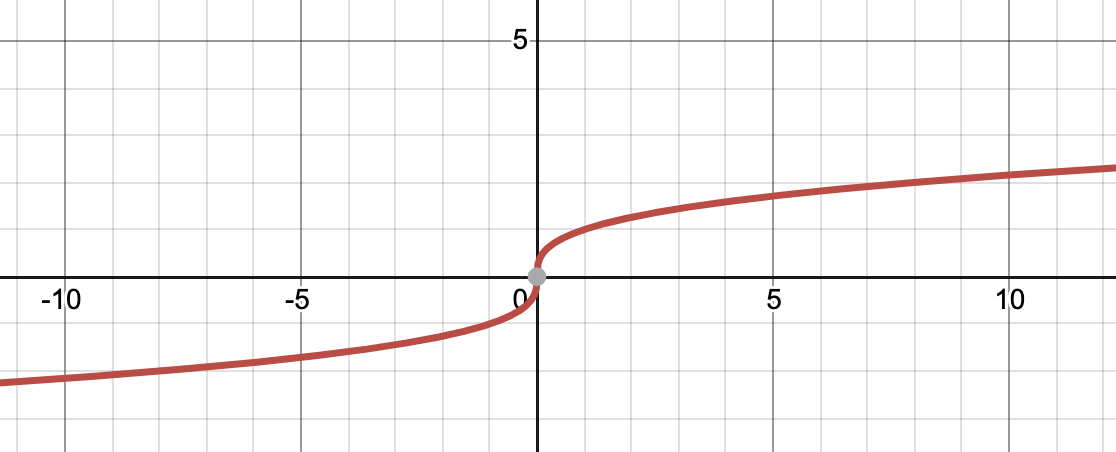 .
.
The other graphs shown are those of  ,
,  , and
, and  .
.
The graph of 
.
The other graphs shown are those of 

← Didn't Know|Knew It →
Which of the following is the graph of  ?
?
Which of the following is the graph of 
Tap to reveal answer
The graph of  is
is
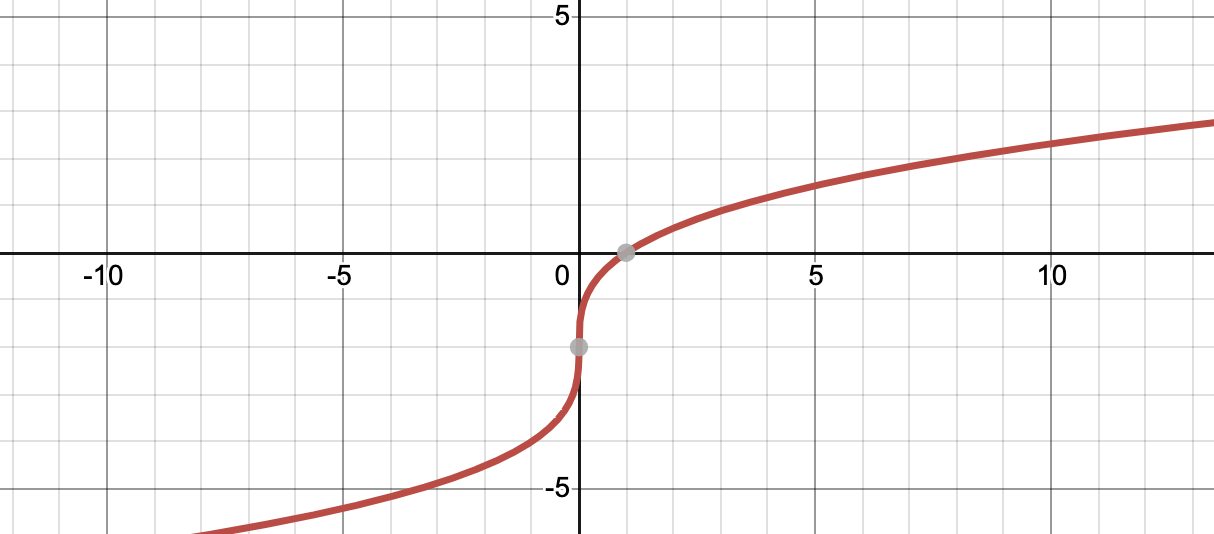
The other graphs pictured are  ,
,  , and
, and  .
.
The graph of 
The other graphs pictured are 


← Didn't Know|Knew It →
State the x-intercept, y-intercept, domain, and range of the function  , pictured below.
State the x-intercept, y-intercept, domain, and range of the function 
Tap to reveal answer
This graph crosses the x axis only once and the y axis only once, and these happen to coincide at the point (0,0). Therefore the x-intercept is at x=0 and the y-intercept is at y=0. The graph will go on infinitely to both the left and the right. Additionally (and despite the fact that it won't happen as quickly), the graph also will go infinitely high in both its positive and negative y values. Therefore, both the domain and range of this graph are  .
.
This graph crosses the x axis only once and the y axis only once, and these happen to coincide at the point (0,0). Therefore the x-intercept is at x=0 and the y-intercept is at y=0. The graph will go on infinitely to both the left and the right. Additionally (and despite the fact that it won't happen as quickly), the graph also will go infinitely high in both its positive and negative y values. Therefore, both the domain and range of this graph are 
← Didn't Know|Knew It →
State the x-intercept, y-intercept, domain, and range of the function  , pictured below.
State the x-intercept, y-intercept, domain, and range of the function 
Tap to reveal answer
This graph intersects the x axis only once and the y axis only once, and these happen to coincide at the point (0,0). Therefore the x-intercept is at x=0 and the y-intercept is at y=0. The graph will go on infinitely to the right. However, the leftmost point is (0,0.) Likewise, the graph will go infinitely high, but its lowest point is also (0,0). Therefore, its domain is  and its range is also
  .
.
This graph intersects the x axis only once and the y axis only once, and these happen to coincide at the point (0,0). Therefore the x-intercept is at x=0 and the y-intercept is at y=0. The graph will go on infinitely to the right. However, the leftmost point is (0,0.) Likewise, the graph will go infinitely high, but its lowest point is also (0,0). Therefore, its domain is 

← Didn't Know|Knew It →
Solve: 
Solve:
Tap to reveal answer
Add three on both sides.

The equation becomes:

Square both sides to eliminate the radical.


Add three on both sides.


Divide by three on both sides.

The answer is: 
Add three on both sides.
The equation becomes:
Square both sides to eliminate the radical.
Add three on both sides.
Divide by three on both sides.
The answer is:
← Didn't Know|Knew It →
Solve the equation: 
Solve the equation:
Tap to reveal answer
Subtract  from both sides to group the radicals.


Square both sides.

Use the FOIL method to simplify the right side.


Combine like-terms.

Subtract one from both sides, and add  on both sides.
The equation becomes: 
Divide by two on both sides and distribute the terms inside the radical.

Square both sides.

Simplify the right side by FOIL method.

Subtract  on both sides. This is the same as subtracting
  on both sides.


Subtract  on both sides. The equation will become:

Multiply by four on both sides to eliminate the fractional denominator.


Use the quadratic equation to solve for the roots.

Simplify the radical and fraction.


Substitute the values of  and
and  back into the original equation, and only
  will satisfy both sides of the equation.
The answer is: 
Subtract
Square both sides.
Use the FOIL method to simplify the right side.
Combine like-terms.
Subtract one from both sides, and add
The equation becomes:
Divide by two on both sides and distribute the terms inside the radical.
Square both sides.
Simplify the right side by FOIL method.
Subtract
Subtract
Multiply by four on both sides to eliminate the fractional denominator.
Use the quadratic equation to solve for the roots.
Simplify the radical and fraction.
Substitute the values of
The answer is:
← Didn't Know|Knew It →
Solve the equation: 
Solve the equation:
Tap to reveal answer
Divide by two on both sides.

The equation becomes: 
Square both sides.


Add three on both sides.

Divide by two on both sides.

The answer is: 
Divide by two on both sides.
The equation becomes:
Square both sides.
Add three on both sides.
Divide by two on both sides.
The answer is:
← Didn't Know|Knew It →
Solve for  :
:

Solve for
Tap to reveal answer
One way to solve this equation is to substitute  for
for  and, subsequently,
  for
for  :
:


Solve the resulting quadratic equation by factoring the expression:

Set each linear binomial to sero and solve:


or


Substitute back:

 - this is not possible.


 - this is the only solution.
None of the responses state that  is the only solution.
One way to solve this equation is to substitute
Solve the resulting quadratic equation by factoring the expression:
Set each linear binomial to sero and solve:
or
Substitute back:
None of the responses state that
← Didn't Know|Knew It →
If  , then
  ?
?
If 
Tap to reveal answer
We will begin by adding 5 to both sides of the equation.


Next, let's square both sides to eliminate the radical.


Finally, we can solve this like a simple two-step equation. Subtract 3 from both sides of the equation.


Now, divide each side by 2.


Finally, check the solution to make sure that it results in a true statement.


We will begin by adding 5 to both sides of the equation.


Next, let's square both sides to eliminate the radical.


Finally, we can solve this like a simple two-step equation. Subtract 3 from both sides of the equation.

Now, divide each side by 2.

Finally, check the solution to make sure that it results in a true statement.


← Didn't Know|Knew It →
Solve the following radical equation.

Solve the following radical equation.
Tap to reveal answer
We can simplify the fraction:

Plugging this into the equation leaves us with:

Note: Because they are like terms, we can add them.
We can simplify the fraction:
Plugging this into the equation leaves us with:
Note: Because they are like terms, we can add them.
← Didn't Know|Knew It →
Solve the following radical equation.

Solve the following radical equation.
Tap to reveal answer
In order to solve this equation, we need to know that

How? Because of these two facts:

- Power rule of exponents: when we raise a power to a power, we need to mulitply the exponents:

With this in mind, we can solve the equation:

In order to eliminate the radical, we have to square it. What we do on one side, we must do on the other.


In order to solve this equation, we need to know that
How? Because of these two facts:
- Power rule of exponents: when we raise a power to a power, we need to mulitply the exponents:
With this in mind, we can solve the equation:
In order to eliminate the radical, we have to square it. What we do on one side, we must do on the other.
← Didn't Know|Knew It →
Solve the following radical equation.

Solve the following radical equation.
Tap to reveal answer
In order to solve this equation, we need to know that

Note: This is due to the power rule of exponents.
With this in mind, we can solve the equation:

In order to get rid of the radical we square it. Remember what we do on one side, we must do on the other.


In order to solve this equation, we need to know that
Note: This is due to the power rule of exponents.
With this in mind, we can solve the equation:
In order to get rid of the radical we square it. Remember what we do on one side, we must do on the other.
← Didn't Know|Knew It →
Solve for x: 
Solve for x:
Tap to reveal answer
To solve, perform inverse opperations, keeping in mind order of opperations:
 first, square both sides
 subtract 1
 divide by 2

To solve, perform inverse opperations, keeping in mind order of opperations:
← Didn't Know|Knew It →