
Negative Exponents - Algebra 2
Card 1 of 472
Evaluate 
Evaluate
Tap to reveal answer
When dealing with exponents, always turn it into this form:

 represents the base of the exponent, and
  is the power in a positive value.

When dealing with exponents, always turn it into this form:
← Didn't Know|Knew It →
Evaluate 
Evaluate
Tap to reveal answer
When dealing with exponents, always turn it into this form:
represents the base of the exponent, and is the power in a positive value.
 It is important to keep the paranthesis as we are squaring
  which makes our answer.
When dealing with exponents, always turn it into this form:
← Didn't Know|Knew It →
Evaluate 
Evaluate
Tap to reveal answer
When dealing with exponents, always turn it into this form:
represents the base of the exponent, and is the power in a positive value.
 Our answer is negative because we have an odd exponent.
When dealing with exponents, always turn it into this form:
← Didn't Know|Knew It →
What is  the same as?
What is
Tap to reveal answer
While a positive exponent says how many times to multiply by a number, a negative exponent says how many times to divide by the number.
To solve for negative exponents, just calculate the reciprocal.
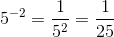
While a positive exponent says how many times to multiply by a number, a negative exponent says how many times to divide by the number.
To solve for negative exponents, just calculate the reciprocal.
← Didn't Know|Knew It →
Solve: 
Solve:
Tap to reveal answer
To evaluate a negative exponent, convert the exponent to positive by taking the inverse.
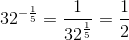
To evaluate a negative exponent, convert the exponent to positive by taking the inverse.
← Didn't Know|Knew It →
Evaluate 
Evaluate
Tap to reveal answer
When dealing with exponents, always turn it into this form:
represents the base of the exponent, and is the power in a positive value.

When dealing with exponents, always turn it into this form:
← Didn't Know|Knew It →
Evaluate  .
.
Evaluate
Tap to reveal answer
When dealing with exponents, always turn it into this form:
represents the base of the exponent, and is the power in a positive value.

When dealing with exponents, always turn it into this form:
← Didn't Know|Knew It →
Evaluate 
Evaluate
Tap to reveal answer
When dealing with exponents, always turn it into this form:
represents the base of the exponent, and is the power in a positive value.

When dealing with exponents, always turn it into this form:
← Didn't Know|Knew It →
Simplify the following expression

Simplify the following expression
Tap to reveal answer

← Didn't Know|Knew It →
Simplify the following expression:

Simplify the following expression:
Tap to reveal answer

← Didn't Know|Knew It →
Solve for  :
:

Solve for
Tap to reveal answer
Raise both sides of the equation to the inverse power of  to cancel the exponent on the left hand side of the equation.


Subtract  from both sides:


Raise both sides of the equation to the inverse power of
Subtract
← Didn't Know|Knew It →
Simplify the following expression

Simplify the following expression
Tap to reveal answer

← Didn't Know|Knew It →
Simplify the following expression
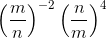
Simplify the following expression
Tap to reveal answer

← Didn't Know|Knew It →
Simplify the following expression
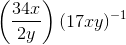
Simplify the following expression
Tap to reveal answer

← Didn't Know|Knew It →
Represent the fraction using only positive exponents:

Represent the fraction using only positive exponents:
Tap to reveal answer

Negative exponents are the reciprocal of their positive counterpart. For example:

Therefore:
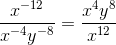
This simplifies to**:**

Negative exponents are the reciprocal of their positive counterpart. For example:
Therefore:
This simplifies to**:**
← Didn't Know|Knew It →
Solve the equation for n:

Solve the equation for n:
Tap to reveal answer
Rewrite the right-hand-side so that each side has the same base:

Use the Property of Equality for Exponential Functions:

Solving for  :
:

Rewrite the right-hand-side so that each side has the same base:
Use the Property of Equality for Exponential Functions:
Solving for
← Didn't Know|Knew It →
Simplify:

Simplify:
Tap to reveal answer
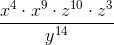
To simplify this expression, first make all of the negative exponents positive. That means putting them in the opposite position (if they're in the numerator, put it in the denominator and vice versa).
It should then look like:
 .
.
Then, combine like terms. Remember, if bases are the same, add exponents!
Therefore, your answer is:

To simplify this expression, first make all of the negative exponents positive. That means putting them in the opposite position (if they're in the numerator, put it in the denominator and vice versa).
It should then look like:
Then, combine like terms. Remember, if bases are the same, add exponents!
Therefore, your answer is:
← Didn't Know|Knew It →
Simplify the expression: 
Simplify the expression:
Tap to reveal answer
A negative exponent is resolved by taking the reciprocal. For example  .
.

start by making all the negative exponents positive ones:
 Note that the whole fraction on the left could have also been written as being divided by a^2 where the one is simply in the denominator, but it is necessary to understand that dividing by a fraction is the same as multiplying by one which occurs in the next step.

Use the multiplication rule of exponents and simplify the constant:

A negative exponent is resolved by taking the reciprocal. For example
start by making all the negative exponents positive ones:
Use the multiplication rule of exponents and simplify the constant:
← Didn't Know|Knew It →
Simplify: 
Simplify:
Tap to reveal answer
First, make all of the negative exponents positive. To do this, put it in the opposite location (if in the numerator, place in the denominator). This should look like:  . Then, simplify each term. Remember, when multiplying and bases are the same, add exponents. Therefore, your final answer should be:
  .
.
First, make all of the negative exponents positive. To do this, put it in the opposite location (if in the numerator, place in the denominator). This should look like:
← Didn't Know|Knew It →
Evaluate 
Evaluate
Tap to reveal answer
When dealing with exponents, always turn it into this form:
represents the base of the exponent, and is the power in a positive value.

When dealing with exponents, always turn it into this form:
← Didn't Know|Knew It →