
Summations and Sequences - Algebra 2
Card 1 of 580


Tap to reveal answer


← Didn't Know|Knew It →
Which of the following is a geometric sequence?
Which of the following is a geometric sequence?
Tap to reveal answer
A geometric sequence is one in which the next term is found by mutlplying the previous term by a particular constant. Thus, we look for an implicit definition which involves multiplication of the previous term. The only possibility is:


A geometric sequence is one in which the next term is found by mutlplying the previous term by a particular constant. Thus, we look for an implicit definition which involves multiplication of the previous term. The only possibility is:
← Didn't Know|Knew It →
Which of the following could be the formula for a geometric sequence?
Which of the following could be the formula for a geometric sequence?
Tap to reveal answer
The explicit formula for a geometric series is  .
.
Therefore,  is the only answer that works.
The explicit formula for a geometric series is
Therefore,
← Didn't Know|Knew It →
Find the sum for the first 25 terms in the series 
Find the sum for the first 25 terms in the series
Tap to reveal answer
Before we add together the first 25 terms, we need to determine the structure of the series. We know the first term is 60. We can find the common ratio r by dividing the second term by the first:

We can use the formula  where A is the first term.
The terms we are adding together are  so we can plug in
  :
:

Common mistakes would involve order of operations - make sure you do exponents first, then subtract, then multiply/divide based on what is grouped together.
Before we add together the first 25 terms, we need to determine the structure of the series. We know the first term is 60. We can find the common ratio r by dividing the second term by the first:
We can use the formula
The terms we are adding together are
Common mistakes would involve order of operations - make sure you do exponents first, then subtract, then multiply/divide based on what is grouped together.
← Didn't Know|Knew It →
Give the 33rd term of the Geometric Series

\[2 is the first term\]
Give the 33rd term of the Geometric Series
\[2 is the first term\]
Tap to reveal answer
First we need to find the common ratio by dividing the second term by the first:

The  term is
 ,
,
so the 33rd term will be
 .
.
First we need to find the common ratio by dividing the second term by the first:
The
so the 33rd term will be
← Didn't Know|Knew It →
Find the 19th term of the sequence 
\[the first term is 7,000\]
Find the 19th term of the sequence
\[the first term is 7,000\]
Tap to reveal answer
First find the common ratio by dividing the second term by the first:

Since the first term is  , the nth term can be found using the formula

 ,
,
so the 19th term is 
First find the common ratio by dividing the second term by the first:
Since the first term is
so the 19th term is
← Didn't Know|Knew It →
Find the 21st term of the sequence 
\[90 is 1st, so n=1\]
Find the 21st term of the sequence
\[90 is 1st, so n=1\]
Tap to reveal answer
First, find the common ratio by dividing the second term by the first:

The nth term can be found using

 ,
,
so the 21st term is
 .
.
First, find the common ratio by dividing the second term by the first:
The nth term can be found using
so the 21st term is
← Didn't Know|Knew It →
Find the 26th term of the sequence 
Find the 26th term of the sequence
Tap to reveal answer
First we need to find the common ratio, which we can do by dividing the second term by the first:

The first term is  , the second term is
  , so the 26th term is
First we need to find the common ratio, which we can do by dividing the second term by the first:
The first term is
← Didn't Know|Knew It →
Find the common ratio for this geometric series:

Find the common ratio for this geometric series:
Tap to reveal answer
Find the common ratio for this geometric series:

The common ratio of a geometric series can be found by dividing any term by the term before it. More generally:

So, do try the following:

So our common ratio is 7
Find the common ratio for this geometric series:
The common ratio of a geometric series can be found by dividing any term by the term before it. More generally:
So, do try the following:
So our common ratio is 7
← Didn't Know|Knew It →
Find the next term in this geometric series:

Find the next term in this geometric series:
Tap to reveal answer
Find the next term in this geometric series:

to find the next term, we must first find the common ratio.
The common ratio of a geometric series can be found by dividing any term by the term before it. More generally:

So, do try the following:

So our common ratio is 7
Next, find the next term in the series by multiplying our last term by 7

Making our next term 16807
Find the next term in this geometric series:
to find the next term, we must first find the common ratio.
The common ratio of a geometric series can be found by dividing any term by the term before it. More generally:
So, do try the following:
So our common ratio is 7
Next, find the next term in the series by multiplying our last term by 7
Making our next term 16807
← Didn't Know|Knew It →
What is  if
if  and
and  ?
?
What is
Tap to reveal answer
Use the geometric series summation formula.

Substitute  into
into  , and replace the
  and
and  terms. The value of
  is two.

Simplify the terms on the right and solve for  .
.


Rewrite the complex fraction using a division sign.

Change the sign from division to a multiplication sign and switch the second term.

Simplify the terms inside the parentheses.

Isolate the variable by multiplying six-seventh on both sides.

Simplify both sides.

The answer is: 
Use the geometric series summation formula.
Substitute
Simplify the terms on the right and solve for
Rewrite the complex fraction using a division sign.
Change the sign from division to a multiplication sign and switch the second term.
Simplify the terms inside the parentheses.
Isolate the variable by multiplying six-seventh on both sides.
Simplify both sides.
The answer is:
← Didn't Know|Knew It →
What is the next term given the following terms? 
What is the next term given the following terms?
Tap to reveal answer
Divide the second term with the first term, and the third term with the second term.


The common ratio of this geometric sequence is four.
Multiply the third term by four.

The answer is: 
Divide the second term with the first term, and the third term with the second term.
The common ratio of this geometric sequence is four.
Multiply the third term by four.
The answer is:
← Didn't Know|Knew It →
Determine the 10th term if the first term is  and the common ratio is
  . Answer in scientific notation.
Determine the 10th term if the first term is
Tap to reveal answer
Write the formula to find the n-th term for a geometric sequence.

Substitute the known values into the equation.

This fraction is equivalent to: 
The 19th term is: 
Write the formula to find the n-th term for a geometric sequence.
Substitute the known values into the equation.
This fraction is equivalent to:
The 19th term is:
← Didn't Know|Knew It →
Determine the sum: 
Determine the sum:
Tap to reveal answer
Write the sum formula for a geometric series.


Identify the number of terms that exist.

There are six existing terms: 
Substitute the terms into the formula.


Simplify the complex fraction.

The sum is: 
Write the sum formula for a geometric series.
Identify the number of terms that exist.
There are six existing terms:
Substitute the terms into the formula.
Simplify the complex fraction.
The sum is:
← Didn't Know|Knew It →
If the first term of a geometric sequence is 4, and the common ratio is  , what is the fifth term?
If the first term of a geometric sequence is 4, and the common ratio is
Tap to reveal answer
Write the formula for the n-th term of the geometric sequence.

Substitute the first term and common ratio.
The equation is: 
To find the fifth term, substitute  .
.

The answer is: 
Write the formula for the n-th term of the geometric sequence.
Substitute the first term and common ratio.
The equation is:
To find the fifth term, substitute
The answer is:
← Didn't Know|Knew It →
Given the sequence  , what is the 7th term?
Given the sequence
Tap to reveal answer
The formula for geometric sequences is defined by:

The term  represents the first term, while
  is the common ratio. The term
  represents the terms.
Substitute the known values.

To determine the seventh term, simply substitute  into the expression.

The answer is: 
The formula for geometric sequences is defined by:
The term
Substitute the known values.
To determine the seventh term, simply substitute
The answer is:
← Didn't Know|Knew It →
A sequence begins as follows:

Which statement is true?
A sequence begins as follows:
Which statement is true?
Tap to reveal answer
An arithmetic sequence is one in which each term is generated by adding the same number - the common difference - to the previous term. As can be seen here, the difference between each term and the previous term varies from term to term:


The sequence cannot be arithmetic.
A geometric sequence is one in which each term is generated by multiplying the previous term by the same number - the common ratio. As can be seen here, the ratio of each term to the previous one is the same:


The sequence could be geometric.
An arithmetic sequence is one in which each term is generated by adding the same number - the common difference - to the previous term. As can be seen here, the difference between each term and the previous term varies from term to term:
The sequence cannot be arithmetic.
A geometric sequence is one in which each term is generated by multiplying the previous term by the same number - the common ratio. As can be seen here, the ratio of each term to the previous one is the same:
The sequence could be geometric.
← Didn't Know|Knew It →
A geometric sequence begins as follows:


Which of the following gives the definition of its  th term?
A geometric sequence begins as follows:
Which of the following gives the definition of its
Tap to reveal answer
The  th term of a geometric sequence is

where  is its initial term and
  is the common ratio between the terms.

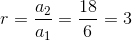
Substituting, the expression becomes

By factoring and remultiplying, this becomes




The
where
Substituting, the expression becomes
By factoring and remultiplying, this becomes
← Didn't Know|Knew It →
What type of sequence is shown below?

What type of sequence is shown below?
Tap to reveal answer
This series is neither geometric nor arithmetic.
A geometric sequences is multiplied by a common ratio ( ) each term. An arithmetic series adds the same additional amount (
 ) to each term. This series does neither.
Mutiplicative and subtractive are not types of sequences.
Therefore, the answer is none of the other answers.
This series is neither geometric nor arithmetic.
A geometric sequences is multiplied by a common ratio (
Mutiplicative and subtractive are not types of sequences.
Therefore, the answer is none of the other answers.
← Didn't Know|Knew It →

What is the explicit formula for the above sequence? What is the 20th value?
What is the explicit formula for the above sequence? What is the 20th value?
Tap to reveal answer
This is a geometric series. The explicit formula for any geometric series is:
 , where
  is the common ratio and
  is the number of terms.
In this instance  and
and  .
.

Substitute  into the equation to find the 20th term:


This is a geometric series. The explicit formula for any geometric series is:
In this instance
Substitute
← Didn't Know|Knew It →