
Radicals - Algebra 2
Card 1 of 1760
Multiply and express the answer in the simplest form:

Multiply and express the answer in the simplest form:
Tap to reveal answer





← Didn't Know|Knew It →

Tap to reveal answer
To solve this expression, multiply the numerator and the denominator by the complex conjugate of the denominator. Since the denominator is  , the complex conjugate of this is
  . Therefore:

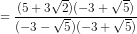


To solve this expression, multiply the numerator and the denominator by the complex conjugate of the denominator. Since the denominator is 

← Didn't Know|Knew It →

Tap to reveal answer
FOIL with difference of squares. The multiplying cancels the square roots on both terms.
FOIL with difference of squares. The multiplying cancels the square roots on both terms.
← Didn't Know|Knew It →
Simplify
Simplify
Tap to reveal answer
To simplify, you must use the Law of Exponents.
First you must multiply the coefficients then add the exponents:
 .
.
To simplify, you must use the Law of Exponents.
First you must multiply the coefficients then add the exponents:
← Didn't Know|Knew It →
Simplify.

Simplify.
Tap to reveal answer
We can solve this by simplifying the radicals first: 
Plugging this into the equation gives us:

We can solve this by simplifying the radicals first:
Plugging this into the equation gives us:
← Didn't Know|Knew It →
Simplify.

Simplify.
Tap to reveal answer
Note: the product of the radicals is the same as the radical of the product:
 which is
Once we understand this, we can plug it into the equation:


Note: the product of the radicals is the same as the radical of the product:
Once we understand this, we can plug it into the equation:
← Didn't Know|Knew It →
Simplify.

Simplify.
Tap to reveal answer
We can simplify the radicals:
 and
and 
Plug in the simplifed radicals into the equation:
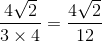

We can simplify the radicals:
Plug in the simplifed radicals into the equation:
← Didn't Know|Knew It →
Simplify and rationalize the denominator if needed,

Simplify and rationalize the denominator if needed,
Tap to reveal answer
We can only simplify the radical in the numerator: 
Plugging in the simplifed radical into the equation we get:

Note: We simplified further because both the numerator and denominator had a "4" which canceled out.
Now we want to rationalize the denominator,
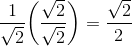
We can only simplify the radical in the numerator:
Plugging in the simplifed radical into the equation we get:
Note: We simplified further because both the numerator and denominator had a "4" which canceled out.
Now we want to rationalize the denominator,
← Didn't Know|Knew It →
What is the product of  and
and  ?
?
What is the product of
Tap to reveal answer
First, simplify  to
to  .
.
Then set up the multiplication problem:
 .
.
Multiply the terms outside of the radical, then the terms under the radical:
 then simplfy:
The radical is still not in its simplest form and must be reduced further:
 . This is the radical in its simplest form.
First, simplify
Then set up the multiplication problem:
Multiply the terms outside of the radical, then the terms under the radical:
The radical is still not in its simplest form and must be reduced further:
← Didn't Know|Knew It →
Simplify

Simplify
Tap to reveal answer
To divide the radicals, simply divide the numbers under the radical and leave them under the radical:

Then simplify this radical:
 .
.
To divide the radicals, simply divide the numbers under the radical and leave them under the radical:
Then simplify this radical:
← Didn't Know|Knew It →
Solve and simplify.

Solve and simplify.
Tap to reveal answer
When multiplying radicals, just take the values inside the radicand and perfom the operation.

 can't be reduced so this is the final answer.
When multiplying radicals, just take the values inside the radicand and perfom the operation.
← Didn't Know|Knew It →
Solve and simplify.

Solve and simplify.
Tap to reveal answer
When multiplying radicals, just take the values inside the radicand and perfom the operation.
In this case, we have a perfect square so simplify that first.
Then, take that answer and multiply that with  to get the final answer.
 .
.
When multiplying radicals, just take the values inside the radicand and perfom the operation.
In this case, we have a perfect square so simplify that first.
Then, take that answer and multiply that with
← Didn't Know|Knew It →
Solve and simplify.

Solve and simplify.
Tap to reveal answer
When dividing radicals, check the denominator to make sure it can be simplified or that there is a radical present that needs to be fixed. Since there is a radical present, we need to eliminate that radical. To do this, we multiply both top and bottom by  . The reason is because we want a whole number in the denominator and multiplying by itself will achieve that. By multiplying itself, it creates a square number which can be reduced to
  .
.

With the denominator being  , the numerator is
  . Final answer is
  .
.
When dividing radicals, check the denominator to make sure it can be simplified or that there is a radical present that needs to be fixed. Since there is a radical present, we need to eliminate that radical. To do this, we multiply both top and bottom by
With the denominator being
← Didn't Know|Knew It →
Solve and simplify.

Solve and simplify.
Tap to reveal answer
When dividing radicals, check the denominator to make sure it can be simplified or that there is a radical present that needs to be fixed.
Both  and
and  are perfect squares so they can be simplify.
Final answer is
 .
.
When dividing radicals, check the denominator to make sure it can be simplified or that there is a radical present that needs to be fixed.
Both
Final answer is
← Didn't Know|Knew It →
Solve and simplify.

Solve and simplify.
Tap to reveal answer
When multiplying radicals, just take the values inside the radicand and perfom the operation.
Since there is a number outside of the radicand, multiply the outside numbers and then the radicand.

When multiplying radicals, just take the values inside the radicand and perfom the operation.
Since there is a number outside of the radicand, multiply the outside numbers and then the radicand.
← Didn't Know|Knew It →
Solve and simplify.

Solve and simplify.
Tap to reveal answer
When multiplying radicals, just take the values inside the radicand and perfom the operation.
Since there is a number outside of the radicand, multiply the outside numbers and then the radicand.

Before we say that's the final answer, check the radicand to see that there are no square numbers that can be factored. A  can be factored and thats a perfect square. When I divide
  with
with  , I get
  which doesn't have perfect square factors.
Therefore, our answer becomes
 .
.
When multiplying radicals, just take the values inside the radicand and perfom the operation.
Since there is a number outside of the radicand, multiply the outside numbers and then the radicand.
Before we say that's the final answer, check the radicand to see that there are no square numbers that can be factored. A
Therefore, our answer becomes
← Didn't Know|Knew It →
Solve and simplify.

Solve and simplify.
Tap to reveal answer
When multiplying radicals, just take the values inside the radicand and perfom the operation.
Since there is a number outside of the radicand, multiply the outside numbers and then the radicand.

When multiplying radicals, just take the values inside the radicand and perfom the operation.
Since there is a number outside of the radicand, multiply the outside numbers and then the radicand.
← Didn't Know|Knew It →
Solve and simplify.

Solve and simplify.
Tap to reveal answer
Since we are dealing with exponents, lets break it down.

Remember to distribute.
Since we are dealing with exponents, lets break it down.
Remember to distribute.
← Didn't Know|Knew It →
Solve and simplify.

Solve and simplify.
Tap to reveal answer
When dividing radicals, check the denominator to make sure it can be simplified or that there is a radical present that needs to be fixed. Since there is a radical present, we need to eliminate that radical. However, there is a faster way to possibly elminate the denominator. Let's simplify the numerator.
 .
.
The reason I split it up is because I can cancel out the radicals and thus simplifying the question to give final answer of  .
.
When dividing radicals, check the denominator to make sure it can be simplified or that there is a radical present that needs to be fixed. Since there is a radical present, we need to eliminate that radical. However, there is a faster way to possibly elminate the denominator. Let's simplify the numerator.
The reason I split it up is because I can cancel out the radicals and thus simplifying the question to give final answer of
← Didn't Know|Knew It →
Solve and simplify.

Solve and simplify.
Tap to reveal answer
When dividing radicals, check the denominator to make sure it can be simplified or that there is a radical present that needs to be fixed. Since there is a radical present, we need to eliminate that radical. However, there is a faster way to possibly elminate the denominator. Let's simplify the numerator.

We still need to eliminate the radical so multiply top and bottom by  .
.
 .
.
When dividing radicals, check the denominator to make sure it can be simplified or that there is a radical present that needs to be fixed. Since there is a radical present, we need to eliminate that radical. However, there is a faster way to possibly elminate the denominator. Let's simplify the numerator.
We still need to eliminate the radical so multiply top and bottom by
← Didn't Know|Knew It →