
Mathematical Relationships and Basic Graphs - Algebra 2
Card 1 of 9568
Evaluate: 
Evaluate:
Tap to reveal answer
 We need to remember to do the exponent first before applying the negative sign.
Answer is  .
.
Answer is
← Didn't Know|Knew It →
Evaluate 
Evaluate
Tap to reveal answer
With the negative inside the parenthesis, we multiply the base four times. Since the exponent is even, our answer will be even. Answer is  .
.
With the negative inside the parenthesis, we multiply the base four times. Since the exponent is even, our answer will be even. Answer is
← Didn't Know|Knew It →
Expand:

Expand:
Tap to reveal answer
When expanding exponents, we simply multiply the base by itself for the number of times indicated by the exponential value.

When expanding exponents, we simply multiply the base by itself for the number of times indicated by the exponential value.
← Didn't Know|Knew It →
Simplify: 
Simplify:
Tap to reveal answer
When dividing exponents with the same base, we subtract the exponents while keeping the base the same.

When dividing exponents with the same base, we subtract the exponents while keeping the base the same.
← Didn't Know|Knew It →
Simplify:

Simplify:
Tap to reveal answer
When exponents with the same base are divided, we will simply subtract the exponents and keep the base the same.
Divide:

When exponents with the same base are divided, we will simply subtract the exponents and keep the base the same.
Divide:
← Didn't Know|Knew It →
The sum of the first n square numbers can be found using the formula  . Find the sum of every square number between 1 and 1000.
The sum of the first n square numbers can be found using the formula
Tap to reveal answer
The problem isn't asking us to add the first 1,000 square numbers, but all the square numbers from 1 to 1,000. To figure out this sum, you might need to look at a list of square numbers, or play around with large squares to find the largest one under 1,000. This ends up being 31:  while
while  , which is not between 1 and 1,000. So what we're adding is the first 31 square numbers.
This means we can plug 31 in for n in that formula:

The problem isn't asking us to add the first 1,000 square numbers, but all the square numbers from 1 to 1,000. To figure out this sum, you might need to look at a list of square numbers, or play around with large squares to find the largest one under 1,000. This ends up being 31:
This means we can plug 31 in for n in that formula:
← Didn't Know|Knew It →
Evaluate:

Evaluate:
Tap to reveal answer
When expanding exponents, we simply multiply the base by itself for the number of times indicated by the exponential value.
 is expanded out to
  .
.
When we multiply the numbers, we get a product of  .
.
When expanding exponents, we simply multiply the base by itself for the number of times indicated by the exponential value.
When we multiply the numbers, we get a product of
← Didn't Know|Knew It →
Simplify: 
Simplify:
Tap to reveal answer
Although the bases are not the same, we know that  . Therefore,
  . When multiplying exponents with the same base, we just add the exponents and keep the base the same.

Although the bases are not the same, we know that
← Didn't Know|Knew It →
Simplify: 
Simplify:
Tap to reveal answer
Although the base is not the same, we know that  . Therefore
  . When dividing exponents with the same base, we subtract the exponents while keeping the base the same.

Although the base is not the same, we know that
← Didn't Know|Knew It →
Simplify:

Simplify:
Tap to reveal answer
When exponents with the same base are multiplied together, we we will simply add the exponents and keep the base the same.
Multiply:

When exponents with the same base are multiplied together, we we will simply add the exponents and keep the base the same.
Multiply:
← Didn't Know|Knew It →
Simplify:

Simplify:
Tap to reveal answer
When exponents with the same base are multiplied together, we we will simply add the exponents and keep the base the same.
Multiply:

When exponents with the same base are multiplied together, we we will simply add the exponents and keep the base the same.
Multiply:
← Didn't Know|Knew It →
Convert  to base
  .
.
Convert
Tap to reveal answer
First, we know that  is divisible by
  .
.
Therefore:

The answer is:

First, we know that
Therefore:
The answer is:
← Didn't Know|Knew It →
Simplify:

Simplify:
Tap to reveal answer
When exponents with the same base are multiplied together, we we will simply add the exponents and keep the base the same.
Multiply:

When exponents with the same base are multiplied together, we we will simply add the exponents and keep the base the same.
Multiply:
← Didn't Know|Knew It →
Convert  to base
  .
.
Convert
Tap to reveal answer
First, we know  is divisible by
  .
.
Therefore:

We can set-up an equation by applying the power rule of exponents.

When a number to a power is raised by an exponent, we add the exponents. Write an equation and solve for  .
.

Simplify.

The answer is:

First, we know
Therefore:
We can set-up an equation by applying the power rule of exponents.
When a number to a power is raised by an exponent, we add the exponents. Write an equation and solve for
Simplify.
The answer is:
← Didn't Know|Knew It →
Multiply these fractions:

Multiply these fractions:
Tap to reveal answer
When multiplying fractions, all we have to do is multiply the numerators together and multiply the denominators together:
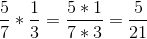
When multiplying fractions, all we have to do is multiply the numerators together and multiply the denominators together:
← Didn't Know|Knew It →
Convert  to base
  .
.
Convert
Tap to reveal answer
First, know  is divisible by
  .
.
Therefore:

We can set-up an equation by applying the power rule of exponents.

When a number to a power is raised by an exponent, we add the exponents. Write an equation and solve for  .
.

Simplify.

The answer is:

First, know
Therefore:
We can set-up an equation by applying the power rule of exponents.
When a number to a power is raised by an exponent, we add the exponents. Write an equation and solve for
Simplify.
The answer is:
← Didn't Know|Knew It →
Convert  to base
Convert
Tap to reveal answer
First, we know the following:

In order to figure out the whole exponent, we can apply the power rule for exponents.

First, we know the following:
In order to figure out the whole exponent, we can apply the power rule for exponents.
← Didn't Know|Knew It →
Simplify 
Simplify
Tap to reveal answer
First, combine exponents of like variables. This gives us 
First, combine exponents of like variables. This gives us
← Didn't Know|Knew It →
Evaluate:

Evaluate:
Tap to reveal answer
We can expand  to the following:

The product is:

We can expand
The product is:
← Didn't Know|Knew It →
Evaluate:

Evaluate:
Tap to reveal answer
We can expand  to the following:

The product is:

We can expand
The product is:
← Didn't Know|Knew It →