
Distributing Exponents (Power Rule) - Algebra 2
Card 1 of 484
Simplify the expression:

Simplify the expression:
Tap to reveal answer
Begin by distributing the exponent through the parentheses. The power rule dictates that an exponent raised to another exponent means that the two exponents are multiplied:

Any negative exponents can be converted to positive exponents in the denominator of a fraction:

The like terms can be simplified by subtracting the power of the denominator from the power of the numerator:


Begin by distributing the exponent through the parentheses. The power rule dictates that an exponent raised to another exponent means that the two exponents are multiplied:
Any negative exponents can be converted to positive exponents in the denominator of a fraction:
The like terms can be simplified by subtracting the power of the denominator from the power of the numerator:
← Didn't Know|Knew It →
Order the following from least to greatest:


Order the following from least to greatest:
Tap to reveal answer
In order to solve this problem, each of the answer choices needs to be simplified.
Instead of simplifying completely, make all terms into a form such that they have 100 as the exponent. Then they can be easily compared.
 ,
,  ,
,  , and
, and  .
.
Thus, ordering from least to greatest:  .
.
In order to solve this problem, each of the answer choices needs to be simplified.
Instead of simplifying completely, make all terms into a form such that they have 100 as the exponent. Then they can be easily compared.
Thus, ordering from least to greatest:
← Didn't Know|Knew It →
What is the largest positive integer,  , such that
  is a factor of
  ?
?
What is the largest positive integer,
Tap to reveal answer
 . Thus,
  is equal to 16.
← Didn't Know|Knew It →
Simplify:

Simplify:
Tap to reveal answer

Step 1: Distribute the exponents in the numberator.

Step 2: Represent the negative exponents in the demoninator.

Step 3: Simplify by combining terms.


Step 1: Distribute the exponents in the numberator.
Step 2: Represent the negative exponents in the demoninator.
Step 3: Simplify by combining terms.
← Didn't Know|Knew It →
Simplify.

Simplify.
Tap to reveal answer
When a power applies to an exponent, it acts as a multiplier, so 2a becomes 4a and -b becomes -2b. The negative exponent is moved to the denominator.
When a power applies to an exponent, it acts as a multiplier, so 2a becomes 4a and -b becomes -2b. The negative exponent is moved to the denominator.
← Didn't Know|Knew It →
Simplify:

Simplify:
Tap to reveal answer
Use the power rule to distribute the exponent:

Use the power rule to distribute the exponent:
← Didn't Know|Knew It →
Simplify:
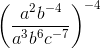
Simplify:
Tap to reveal answer
Step 1: Distribute the exponent through the terms in parentheses:
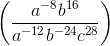
Step 2: Use the division of exponents rule. Subtract the exponents in the numerator from the exponents in the denominator:

Step 1: Distribute the exponent through the terms in parentheses:
Step 2: Use the division of exponents rule. Subtract the exponents in the numerator from the exponents in the denominator:
← Didn't Know|Knew It →
Simplify  .
.
Simplify
Tap to reveal answer
When faced with a problem that has an exponent raised to another exponent, the powers are multiplied:  then simplify:
  .
.
When faced with a problem that has an exponent raised to another exponent, the powers are multiplied:
← Didn't Know|Knew It →
Solve: 
Solve:
Tap to reveal answer
Solve each term separately. A number to the zeroth power is equal to 1, but be careful to apply the signs after the terms have been simplified.

Solve each term separately. A number to the zeroth power is equal to 1, but be careful to apply the signs after the terms have been simplified.
← Didn't Know|Knew It →
Simplify this expression: 
Simplify this expression:
Tap to reveal answer
 is the correct answer because the order of operations were followed and the multiplication and power rules of exponents were obeyed. These rules are as follows: PEMDAS (parentheses,exponents, multiplication, division, addition, subtraction), for multiplication of exponents follow the format
  , and
, and  .
.

First we simplify terms within the parenthesis because of the order of operations and the multiplication rule of exponents:

Next we use the power rule to distribute the outer power:
 =
=
**note that in the first step it isn't necessary to combine the two x powers because the individuals terms will still add to x^16 at the end if you use the power rule correctly. However, following the order of operations is a great way to avoid simple math errors and is relevant in many problems.
First we simplify terms within the parenthesis because of the order of operations and the multiplication rule of exponents:
Next we use the power rule to distribute the outer power:
**note that in the first step it isn't necessary to combine the two x powers because the individuals terms will still add to x^16 at the end if you use the power rule correctly. However, following the order of operations is a great way to avoid simple math errors and is relevant in many problems.
← Didn't Know|Knew It →
Simplify the expression:

Simplify the expression:
Tap to reveal answer
We begin by distributing the power to all terms within the parentheses. Remember that when we raise a power to a power, we multiply each exponent:

Anytime we have negative exponents, we can convert them to positive exponents. However, if the exponent was negative in the numerator, the term shifts to the denominator. If the exponent was negative in the denominator, the term shifts to the numerator.

We begin by distributing the power to all terms within the parentheses. Remember that when we raise a power to a power, we multiply each exponent:
Anytime we have negative exponents, we can convert them to positive exponents. However, if the exponent was negative in the numerator, the term shifts to the denominator. If the exponent was negative in the denominator, the term shifts to the numerator.
← Didn't Know|Knew It →
Simplify: 
Simplify:
Tap to reveal answer
To simplify this, we will need to use the power rule and order of operations.
Evaluate the first term. This will be done in two ways to show that the power rule will work for exponents outside of the parenthesis for a single term.


For the second term, we cannot distribute  and
and  with the exponent
  outside the parentheses because it's not a single term. Instead, we must evaluate the terms inside the parentheses first.
Evaluate the second term.

Square the value inside the parentheses.

Subtract the value of the second term with the first term.

To simplify this, we will need to use the power rule and order of operations.
Evaluate the first term. This will be done in two ways to show that the power rule will work for exponents outside of the parenthesis for a single term.
For the second term, we cannot distribute
Evaluate the second term.
Square the value inside the parentheses.
Subtract the value of the second term with the first term.
← Didn't Know|Knew It →
Solve: 
Solve:
Tap to reveal answer
First convert  into a known base. The number
  can be rewritten as
  .
.
Rewrite the expression.

Use the power rule to multiply the exponents.

Use order of operations to evaluate the expression.

First convert
Rewrite the expression.
Use the power rule to multiply the exponents.
Use order of operations to evaluate the expression.
← Didn't Know|Knew It →
Which of the following is equivalent to the expression  ?
?
Which of the following is equivalent to the expression
Tap to reveal answer
Which of the following is equivalent to the expression  ?
?
We can rewrite the given expression by distributing the exponent on the outside.

Now, this may look a little messier, but we need to recall that when we distribute an exponent through parentheses as we are trying to do above, we need to multiple the exponent on the inside by the number on the outside.
In a general sense it looks like this:

For our specific problem, it looks like this:

Which of the following is equivalent to the expression
We can rewrite the given expression by distributing the exponent on the outside.
Now, this may look a little messier, but we need to recall that when we distribute an exponent through parentheses as we are trying to do above, we need to multiple the exponent on the inside by the number on the outside.
In a general sense it looks like this:
For our specific problem, it looks like this:
← Didn't Know|Knew It →
Simplify: 
Simplify:
Tap to reveal answer
To simplify this expression, recall that it could be written as this:  . Since we're dealing with a quartic root, for every 4 of the same term, cross them out underneath the radical and bring one of those terms out. Therefore, we are only left with one x underneath the radical. The answer is:
  .
.
To simplify this expression, recall that it could be written as this:
← Didn't Know|Knew It →
Simplify the following expression:

Simplify the following expression:
Tap to reveal answer
Simplify the following expression:

To raise exponents to another power, we need to multiply them:

So we get:

Simplify the following expression:
To raise exponents to another power, we need to multiply them:
So we get:
← Didn't Know|Knew It →
Simplify the following expression by distributing the exponent:

Simplify the following expression by distributing the exponent:
Tap to reveal answer
Simplify the following expression by distributing the exponent:

When we are distributing an exponent, we want to multiple the exponent of each term within the parentheses by the exponent outside the parentheses.

Finally, perform the multiplication to get your answer:

Simplify the following expression by distributing the exponent:
When we are distributing an exponent, we want to multiple the exponent of each term within the parentheses by the exponent outside the parentheses.
Finally, perform the multiplication to get your answer:
← Didn't Know|Knew It →
Simplify the following expression:

Simplify the following expression:
Tap to reveal answer
Simplify the following expression:

To simplify exponents that are being raised to a higher power, we need to multiply each term's exponent by the exponent outside of the parentheses.

Follow up by actually multiplying through

Making our answer:

Simplify the following expression:
To simplify exponents that are being raised to a higher power, we need to multiply each term's exponent by the exponent outside of the parentheses.
Follow up by actually multiplying through
Making our answer:
← Didn't Know|Knew It →
Simplify.

Simplify.
Tap to reveal answer
When an exponent is being raised by another exponent, we just multiply the powers of the exponents and keep the base the same.

When an exponent is being raised by another exponent, we just multiply the powers of the exponents and keep the base the same.
← Didn't Know|Knew It →
Simplify.

Simplify.
Tap to reveal answer
When an exponent is being raised by another exponent, we just multiply the powers of the exponents and keep the base the same.

When an exponent is being raised by another exponent, we just multiply the powers of the exponents and keep the base the same.
← Didn't Know|Knew It →