
Basic Statistics - Algebra 2
Card 1 of 1812
What is the standard deviation of  ?
?
What is the standard deviation of
Tap to reveal answer
Standard deviation is  where
where  represents the data point in the set,
  is the mean of the data set and
  is number of points in the set.
The mean is the sum of the data set divided by the number of data points in the set.

Plugging in the values:

Standard deviation is
The mean is the sum of the data set divided by the number of data points in the set.
Plugging in the values:
← Didn't Know|Knew It →
In her last six basketball games, Jane scored 15, 17, 12, 15, 18, and 22 points per game. What is the standard deviation of these score totals? Round your answer to the nearest tenth.
In her last six basketball games, Jane scored 15, 17, 12, 15, 18, and 22 points per game. What is the standard deviation of these score totals? Round your answer to the nearest tenth.
Tap to reveal answer
The following is the formula for standard deviation:

Here is a breakdown of what that formula is telling you to do:
1. Solve for the mean (average) of the five test scores
2. Subtract that mean from each of the five original test scores. Square each of the differences.
3. Find the mean (average) of each of these differences you found in Step 2
4. Take the square root of this final mean from #3. This is the standard deviation
Here are those steps:
1. Find the mean of her score totals:

2. Subtract the mean from each of the test scores, then square the differences:


3. Find the mean of the squared values from Step 2:


4. Take the square root of your answer from Step 3:

The following is the formula for standard deviation:
Here is a breakdown of what that formula is telling you to do:
1. Solve for the mean (average) of the five test scores
2. Subtract that mean from each of the five original test scores. Square each of the differences.
3. Find the mean (average) of each of these differences you found in Step 2
4. Take the square root of this final mean from #3. This is the standard deviation
Here are those steps:
1. Find the mean of her score totals:
2. Subtract the mean from each of the test scores, then square the differences:
3. Find the mean of the squared values from Step 2:
4. Take the square root of your answer from Step 3:
← Didn't Know|Knew It →
Mr. Bell gave out a science test last week to six honors students. The scores were 88, 94, 80, 79, 74, and 83. What is the standard deviation of the scores? (Round to the nearest tenth.)
Mr. Bell gave out a science test last week to six honors students. The scores were 88, 94, 80, 79, 74, and 83. What is the standard deviation of the scores? (Round to the nearest tenth.)
Tap to reveal answer
First, find the mean of the six numbers by adding them all together, and dividing them by six.
88 + 94 + 80 + 79 + 74 + 83 = 498
498/6 = 83
Next, find the variance by subtracting the mean from each of the given numbers and then squaring the answers.
88 – 83 = 5
52 = 25
94 – 83 = 11
112 = 121
80 – 83 = –3
–32 = 9
79 – 83 = –4
–42 = 16
74 – 83 = –9
–92 = 81
83 – 83 = 0
02 = 0
Find the average of the squared answers by adding up all of the squared answers and dividing by six.
25 + 121 + 9 +16 +81 + 0 = 252
252/6 = 42
42 is the variance.
To find the standard deviation, take the square root of the variance.
The square root of 42 is 6.481.
First, find the mean of the six numbers by adding them all together, and dividing them by six.
88 + 94 + 80 + 79 + 74 + 83 = 498
498/6 = 83
Next, find the variance by subtracting the mean from each of the given numbers and then squaring the answers.
88 – 83 = 5
52 = 25
94 – 83 = 11
112 = 121
80 – 83 = –3
–32 = 9
79 – 83 = –4
–42 = 16
74 – 83 = –9
–92 = 81
83 – 83 = 0
02 = 0
Find the average of the squared answers by adding up all of the squared answers and dividing by six.
25 + 121 + 9 +16 +81 + 0 = 252
252/6 = 42
42 is the variance.
To find the standard deviation, take the square root of the variance.
The square root of 42 is 6.481.
← Didn't Know|Knew It →
On his five tests for the semester, Andrew earned the following scores: 83, 75, 90, 92, and 85. What is the standard deviation of Andrew's scores? Round your answer to the nearest hundredth.
On his five tests for the semester, Andrew earned the following scores: 83, 75, 90, 92, and 85. What is the standard deviation of Andrew's scores? Round your answer to the nearest hundredth.
Tap to reveal answer
The following is the formula for standard deviation:

Here is a breakdown of what that formula is telling you to do:
1. Solve for the mean (average) of the five test scores
2. Subtract that mean from each of the five original test scores. Square each of the differences.
3. Find the mean (average) of each of these differences you found in Step 2
4. Take the square root of this final mean from #3. This is the standard deviation
Here are those steps:
1. Find the mean of the test scores:

2. Subtract the mean from each of the test scores, then square the differences:


3. Find the mean of the squared values from Step 2:

4. Take the square root of your answer from Step 3:

The following is the formula for standard deviation:
Here is a breakdown of what that formula is telling you to do:
1. Solve for the mean (average) of the five test scores
2. Subtract that mean from each of the five original test scores. Square each of the differences.
3. Find the mean (average) of each of these differences you found in Step 2
4. Take the square root of this final mean from #3. This is the standard deviation
Here are those steps:
1. Find the mean of the test scores:
2. Subtract the mean from each of the test scores, then square the differences:
3. Find the mean of the squared values from Step 2:
4. Take the square root of your answer from Step 3:
← Didn't Know|Knew It →
In the population of high school boys, the variance in height, measured in inches, was found to be 16. Assuming that the height data is normally distributed, 95% of high school boys should have a height within how many inches of the mean?
In the population of high school boys, the variance in height, measured in inches, was found to be 16. Assuming that the height data is normally distributed, 95% of high school boys should have a height within how many inches of the mean?
Tap to reveal answer
The 68-95-99.7 rule states that nearly all values lie within 3 standard deviations of the mean in a normal distribution. In this case the question asks for 95% so we want to know what 2 standard deviations from the mean is.
We are given the variance, so to find the standard deviation, take the square root.

So two standard devations is 8 inches. 95% of heights should be within 8 inches of the mean.
The 68-95-99.7 rule states that nearly all values lie within 3 standard deviations of the mean in a normal distribution. In this case the question asks for 95% so we want to know what 2 standard deviations from the mean is.
We are given the variance, so to find the standard deviation, take the square root.
So two standard devations is 8 inches. 95% of heights should be within 8 inches of the mean.
← Didn't Know|Knew It →
At the end of the fall semester, a math class of ninth graders had the following grades: 85, 75, 97, 83, 62, 75, 88, 84, 92, and 89.
What is the standard deviation of this class?
At the end of the fall semester, a math class of ninth graders had the following grades: 85, 75, 97, 83, 62, 75, 88, 84, 92, and 89.
What is the standard deviation of this class?
Tap to reveal answer
The standard deviation of a set of numbers is how much the numbers deviate from the mean. More formally, the standard deviation is

where  is a number in the series,
  is the mean, and
  is the number of data points. So, to calculate the standard deviation, we must first calculate the mean. The mean of this data set is

Now that we know the mean, we can start calculating the standard deviation. We first need to find the sum of each data point minus the average squared.

Calculating that, we get that the variance from the mean is  . Plugging that into our equation for standard deviation, with
  being ten data points, we get

The standard deviation of a set of numbers is how much the numbers deviate from the mean. More formally, the standard deviation is
where
Now that we know the mean, we can start calculating the standard deviation. We first need to find the sum of each data point minus the average squared.
Calculating that, we get that the variance from the mean is
← Didn't Know|Knew It →
Determine the standard deviation for the following data set:
12, 15, 30, 5, 27, 19
Determine the standard deviation for the following data set:
12, 15, 30, 5, 27, 19
Tap to reveal answer
Formula for the standard deviation:

1. Find the mean

2. Subtract the mean from each number in the data set


3. Sum up the square of the differences and divide by n

4. Take the square root of the variance

Formula for the standard deviation:
1. Find the mean
2. Subtract the mean from each number in the data set
3. Sum up the square of the differences and divide by n
4. Take the square root of the variance
← Didn't Know|Knew It →
In a normal distribution, what percentage is covered within one standard deviation?
In a normal distribution, what percentage is covered within one standard deviation?
Tap to reveal answer
By drawing a bell curve, the middle line is  . One standard deviation left and right of the middle line is
  each. That means one standard deviation within is
  .
.
By drawing a bell curve, the middle line is
← Didn't Know|Knew It →
If standard deviation is  and the mean is
  , what is the range of the number set if it's within one standard deviation?
If standard deviation is
Tap to reveal answer
Standard deviation is the dispersion of the data set. Since it's asking for within one standard deviation, we need to take the mean and add the standard deviation to find the upper bound of the range. Then, we will need to subtract the standard deviation from the mean to identify the lower bound of the range.
 =
=
Standard deviation is the dispersion of the data set. Since it's asking for within one standard deviation, we need to take the mean and add the standard deviation to find the upper bound of the range. Then, we will need to subtract the standard deviation from the mean to identify the lower bound of the range.
← Didn't Know|Knew It →
What is the standard deviation of this set?

What is the standard deviation of this set?
Tap to reveal answer
Standard deviation is  where
where  represents the data point in the set,
  is the mean of the data set and
  is number of points in the set.
The mean is the sum of the data set divided by the number of data points in the set.

Plugging in the values:

Standard deviation is
The mean is the sum of the data set divided by the number of data points in the set.
Plugging in the values:
← Didn't Know|Knew It →
Standard Deviation can be calculated from what statistical term?
Standard Deviation can be calculated from what statistical term?
Tap to reveal answer
Another way to calculate standard deviation is the square root of variance.
Variance is,
 .
.
Taking the square root of this is how standard devation can be calculated.
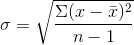
Another way to calculate standard deviation is the square root of variance.
Variance is,
Taking the square root of this is how standard devation can be calculated.
← Didn't Know|Knew It →
If the mean is  with a standard deviation of
  , then which of the following values is within one standard deviation?
If the mean is
Tap to reveal answer
If mean is  with standard deviation of
  , then one standard deviation within has a range of
  to
to  .
.
Remember, we find the range by adding the standard deviation to the mean and subtracting the standard deviation from the mean.

Only  is in the range.
The rest of the numbers are more than one standard deviation.
If mean is
Remember, we find the range by adding the standard deviation to the mean and subtracting the standard deviation from the mean.
Only
The rest of the numbers are more than one standard deviation.
← Didn't Know|Knew It →
If variance is  , what is the standard deviation?
If variance is
Tap to reveal answer
Variance is,
.
To find standard deviation is to take the sqaure root of the variance.
 .
.
Variance is,
To find standard deviation is to take the sqaure root of the variance.
← Didn't Know|Knew It →
What is the difference between two standard deviations on the right tail with one standard deviation on the right tail? Assume a normal distribution.
What is the difference between two standard deviations on the right tail with one standard deviation on the right tail? Assume a normal distribution.
Tap to reveal answer
Two standard deviations represents  . One standard deviation represents
  . The difference is
  . However, the question is focusing on the right side of the tail. Since it's normal distribution, both tails of the graph are equal. Divide
  by
by  and we get
  .
.
Two standard deviations represents
← Didn't Know|Knew It →
If the number set is within a standard deviation and the range is  to
to  , what is the standard deviation? Assume a normal distribution.
If the number set is within a standard deviation and the range is
Tap to reveal answer
Since it's normally distributed, that means we can find the mean. The middle number in the number set is the mean. In this case that value is  . Since it's within one standard deviation, we can take the difference of either
  and
and  or
or  and
and  which the answer is
  either way.
Since it's normally distributed, that means we can find the mean. The middle number in the number set is the mean. In this case that value is
← Didn't Know|Knew It →
If the number set is within  standard deviations and the range is
  to
to  , what is the standard deviation? Assume a normal distribution.
If the number set is within
Tap to reveal answer
Since it's normally distributed, that means we can find the mean. The middle number in the number set is the mean. In this case that value is  .
.

Since it's  standard deviations, we need to set up an equation.
 This is written like this because
  is the lowest number in the set,
  represents the
  standard deviations and
  is one standard deviation. By subtracting
  both sides and dividing both sides by
  , we get
  .
.


Since it's normally distributed, that means we can find the mean. The middle number in the number set is the mean. In this case that value is
Since it's
← Didn't Know|Knew It →
How many standard deviations represents  of a set in a normal distribution?
How many standard deviations represents
Tap to reveal answer
One standard deviation represents  . Two standard deviations represents
  . Three standard deviations represents
  .
.
As you add more standard deviations, the percent coverages get a bit bigger.
The answer is just two.
One standard deviation represents
As you add more standard deviations, the percent coverages get a bit bigger.
The answer is just two.
← Didn't Know|Knew It →
Determine the population standard deviation of the following data set and round to three decimal places: 
Determine the population standard deviation of the following data set and round to three decimal places:
Tap to reveal answer
Write the formula for population standard deviation.

 represents the number of terms,
  represents the terms in the data set, and
  is the mean.
Calculate the mean,  .
.


Evaluate the variance,  .
.

The standard deviation is the square root of the variance.

The answer is: 
Write the formula for population standard deviation.
Calculate the mean,
Evaluate the variance,
The standard deviation is the square root of the variance.
The answer is:
← Didn't Know|Knew It →
A jellybean machine dispenses 3 jellybeans on the first trial, 5 jellybeans on the second trial, and 7 jellybeans on the third trial. Determine the sample standard deviation.
A jellybean machine dispenses 3 jellybeans on the first trial, 5 jellybeans on the second trial, and 7 jellybeans on the third trial. Determine the sample standard deviation.
Tap to reveal answer
The standard deviation measures the spread of the results.
Write the formula for the sample standard deviation.

Determine the mean  .
.

The term  means that we are summing the squared differences from the mean.

Simplify the terms.

 represents the sample size. There are three numbers in the data.

The answer is: 
The standard deviation measures the spread of the results.
Write the formula for the sample standard deviation.
Determine the mean
The term
Simplify the terms.
The answer is:
← Didn't Know|Knew It →
Determine the sample standard deviation if the sample variance is  .
.
Determine the sample standard deviation if the sample variance is
Tap to reveal answer
Write the formula for the standard deviation given the variance.

Substitute the variance into the standard deviation.

The answer is: 
Write the formula for the standard deviation given the variance.
Substitute the variance into the standard deviation.
The answer is:
← Didn't Know|Knew It →