
How to find the perimeter of a parallelogram
ACT Math · Learn by Concept
Help Questions
ACT Math › How to find the perimeter of a parallelogram

Note: Figure NOT drawn to scale.
To the nearest tenth, give the perimeter of Parallelogram 


Explanation


The perimeter of the parallelogram is


Note: Figure NOT drawn to scale.
Give the perimeter of Parallelogram 


Explanation
By the 45-45-90 Theorem, the lengths of the legs of 

Its hypotenuse has measure 

The perimeter of the parallelogram is


Note: Figure NOT drawn to scale.
Give the perimeter of Parallelogram 


Explanation
By the 30-60-90 Theorem, the length of the short leg of 


Its hypotenuse has twice the length of the short leg, so

The perimeter of the parallelogram is


Note: Figure NOT drawn to scale.
In the above figure, Parallelogram 


Explanation


The area of the parallelogram is the product of height 


The perimeter of the parallelogram is


A parallelogram, with dimensions in cm, is shown below. 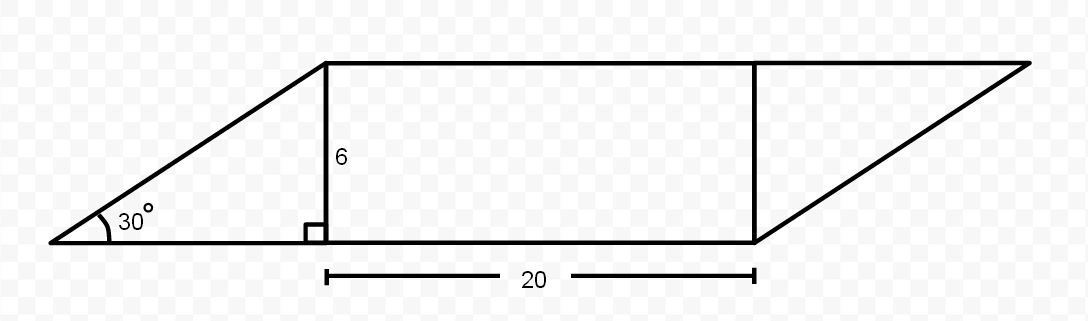
What is the perimeter of the parallelogram, in cm?


Explanation
The triangle on the left side of the figure has a 




Our third angle is 

A 



We also now know that


Now we know all of our missing side lengths. The right and left side of the parallelogram will each be 






In the above figure, Parallelogram


Explanation
By the 30-60-90 Theorem,

The area of the parallelogram is the product of height


Also by the 30-60-90 Theorem,

The perimeter of the parallelogram is


In the above figure, Parallelogram 
Explanation
By the 45-45-90 Theorem, 


Also by the 45-45-90 Theorem,

The perimeter of the parallelogram is

