
How to find the perimeter of a 45/45/90 right isosceles triangle
ACT Math · Learn by Concept
Help Questions
ACT Math › How to find the perimeter of a 45/45/90 right isosceles triangle
What is the perimeter of an isosceles right triangle with an hypotenuse of length 





Explanation
Your right triangle is a 
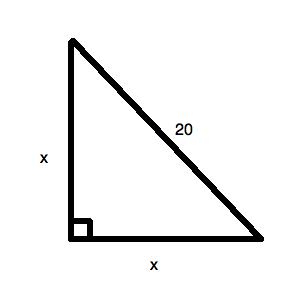
Now, you know that you also have a reference triangle for 
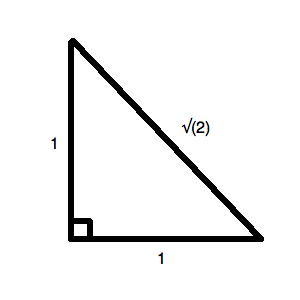
This means that you can set up a ratio to find 

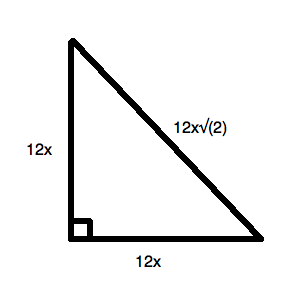
Your triangle thus could be drawn like this:
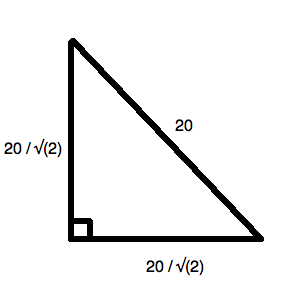
Now, notice that you can rationalize the denominator of 

Thus, the perimeter of your figure is:

What is the perimeter of an isosceles right triangle with an area of 





Explanation
Recall that an isosceles right triangle is also a 
or 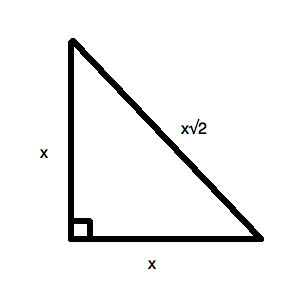
Now, you know that the area of a triangle is:

For this triangle, though, the base and height are the same. So it is:

Now, we have to be careful, given that our area contains 


Thus, 
Therefore, your perimeter is:

A tree is 


Explanation
This is a right triangle where the rope is the hypotenuse. One leg is the radius of the circle, 5 feet. The other leg is half of the tree's height, 12 feet. We can now use the Pythagorean Theorem 



An isosceles right triangle has a hypotenuse of length 


Explanation
The ratio of sides to hypotenuse of an isosceles right triangle is always 


Since the perimeter has two of these legs, we just need to multiply this by 
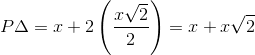
So, our perimeter in terms of 
