
Square Roots and Operations - ACT Math
Card 0 of 243
State the product: 
State the product:
Don't try to do too much at first for this problem. Multiply your radicals and your coefficients, then worry about any additional simplification.

Now simplify the radical.

Don't try to do too much at first for this problem. Multiply your radicals and your coefficients, then worry about any additional simplification.
Now simplify the radical.
Compare your answer with the correct one above
Find the product: 
Find the product:
Don't try to do too much at first for this problem. Multiply your radicals and your coefficients, then worry about any additional simplification.

Now, simplify your radical.

Don't try to do too much at first for this problem. Multiply your radicals and your coefficients, then worry about any additional simplification.
Now, simplify your radical.
Compare your answer with the correct one above
Which of the following is equivalent to the expression
 ?
?
Which of the following is equivalent to the expression
The most difficult element of this problem is being able to correctly simplify each of the square roots. This means starting with our first contestant,  . There are several different methods for simplifying square roots, each with their own benefits. Furthermore, some calculators permissible on the ACT can actually do it for you (might be worth looking into). But for those of us not so fortunate, here is one particular method, which utilizes what is called a factor tree.
Start by writing the number inside the square root, 45 in our case. And find two factors of (numbers that multiplied together equal) 45 other than 1 and the number itself. In our case there are two possibilities: 9 and 5 or 3 and 15. Both will work, but we will go with the latter pair. Look at each of the two factors to see if the same process can be repeated. Looking at 3, we realize it is prime, meaning no additional factors exist. Therefore, we leave the 3 as is. However, the 15 can be further broken up into the factors 5 and 3, which we can illustrate as shown. We then attempt to repeat the process with the next tier of numbers, but we soon realize that both 5 and 3 are prime. Therefore, we can go no further, and our factor tree is finished.

But what do we do now? We look for pairs. For each pair of numbers we have under the radical, we put one number on the outside of the square root. That means one 3 goes outside the square root. For each under the radical without a pair, we put that number inside the square root, meaning one 5 goes inside the square root. This gives a final answer of  .
.
We then repeat the process with our second contestant,  . A factor tree for 180 could take several different paths, but any correct one (including the example below) should end with the same numbers under the radical. Though perhaps not in the same order, the numbers under the radical should include two 2s, two 3s, and one 5. We see that a pair of 2s and a pair of 3s should give us one 2 and one 3 on the outside of the square root, while a pairless 5 should go on the inside. Any time multiple numbers end up on either the inside or outside, we simply multiple those numbers.


Therefore, we get  .
.
We then complete the process one more time with our final contestant, 125. Doing so invariably gives the following factor tree.
The problem in this case is that we don't have a pair but a trio of 5s. In this case, we simply pair two of them, leaving one to be the odd five out.

Our final answer for this contestant then is  .
.
Substituting our simplified square roots for the originals gives us the new expression
 . From here it is best to think of
  like an apple. In the first term I have 3 "apples". I then subtract, or take away, 6 "apples". Finally, I add back 5 "apples". How many apples do I have?
 . I have 2 apples, or in other words
  .
.
The most difficult element of this problem is being able to correctly simplify each of the square roots. This means starting with our first contestant,
Start by writing the number inside the square root, 45 in our case. And find two factors of (numbers that multiplied together equal) 45 other than 1 and the number itself. In our case there are two possibilities: 9 and 5 or 3 and 15. Both will work, but we will go with the latter pair. Look at each of the two factors to see if the same process can be repeated. Looking at 3, we realize it is prime, meaning no additional factors exist. Therefore, we leave the 3 as is. However, the 15 can be further broken up into the factors 5 and 3, which we can illustrate as shown. We then attempt to repeat the process with the next tier of numbers, but we soon realize that both 5 and 3 are prime. Therefore, we can go no further, and our factor tree is finished.
But what do we do now? We look for pairs. For each pair of numbers we have under the radical, we put one number on the outside of the square root. That means one 3 goes outside the square root. For each under the radical without a pair, we put that number inside the square root, meaning one 5 goes inside the square root. This gives a final answer of
We then repeat the process with our second contestant,
Therefore, we get
We then complete the process one more time with our final contestant, 125. Doing so invariably gives the following factor tree.
The problem in this case is that we don't have a pair but a trio of 5s. In this case, we simply pair two of them, leaving one to be the odd five out.
Our final answer for this contestant then is
Substituting our simplified square roots for the originals gives us the new expression
Compare your answer with the correct one above
What is  in its simplest form?
What is
Since  and
and  are both followed by the
  , they can be subtracted normally. The
  does not change, as it cannot be simplified.
Since
Compare your answer with the correct one above
Simplify 
Simplify
Find the largest factors of 128, 54, and 32 that are perfect squares. For 128, the factors are 64 and 2, thus  =
=  . For 54, the factors are 27 and 2, thus
  =
=  . For 32, the factors are 16 and 2, thus
  =
=  . Simplifying these terms, leads to
  . Combining like terms results in the final answer of
  .
.
Find the largest factors of 128, 54, and 32 that are perfect squares. For 128, the factors are 64 and 2, thus
Compare your answer with the correct one above
Simplify the following completely:

Simplify the following completely:
To simplify this expression, simply multiply the radicands and reduce to simplest form.


To simplify this expression, simply multiply the radicands and reduce to simplest form.
Compare your answer with the correct one above
Simplify: 
Simplify:
Take each fraction separately first:
(2√3)/(√2) = \[(2√3)/(√2)\] * \[(√2)/(√2)\] = (2 * √3 * √2)/(√2 * √2) = (2 * √6)/2 = √6
Similarly:
(4√2)/(√3) = \[(4√2)/(√3)\] * \[(√3)/(√3)\] = (4√6)/3 = (4/3)√6
Now, add them together:
√6 + (4/3)√6 = (3/3)√6 + (4/3)√6 = (7/3)√6
Take each fraction separately first:
(2√3)/(√2) = \[(2√3)/(√2)\] * \[(√2)/(√2)\] = (2 * √3 * √2)/(√2 * √2) = (2 * √6)/2 = √6
Similarly:
(4√2)/(√3) = \[(4√2)/(√3)\] * \[(√3)/(√3)\] = (4√6)/3 = (4/3)√6
Now, add them together:
√6 + (4/3)√6 = (3/3)√6 + (4/3)√6 = (7/3)√6
Compare your answer with the correct one above
Find the sum:

Find the sum:
Find the Sum:

Simplify the radicals:

Find the Sum:
Simplify the radicals:
Compare your answer with the correct one above
Add 
Add
The first step when adding square roots is to simplify each term as much as possible. Since the first term has a square within the square root, we can reduce  to
to  . Now each term has only prime numbers within the sqaure roots, so nothing can be further simplified and our new expression is
  .
.
Only terms that have the same expression within the sqaure root can be combined. In this question, these are the first and third terms. When combining terms, the expression within the square root stays the say, while the terms out front are added. Therefore we get  . Since the second term of the original equation cannot be combined with any other term, we get the final answer of
  .
.
The first step when adding square roots is to simplify each term as much as possible. Since the first term has a square within the square root, we can reduce
Only terms that have the same expression within the sqaure root can be combined. In this question, these are the first and third terms. When combining terms, the expression within the square root stays the say, while the terms out front are added. Therefore we get
Compare your answer with the correct one above
Simplify the following:

Simplify the following:
When multiplying square roots, the easiest thing to do is first to factor each root. Thus:

Now, when you combine the multiplied roots, it will be easier to come to your final solution. Remember that multiplying roots is very easy! Just multiply together everything "under" the roots:

Finally this can be simplified as:

When multiplying square roots, the easiest thing to do is first to factor each root. Thus:
Now, when you combine the multiplied roots, it will be easier to come to your final solution. Remember that multiplying roots is very easy! Just multiply together everything "under" the roots:
Finally this can be simplified as:
Compare your answer with the correct one above
Simplify the following expression: 
Simplify the following expression:
Begin by factoring out each of the radicals:

For the first two radicals, you can factor out a  or
or  :
:

The other root values cannot be simply broken down. Now, combine the factors with  :
:

This is your simplest form.
Begin by factoring out each of the radicals:
For the first two radicals, you can factor out a
The other root values cannot be simply broken down. Now, combine the factors with
This is your simplest form.
Compare your answer with the correct one above
Solve for  .
.
Note,  :
:

Solve for
Note,
Begin by getting your  terms onto the left side of the equation and your numeric values onto the right side of the equation:

Next, you can combine your radicals. You do this merely by subtracting their respective coefficients:

Now, square both sides:



Solve by dividing both sides by  :
:

Begin by getting your
Next, you can combine your radicals. You do this merely by subtracting their respective coefficients:
Now, square both sides:
Solve by dividing both sides by
Compare your answer with the correct one above
Simplify:

Simplify:
Begin simplifying by breaking apart the square roots in question. Thus, you know:

Now, with square roots, you can combine factors just as if a given root were a variable. So, just as  , so too does
  .
.
Begin simplifying by breaking apart the square roots in question. Thus, you know:
Now, with square roots, you can combine factors just as if a given root were a variable. So, just as
Compare your answer with the correct one above
Simplify:  .
.
Simplify:
Begin simplifying by breaking apart the square roots in question. Thus, you know:

Now, with square roots, you can combine factors just as if a given root were a variable. So, just as  , so too does
  .
.
Begin simplifying by breaking apart the square roots in question. Thus, you know:
Now, with square roots, you can combine factors just as if a given root were a variable. So, just as
Compare your answer with the correct one above
What is  divided by
  ?
?
What is
Upon dividing by  , the
, the  in the numerator cancels out, and the only number remaining is
  :
:

Upon dividing by
Compare your answer with the correct one above
Simplify 
Simplify
Find the greatest factor that is a perfect square for 112 and 63. For 112, the factors are 16 and 7, thus  . For 63, the factors are 9 and 7, thus
  . Simplifying these terms will give
  . Cancel out the
  results in
  .
.
Find the greatest factor that is a perfect square for 112 and 63. For 112, the factors are 16 and 7, thus
Compare your answer with the correct one above
Simplify the following expression:

Simplify the following expression:
Although it may seem as though we cannot do anything to this expression due to our numerator and denominator having different indices, there is in fact some real simplifying to be done here.
To begin, our numerator can be evaluated, because 343 is in fact a perfect cube:

This fact helps us out with our denominator as well. Our original equation becomes the following:

Then, we can pull out two of the sevens on the bottom and cancel them like so:
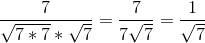
We may seem to be done, but if you look, you will not see our solution among the answer choices. That is because we need to rationalize the denominator. We should never have a square root in our denominator. To remedy this, we do a fairly simple move that won't change the value of our fraction, but just the form it is in:
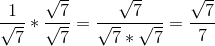
Now we'll have no issue finding our answer choice!
Although it may seem as though we cannot do anything to this expression due to our numerator and denominator having different indices, there is in fact some real simplifying to be done here.
To begin, our numerator can be evaluated, because 343 is in fact a perfect cube:
This fact helps us out with our denominator as well. Our original equation becomes the following:
Then, we can pull out two of the sevens on the bottom and cancel them like so:
We may seem to be done, but if you look, you will not see our solution among the answer choices. That is because we need to rationalize the denominator. We should never have a square root in our denominator. To remedy this, we do a fairly simple move that won't change the value of our fraction, but just the form it is in:
Now we'll have no issue finding our answer choice!
Compare your answer with the correct one above
Simplify:

Simplify:
Division of square roots is easy, since you can combine the roots and treat it like any other fraction. Thus, you can convert our fraction as follows:
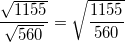
Next, you begin to reduce the fraction:

This reduces to:
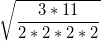
Now, break this apart again into:
 , which is
Division of square roots is easy, since you can combine the roots and treat it like any other fraction. Thus, you can convert our fraction as follows:
Next, you begin to reduce the fraction:
This reduces to:
Now, break this apart again into:
Compare your answer with the correct one above
Simplify:

Simplify:
Division of square roots is easy, since you can combine the roots and treat it like any other fraction. Thus, you can convert our fraction as follows:
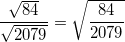
Next, you begin to reduce the fraction:

This reduces to:

Now, break this apart again into:
 , which is
Finish by rationalizing the denominator:

Division of square roots is easy, since you can combine the roots and treat it like any other fraction. Thus, you can convert our fraction as follows:
Next, you begin to reduce the fraction:
This reduces to:
Now, break this apart again into:
Finish by rationalizing the denominator:
Compare your answer with the correct one above
x4 = 100
If x is placed on a number line, what two integers is it between?
x4 = 100
If x is placed on a number line, what two integers is it between?
It might be a little difficult taking a fourth root of 100 to isolate x by itself; it might be easier to select an integer and take that number to the fourth power. For example 34 = 81 and 44 = 256. Since 34 is less than 100 and 44 is greater than 100, x would lie between 3 and 4.
It might be a little difficult taking a fourth root of 100 to isolate x by itself; it might be easier to select an integer and take that number to the fourth power. For example 34 = 81 and 44 = 256. Since 34 is less than 100 and 44 is greater than 100, x would lie between 3 and 4.
Compare your answer with the correct one above