
Arithmetic - ACT Math
Card 0 of 6453
Order the following decimals from greatest to least:
0.999, 0.909, 0.990
Order the following decimals from greatest to least:
0.999, 0.909, 0.990
The greatest is 0.999 (999/1000), then 0.990 (990/1000), finally 0.909 (909/1000).
0.999 > 0.990 > 0.909
The greatest is 0.999 (999/1000), then 0.990 (990/1000), finally 0.909 (909/1000).
0.999 > 0.990 > 0.909
Compare your answer with the correct one above
In a school relay race, every 5-man team must sprint 110 yards total. However, Jim’s team is short a person. Thus, Jim must run two sections for his team. How far does Jim have to run?
In a school relay race, every 5-man team must sprint 110 yards total. However, Jim’s team is short a person. Thus, Jim must run two sections for his team. How far does Jim have to run?
We first find out how much each person must run. Thus we take 110/5 to get 22 yards. However, Jim must run twice the amount of a normal competitor, so we multiply by 2 to get 44 yards.
We first find out how much each person must run. Thus we take 110/5 to get 22 yards. However, Jim must run twice the amount of a normal competitor, so we multiply by 2 to get 44 yards.
Compare your answer with the correct one above
Truck A has a length of 8'3" (8 ft. and 3 inches). Truck B has a length of 14'5".
What is the percentage increase in length going from Truck A to Truck B?
Truck A has a length of 8'3" (8 ft. and 3 inches). Truck B has a length of 14'5".
What is the percentage increase in length going from Truck A to Truck B?
Find a common unit—in this case it is inches. The increase is from 99” to 173”. To find the percentage increase we find the difference and then divide by the length of Truck A.
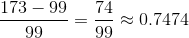
or 74.74%
Find a common unit—in this case it is inches. The increase is from 99” to 173”. To find the percentage increase we find the difference and then divide by the length of Truck A.
or 74.74%
Compare your answer with the correct one above
0.3 < 1/3
4 > √17
1/2 < 1/8
–|–6| = 6
Which of the above statements is true?
0.3 < 1/3
4 > √17
1/2 < 1/8
–|–6| = 6
Which of the above statements is true?
The best approach to this equation is to evaluate each of the equations and inequalities. The absolute value of –6 is 6, but the opposite of that value indicated by the “–“ is –6, which does not equal 6.
1/2 is 0.5, while 1/8 is 0.125 so 0.5 > 0.125.
√17 has to be slightly more than the √16, which equals 4, so“>” should be “<”.
Finally, the fraction 1/3 has repeating 3s which makes it larger than 3/10 so it is true.
The best approach to this equation is to evaluate each of the equations and inequalities. The absolute value of –6 is 6, but the opposite of that value indicated by the “–“ is –6, which does not equal 6.
1/2 is 0.5, while 1/8 is 0.125 so 0.5 > 0.125.
√17 has to be slightly more than the √16, which equals 4, so“>” should be “<”.
Finally, the fraction 1/3 has repeating 3s which makes it larger than 3/10 so it is true.
Compare your answer with the correct one above
Which of the following numbers is between 1/5 and 1/6?
Which of the following numbers is between 1/5 and 1/6?
Long division shows that 1/5 = 0.20 and 1/6 = 0.16666... 0.13 < 0.16 < 1/6 < 0.19 < 1/5 < 0.22 < 0.25.
Long division shows that 1/5 = 0.20 and 1/6 = 0.16666... 0.13 < 0.16 < 1/6 < 0.19 < 1/5 < 0.22 < 0.25.
Compare your answer with the correct one above
Trevor, James, and Will were each given a candy bar. Trevor ate 7/12 of his and Will ate 20% of his. If James ate more than Will and less than Trevor, what amount could James have eaten?
Trevor, James, and Will were each given a candy bar. Trevor ate 7/12 of his and Will ate 20% of his. If James ate more than Will and less than Trevor, what amount could James have eaten?
Turn Trevor and Will’s amounts into decimals to compare: 20% = 0.20 and 7/12 = 0.5083 rounded. When the answer choices are converted into decimals, 2/7 = 0.2871 is the only value between 0.20 and 0.5083.
Turn Trevor and Will’s amounts into decimals to compare: 20% = 0.20 and 7/12 = 0.5083 rounded. When the answer choices are converted into decimals, 2/7 = 0.2871 is the only value between 0.20 and 0.5083.
Compare your answer with the correct one above
An acid-water solution is made in which 65% of the solution is water by volume. How many liters of acid are there in 50 liters of the solution?
An acid-water solution is made in which 65% of the solution is water by volume. How many liters of acid are there in 50 liters of the solution?
35% of the solution is acid, therefore 0.35 * 50 = 17.5.
35% of the solution is acid, therefore 0.35 * 50 = 17.5.
Compare your answer with the correct one above
Danielle has two jobs. Her retail job pays her $8.50 per hour and she works 20 hours per week in that job. Her office job pays her $12 per hour and she works 15 hours per week in the office. If she starts working an extra 10 hours a week at her office job, what is her percentage increase in total weekly pay? Round to one decimal point.
Danielle has two jobs. Her retail job pays her $8.50 per hour and she works 20 hours per week in that job. Her office job pays her $12 per hour and she works 15 hours per week in the office. If she starts working an extra 10 hours a week at her office job, what is her percentage increase in total weekly pay? Round to one decimal point.
Pay = Hours worked x Rate per hour
Retail job = 20 x $8.50 = $170.00
Office job = 15 x $12.00 = $180.00
Current weekly pay = $170.00 + $180.00 = $350.00
Additional Office job hours = 10 x $12.00 = $120.00
Percentage Increase = $120 / $350 = .343 (rounded) --> 34.3%
Pay = Hours worked x Rate per hour
Retail job = 20 x $8.50 = $170.00
Office job = 15 x $12.00 = $180.00
Current weekly pay = $170.00 + $180.00 = $350.00
Additional Office job hours = 10 x $12.00 = $120.00
Percentage Increase = $120 / $350 = .343 (rounded) --> 34.3%
Compare your answer with the correct one above
The manager of a department store decided to raise the price of a certain pair of shoes by 30%. The next day, the store ran a sale of 20% off all items. What is the difference in price, in percentage terms, between the initial price of the shoes and the sale price?
The manager of a department store decided to raise the price of a certain pair of shoes by 30%. The next day, the store ran a sale of 20% off all items. What is the difference in price, in percentage terms, between the initial price of the shoes and the sale price?
To find the price after the initial 30% increase by the manager, you must multiply the original price by 1.3. Then, to find the price after the 20% off sale, you must multiply the new price by 0.8. The original price, therefore, is being multiplied by 1.3*0.8 = 1.04, indicating a 4% overall increase.
To find the price after the initial 30% increase by the manager, you must multiply the original price by 1.3. Then, to find the price after the 20% off sale, you must multiply the new price by 0.8. The original price, therefore, is being multiplied by 1.3*0.8 = 1.04, indicating a 4% overall increase.
Compare your answer with the correct one above
A shirt is originally priced at $54. It is on sale for 60% off, and Jeff has a coupon for an additional 15% off the reduced price. What is the final price Jeff pays for the shirt?
A shirt is originally priced at $54. It is on sale for 60% off, and Jeff has a coupon for an additional 15% off the reduced price. What is the final price Jeff pays for the shirt?
After 60% off, the shirt is marked down to $21.60 (found by: $54 - $54*0.6 = $21.60). Jeff uses a 15% off coupon, knocking the price down to $18.36 ( found by: $21.60 - $21.60*0.15 = $18.36).
After 60% off, the shirt is marked down to $21.60 (found by: $54 - $54*0.6 = $21.60). Jeff uses a 15% off coupon, knocking the price down to $18.36 ( found by: $21.60 - $21.60*0.15 = $18.36).
Compare your answer with the correct one above
A video game console with a list price of $500 is marked down 20%. If Katie gets an employee discount of 10% off the sale price, how much does she pay for the video game console?
A video game console with a list price of $500 is marked down 20%. If Katie gets an employee discount of 10% off the sale price, how much does she pay for the video game console?
First find the sale price. Multiply the list price by .2 and subtract that from the list price. 500 – 500 * .2 = 500 – 100 = 400. Now take the employee discount from the new price, 400 – 400 * .1 = 400 – 40 = 360, so Katie would pay $360 for the video game console.
First find the sale price. Multiply the list price by .2 and subtract that from the list price. 500 – 500 * .2 = 500 – 100 = 400. Now take the employee discount from the new price, 400 – 400 * .1 = 400 – 40 = 360, so Katie would pay $360 for the video game console.
Compare your answer with the correct one above
A shirt, originally $50, is on sale for 20% off. If Andrew has a coupon that takes 15% off the reduced price, what does he pay?
A shirt, originally $50, is on sale for 20% off. If Andrew has a coupon that takes 15% off the reduced price, what does he pay?
The shirt is on sale for 50 x .8 = $40. If Andrew takes another 15% off, he will pay $40 x .85= $34.00
The shirt is on sale for 50 x .8 = $40. If Andrew takes another 15% off, he will pay $40 x .85= $34.00
Compare your answer with the correct one above
A dress is priced at $375 and a pair of shoes are $150. If they are both on sale for 30% off, what is price of purchasing them both on sale?
A dress is priced at $375 and a pair of shoes are $150. If they are both on sale for 30% off, what is price of purchasing them both on sale?
$375 + $150 = $525
Sale price is 30% off or (0.3)($525) = $157.50
Subtract the discount from the initial price: $525 – $157.50 = $367.50
$375 + $150 = $525
Sale price is 30% off or (0.3)($525) = $157.50
Subtract the discount from the initial price: $525 – $157.50 = $367.50
Compare your answer with the correct one above
You are shopping for produce that is on sale. Oranges are 20% off and apples are 15% off. If The regular price of oranges are 3 for $1.00 and the regular price of apples is 3 for $2.00. If you buy 3 oranges and 6 apples, how much will it cost?
You are shopping for produce that is on sale. Oranges are 20% off and apples are 15% off. If The regular price of oranges are 3 for $1.00 and the regular price of apples is 3 for $2.00. If you buy 3 oranges and 6 apples, how much will it cost?
Cost of 3 oranges = $1.00
Sales price = $1.00 – (0.20)($1.00) = $0.80
Cost of 6 apples = $2.00 x 2 = $4.00
Sales price = $4.00 – (0.15)($4.00) = $3.40
Total cost = $0.80 + $3.40 = $4.20
Cost of 3 oranges = $1.00
Sales price = $1.00 – (0.20)($1.00) = $0.80
Cost of 6 apples = $2.00 x 2 = $4.00
Sales price = $4.00 – (0.15)($4.00) = $3.40
Total cost = $0.80 + $3.40 = $4.20
Compare your answer with the correct one above
Solve the following equation:
(9 + 1) * (42 + 2) * (72 + 1) / 2 = ?
Solve the following equation:
(9 + 1) * (42 + 2) * (72 + 1) / 2 = ?
Order of operations: "PEMDAS” or "Please Excuse My Dear Aunt Sally"
"Parentheses, Exponents, Multiplication and Division, and Addition and Subtraction".
(9 + 1) * (42 + 2) * (72 + 1) / 2 =
(10) * (16 + 2) * (49 + 1) / 2 =
(10) * (18) * (50) / 2 =
9000/2 = 4500
Order of operations: "PEMDAS” or "Please Excuse My Dear Aunt Sally"
"Parentheses, Exponents, Multiplication and Division, and Addition and Subtraction".
(9 + 1) * (42 + 2) * (72 + 1) / 2 =
(10) * (16 + 2) * (49 + 1) / 2 =
(10) * (18) * (50) / 2 =
9000/2 = 4500
Compare your answer with the correct one above
Solve the following equation:
(4 * 12) / (5 + 6 + 1) + 72 + (2 * 1 + 2)3 = ?
Solve the following equation:
(4 * 12) / (5 + 6 + 1) + 72 + (2 * 1 + 2)3 = ?
Order of operations: "PEMDAS” or "Please Excuse My Dear Aunt Sally"
"Parentheses, Exponents, Multiplication and Division, and Addition and Subtraction".
(4 * 12) / (5 + 6 + 1) + 72 + (2 * 1 + 2)3 =
(48)/(12) + 72 + (2 + 2)3 =
(48)/(12) + 72 + (4) 3 =
(48)/(12) + 72 + 64 =
4 + 72 + 64 = 140
Order of operations: "PEMDAS” or "Please Excuse My Dear Aunt Sally"
"Parentheses, Exponents, Multiplication and Division, and Addition and Subtraction".
(4 * 12) / (5 + 6 + 1) + 72 + (2 * 1 + 2)3 =
(48)/(12) + 72 + (2 + 2)3 =
(48)/(12) + 72 + (4) 3 =
(48)/(12) + 72 + 64 =
4 + 72 + 64 = 140
Compare your answer with the correct one above
Solve: 4 + 2 * 4 = ?
Solve: 4 + 2 * 4 = ?
To solve you must use the order of operations PEMDAS.
Multiplication comes first 4 * 2 = 8. Then add 4 + 8 = 12.
To solve you must use the order of operations PEMDAS.
Multiplication comes first 4 * 2 = 8. Then add 4 + 8 = 12.
Compare your answer with the correct one above
An item of clothing is featured in a store's 25% off sale. Karl, an employee, receives an additional 25% of the sale price. If the item originally cost $120, how much would Karl pay for it?
An item of clothing is featured in a store's 25% off sale. Karl, an employee, receives an additional 25% of the sale price. If the item originally cost $120, how much would Karl pay for it?
This problem requires an understanding of percentages and how to appropriately use them. The sale takes 25% of off the original price, by multiplying $120 by 0.25 we get $30, so the sale price is $120 – $30 = $90. We are then told that Karl receives an additional 25% off of the sale price so we multiply $90 by 0.25, we get $22.50, so the price that Karl would pay would be $90 – $22.50 = $67.50.
This problem requires an understanding of percentages and how to appropriately use them. The sale takes 25% of off the original price, by multiplying $120 by 0.25 we get $30, so the sale price is $120 – $30 = $90. We are then told that Karl receives an additional 25% off of the sale price so we multiply $90 by 0.25, we get $22.50, so the price that Karl would pay would be $90 – $22.50 = $67.50.
Compare your answer with the correct one above
What is the least common multiple of 8, 25, and 40?
What is the least common multiple of 8, 25, and 40?
Find the multiples of 40, and find the smallest one that is divisible by 8 and 25.
Find the multiples of 40, and find the smallest one that is divisible by 8 and 25.
Compare your answer with the correct one above
What is the greatest common factor of 36,108, and 180?
What is the greatest common factor of 36,108, and 180?
We can find the greatest common factor of a series of numbers by performing the prime factorization of each number. The greatest common factor will be the product of the combinations of prime factors that each number has in common. 36 can be factorized to 22 * 32.108 can be factorized to 22 * 33. 180 can be factorized to 32 * 22 * 5. The greatest common prime factorization is 22 * 32, the product of which is 36. So 36 is the greatest common factor. Remember that 22 * 33 = 22 * 32 * 3.
We can find the greatest common factor of a series of numbers by performing the prime factorization of each number. The greatest common factor will be the product of the combinations of prime factors that each number has in common. 36 can be factorized to 22 * 32.108 can be factorized to 22 * 33. 180 can be factorized to 32 * 22 * 5. The greatest common prime factorization is 22 * 32, the product of which is 36. So 36 is the greatest common factor. Remember that 22 * 33 = 22 * 32 * 3.
Compare your answer with the correct one above