
Expressions - ACT Math
Card 0 of 981
Given that x = 2 and y = 3, how much less is the value of 3_x_2 – 2_y_ than the value of 3_y_2 – 2_x_?
Given that x = 2 and y = 3, how much less is the value of 3_x_2 – 2_y_ than the value of 3_y_2 – 2_x_?
First, we solve each expression by plugging in the given values for x and y:
3(22) – 2(3) = 12 – 6 = 6
3(32) – 2(2) = 27 – 4 = 23
Then we find the difference between the first and second expressions’ values:
23 – 6 = 17
First, we solve each expression by plugging in the given values for x and y:
3(22) – 2(3) = 12 – 6 = 6
3(32) – 2(2) = 27 – 4 = 23
Then we find the difference between the first and second expressions’ values:
23 – 6 = 17
Compare your answer with the correct one above
Evaluate 4x2 + 6x – 17, when x = 3.
Evaluate 4x2 + 6x – 17, when x = 3.
Plug in 3 for x, giving you 36 + 18 – 17, which equals 37.
Plug in 3 for x, giving you 36 + 18 – 17, which equals 37.
Compare your answer with the correct one above
John has a motorcycle. He drives it to the store, which is 30 miles away. It takes him 30 minutes to drive there and 60 minutes to drive back, due to traffic. What was his average speed roundtrip in miles per hour?
John has a motorcycle. He drives it to the store, which is 30 miles away. It takes him 30 minutes to drive there and 60 minutes to drive back, due to traffic. What was his average speed roundtrip in miles per hour?
The whole trip is 60 miles, and it takes 90 minutes, which is 1.5 hours.
Miles per hour is 60/1.5 = 40 mph
The whole trip is 60 miles, and it takes 90 minutes, which is 1.5 hours.
Miles per hour is 60/1.5 = 40 mph
Compare your answer with the correct one above
If (xy/2) – 3_w_ = –9, what is the value of w in terms of x and y?
If (xy/2) – 3_w_ = –9, what is the value of w in terms of x and y?
–3_w_ = –9 – (xy/2)
w = 3 + (xy/6)
–3_w_ = –9 – (xy/2)
w = 3 + (xy/6)
Compare your answer with the correct one above
Evaluate 5_x_2 + 16_x_ + 7 when x = 7
Evaluate 5_x_2 + 16_x_ + 7 when x = 7
Plug in 7 for x and you get 5(49) + 16(7) + 7 = 364
Plug in 7 for x and you get 5(49) + 16(7) + 7 = 364
Compare your answer with the correct one above
If a = 4 and b =3 then: 2a2 + 3ab – 7 is?
If a = 4 and b =3 then: 2a2 + 3ab – 7 is?
Substitute the values of a and b into the equation. Then
2a2 + 3ab – 7
(2 x 42 ) + (3 x 4 x 3) – 7
(2 x 16) + (36) -7
32 + 36 – 7
61
Substitute the values of a and b into the equation. Then
2a2 + 3ab – 7
(2 x 42 ) + (3 x 4 x 3) – 7
(2 x 16) + (36) -7
32 + 36 – 7
61
Compare your answer with the correct one above
Which of the following is equivalent to 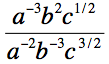 ?
?
Which of the following is equivalent to ?
First, we can use the property of exponents that xy/xz = xy–z

Then we can use the property of exponents that states x–y = 1/xy
a–1b5c–1 = b5/ac
First, we can use the property of exponents that xy/xz = xy–z
Then we can use the property of exponents that states x–y = 1/xy
a–1b5c–1 = b5/ac
Compare your answer with the correct one above
What is the value of x when 3x + 5 = 2x – 7?
What is the value of x when 3x + 5 = 2x – 7?
To answer this question we need to isolate x. A useful first step is to subtract 5 from both sides. The expression then becomes 3x = 2x – 12. Then we can subtract 2x from both sides. This leaves x = –12.
To answer this question we need to isolate x. A useful first step is to subtract 5 from both sides. The expression then becomes 3x = 2x – 12. Then we can subtract 2x from both sides. This leaves x = –12.
Compare your answer with the correct one above
Simplify the following expression:
2x(x2 + 4ax – 3a2) – 4a2(4x + 3a)
Simplify the following expression:
2x(x2 + 4ax – 3a2) – 4a2(4x + 3a)
Begin by distributing each part:
2x(x2 + 4ax – 3a2) = 2x * x2 + 2x * 4ax – 2x * 3a2 = 2x3 + 8ax2 – 6a2x
The second:
–4a2(4x + 3a) = –16a2x – 12a3
Now, combine these:
2x3 + 8ax2 – 6a2x – 16a2x – 12a3
The only common terms are those with a2x; therefore, this reduces to
2x3 + 8ax2 – 22a2x – 12a3
This is the same as the given answer:
–12a3 – 22a2x + 8ax2 + 2x3
Begin by distributing each part:
2x(x2 + 4ax – 3a2) = 2x * x2 + 2x * 4ax – 2x * 3a2 = 2x3 + 8ax2 – 6a2x
The second:
–4a2(4x + 3a) = –16a2x – 12a3
Now, combine these:
2x3 + 8ax2 – 6a2x – 16a2x – 12a3
The only common terms are those with a2x; therefore, this reduces to
2x3 + 8ax2 – 22a2x – 12a3
This is the same as the given answer:
–12a3 – 22a2x + 8ax2 + 2x3
Compare your answer with the correct one above
Simplify the following rational expression:
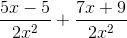
Simplify the following rational expression:
Since both rational terms in the expression have the common denominator  , combine the numerators and simplify like terms:
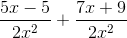
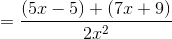


Since both rational terms in the expression have the common denominator
Compare your answer with the correct one above
Simplify the expression, leaving no radicals in the denominator:

Simplify the expression, leaving no radicals in the denominator:
The easy way to solve this problem is to multiply both halves of the fraction by the conjugate of the denominator, since this will eliminate the radical in the denominator.
 Conjugate the fraction.
Next, simplify the denominator, eliminating any terms you can along the way.

Thus,  is our answer.
The easy way to solve this problem is to multiply both halves of the fraction by the conjugate of the denominator, since this will eliminate the radical in the denominator.
Next, simplify the denominator, eliminating any terms you can along the way.
Thus,
Compare your answer with the correct one above
If x = y – 3, then (y – x)3 =
If x = y – 3, then (y – x)3 =
Solve for equation for y – x = 3. Then, plug in 3 into (y – x)3 = 27.
Solve for equation for y – x = 3. Then, plug in 3 into (y – x)3 = 27.
Compare your answer with the correct one above
Simplify the following rational expression: (9x - 2)/(x2) MINUS (6x - 8)/(x2)
Simplify the following rational expression: (9x - 2)/(x2) MINUS (6x - 8)/(x2)
Since both expressions have a common denominator, x2, we can just recopy the denominator and focus on the numerators. We get (9x - 2) - (6x - 8). We must distribute the negative sign over the 6x - 8 expression which gives us 9x - 2 - 6x + 8 ( -2 minus a -8 gives a +6 since a negative and negative make a positive). The numerator is therefore 3x + 6.
Since both expressions have a common denominator, x2, we can just recopy the denominator and focus on the numerators. We get (9x - 2) - (6x - 8). We must distribute the negative sign over the 6x - 8 expression which gives us 9x - 2 - 6x + 8 ( -2 minus a -8 gives a +6 since a negative and negative make a positive). The numerator is therefore 3x + 6.
Compare your answer with the correct one above
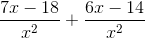
Simplify the following rational expression:
Simplify the following rational expression:
Since both fractions in the expression have a common denominator of  , we can combine like terms into a single numerator over the denominator:
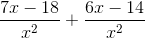
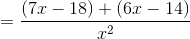

Since both fractions in the expression have a common denominator of
Compare your answer with the correct one above
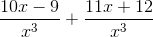
Simplify the following expression:
Simplify the following expression:
Since both terms in the expression have the common denominator  , combine the fractions and simplify the numerators:
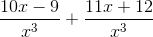


Since both terms in the expression have the common denominator
Compare your answer with the correct one above
Compute the following: 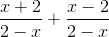
Compute the following:
Notice that the denominator are the same for both terms. Since they are both the same, the fractions can be added. The denominator will not change in this problem.

Notice that the denominator are the same for both terms. Since they are both the same, the fractions can be added. The denominator will not change in this problem.
Compare your answer with the correct one above
Combine the following rational expressions:

Combine the following rational expressions:
When working with complex fractions, it is important not to let them intimidate you. They follow the same rules as regular fractions!
In this case, our problem is made easier by the fact that we already have a common denominator. Nothing fancy is required to start. Simply add the numerators:

For our next step, we need to combine like terms. This is easier to see if we group them together.

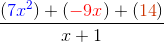
Thus, our final answer is:
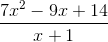
When working with complex fractions, it is important not to let them intimidate you. They follow the same rules as regular fractions!
In this case, our problem is made easier by the fact that we already have a common denominator. Nothing fancy is required to start. Simply add the numerators:
For our next step, we need to combine like terms. This is easier to see if we group them together.
Thus, our final answer is:
Compare your answer with the correct one above
Simplify the following expression:

Simplify the following expression:
In order to add fractions, we must first make sure they have the same denominator.
So, we multiply  by
by  and get the following:


Then, we add across the numerators and simplify:
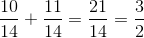
In order to add fractions, we must first make sure they have the same denominator.
So, we multiply
Then, we add across the numerators and simplify:
Compare your answer with the correct one above
Simplify the following:
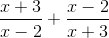
Simplify the following:
To simplify the following, a common denominator must be achieved. In this case, the first term must be multiplied by (x+2) in both the numerator and denominator and likewise with the second term with (x-3).

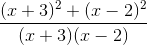
To simplify the following, a common denominator must be achieved. In this case, the first term must be multiplied by (x+2) in both the numerator and denominator and likewise with the second term with (x-3).
Compare your answer with the correct one above
Simplify the following 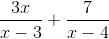
Simplify the following
Find the least common denominator between x-3 and x-4, which is (x-3)(x-4). Therefore, you have  . Multiplying the terms out equals
 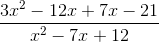 . Combining like terms results in
 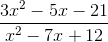 .
.
Find the least common denominator between x-3 and x-4, which is (x-3)(x-4). Therefore, you have
Compare your answer with the correct one above