
Coordinate Plane - ACT Math
Card 0 of 2502
Which of the following graphs does NOT represent a function?
Which of the following graphs does NOT represent a function?
This question relies on both the vertical-line test and the definition of a function. We need to use the vertical-line test to determine which of the graphs is not a function (i.e. the graph that has more than one output for a given input). The vertical-line test states that a graph represents a function when a vertical line can be drawn at every point in the graph and only intersect it at one point; thus, if a vertical line is drawn in a graph and it intersects that graph at more than one point, then the graph is not a function. The circle is the only answer choice that fails the vertical-line test, and so it is not a function.
This question relies on both the vertical-line test and the definition of a function. We need to use the vertical-line test to determine which of the graphs is not a function (i.e. the graph that has more than one output for a given input). The vertical-line test states that a graph represents a function when a vertical line can be drawn at every point in the graph and only intersect it at one point; thus, if a vertical line is drawn in a graph and it intersects that graph at more than one point, then the graph is not a function. The circle is the only answer choice that fails the vertical-line test, and so it is not a function.
Compare your answer with the correct one above
Suppose  .
.
To obtain the graph of  , shift the graph
  a distance of
  units .
Suppose
To obtain the graph of
There are four shifts of the graph y = f(x):
y = f(x) + c shifts the graph c units upwards.
y = f(x) – c shifts the graph c units downwards.
y = f(x + c) shifts the graph c units to the left.
y = f(x – c) shifts the graph c units to the right.
There are four shifts of the graph y = f(x):
y = f(x) + c shifts the graph c units upwards.
y = f(x) – c shifts the graph c units downwards.
y = f(x + c) shifts the graph c units to the left.
y = f(x – c) shifts the graph c units to the right.
Compare your answer with the correct one above
Which of the given functions is depicted below?
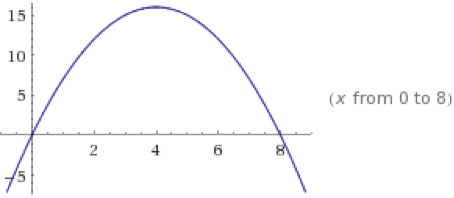
Which of the given functions is depicted below?
The graph has x-intercepts at x = 0 and x = 8. This indicates that 0 and 8 are roots of the function.
The function must take the form y = x(x - 8) in order for these roots to be true.
The parabola opens downward, indicating a negative leading coefficient. Expand the equation to get our answer.
y = -x(x - 8)
y = -x2 + 8x
y = 8x - x2
Therefore, the answer must be y = 8x - x2
The graph has x-intercepts at x = 0 and x = 8. This indicates that 0 and 8 are roots of the function.
The function must take the form y = x(x - 8) in order for these roots to be true.
The parabola opens downward, indicating a negative leading coefficient. Expand the equation to get our answer.
y = -x(x - 8)
y = -x2 + 8x
y = 8x - x2
Therefore, the answer must be y = 8x - x2
Compare your answer with the correct one above
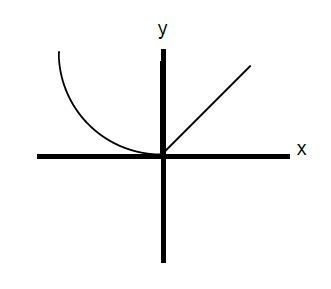
The figure above shows the graph of y = f(x). Which of the following is the graph of y = |f(x)|?
The figure above shows the graph of y = f(x). Which of the following is the graph of y = |f(x)|?
One of the properties of taking an absolute value of a function is that the values are all made positive. The values themselves do not change; only their signs do. In this graph, none of the y-values are negative, so none of them would change. Thus the two graphs should be identical.
One of the properties of taking an absolute value of a function is that the values are all made positive. The values themselves do not change; only their signs do. In this graph, none of the y-values are negative, so none of them would change. Thus the two graphs should be identical.
Compare your answer with the correct one above
Circle  has diameter
  , which intersects the circle at points
  and
and  . Given this information, which of the following is an accurate equation for circle
  ?
?
Circle
The basic formula for a circle in the coordinate plane is  , where
  is the center of the circle with radius
  .
.
We know that  , since that is the only way a diameter can pass through the circle and intercept an x-coordinate of
  at both ends.
  , on the other hand, may be seen as halfway between one y-coordinate and the other y-coordinate. Averaging the two, we get:
 , so
, so  becomes our
  . Since the diameter is
  units long, we know the radius is half that, so
  .
.
Thus, we have  .
.
The basic formula for a circle in the coordinate plane is
We know that
Thus, we have
Compare your answer with the correct one above
Solve the following system of equations:
–2x + 3y = 10
2x + 5y = 6
Solve the following system of equations:
–2x + 3y = 10
2x + 5y = 6
Since we have –2x and +2x in the equations, it makes sense to add the equations together to give 8y = 16 yielding y = 2. Then we substitute y = 2 into one of the original equations to get x = –2. So the solution to the system of equations is (–2, 2)
Since we have –2x and +2x in the equations, it makes sense to add the equations together to give 8y = 16 yielding y = 2. Then we substitute y = 2 into one of the original equations to get x = –2. So the solution to the system of equations is (–2, 2)
Compare your answer with the correct one above
What is the equation of a circle centered around the point  with a radius of
  ?
?
What is the equation of a circle centered around the point
The formula for a circle centered around a point  with radius
  is given by:
 .
.
Thus we see the answer is

The formula for a circle centered around a point
Thus we see the answer is
Compare your answer with the correct one above
What is the  of the following equation:
  ?
?
What is the
The y-intercept is the constant at the end of the equation. Thus for our equation the y-intercept is 7
The y-intercept is the constant at the end of the equation. Thus for our equation the y-intercept is 7
Compare your answer with the correct one above
What is the equation for a circle of radius 12, centered at the intersection of the two lines:
y_1 = 4_x + 3
and
y_2 = 5_x + 44?
What is the equation for a circle of radius 12, centered at the intersection of the two lines:
y_1 = 4_x + 3
and
y_2 = 5_x + 44?
To begin, let us determine the point of intersection of these two lines by setting the equations equal to each other:
4_x_ + 3 = 5_x_ + 44; 3 = x + 44; –41 = x
To find the y-coordinate, substitute into one of the equations. Let's use _y_1:
y = 4 * –41 + 3 = –164 + 3 = –161
The center of our circle is therefore: (–41, –161).
Now, recall that the general form for a circle with center at (_x_0, _y_0) is:
(x - _x_0)2 + (y - _y_0)2 = _r_2
For our data, this means that our equation is:
(x + 41)2 + (y + 161)2 = 122 or (x + 41)2 + (y + 161)2 = 144
To begin, let us determine the point of intersection of these two lines by setting the equations equal to each other:
4_x_ + 3 = 5_x_ + 44; 3 = x + 44; –41 = x
To find the y-coordinate, substitute into one of the equations. Let's use _y_1:
y = 4 * –41 + 3 = –164 + 3 = –161
The center of our circle is therefore: (–41, –161).
Now, recall that the general form for a circle with center at (_x_0, _y_0) is:
(x - _x_0)2 + (y - _y_0)2 = _r_2
For our data, this means that our equation is:
(x + 41)2 + (y + 161)2 = 122 or (x + 41)2 + (y + 161)2 = 144
Compare your answer with the correct one above
What is the equation for a circle of radius 9, centered at the intersection of the following two lines?


What is the equation for a circle of radius 9, centered at the intersection of the following two lines?
To begin, let us determine the point of intersection of these two lines by setting the equations equal to each other:


To find the y-coordinate, substitute into one of the equations. Let's use  :
:


The center of our circle is therefore  .
.
Now, recall that the general form for a circle with center at  is
is

For our data, this means that our equation is:


To begin, let us determine the point of intersection of these two lines by setting the equations equal to each other:
To find the y-coordinate, substitute into one of the equations. Let's use
The center of our circle is therefore
Now, recall that the general form for a circle with center at
For our data, this means that our equation is:
Compare your answer with the correct one above
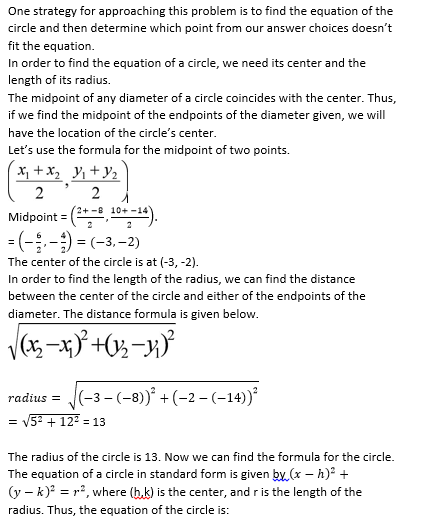
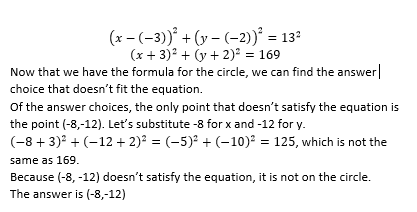
The diameter of a circle has endpoints at points (2, 10) and (–8, –14). Which of the following points does NOT lie on the circle?
The diameter of a circle has endpoints at points (2, 10) and (–8, –14). Which of the following points does NOT lie on the circle?
Compare your answer with the correct one above
What is the equation of a circle centered about the origin with a radius of 7? Simplify all exponential expressions if possible.
What is the equation of a circle centered about the origin with a radius of 7? Simplify all exponential expressions if possible.
The general formula for a circle centered about points  with a radius of
  is:
is:
 .
.
Since we are centered about the origin both  and
and  are zero. Thus the equation we have is:
 after simplifying
The general formula for a circle centered about points
Since we are centered about the origin both
Compare your answer with the correct one above
The Y axis is a of the function Y = 1/X
The Y axis is a of the function Y = 1/X
A line is an asymptote in a graph if the graph of the function nears the line as X or Y gets larger in absolute value.
A line is an asymptote in a graph if the graph of the function nears the line as X or Y gets larger in absolute value.
Compare your answer with the correct one above
What is the domain of the following function:
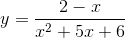
What is the domain of the following function:
The denominator cannot be zero, otherwise the function is indefinite. Therefore x cannot be –2 or –3.
The denominator cannot be zero, otherwise the function is indefinite. Therefore x cannot be –2 or –3.
Compare your answer with the correct one above
What is the equation of a circle with center  and radius of
  ?
?
What is the equation of a circle with center
The basic formula for a circle in the coordinate plane is  , where
  is the center of the circle with radius
  .
.
Using this, we can simply substitute  for
for  ,
,  for
for  , and
, and  for
for  . Customarily,
  is simplified for the final equation.
 ---->
---->  .
.
The basic formula for a circle in the coordinate plane is
Using this, we can simply substitute
Compare your answer with the correct one above
Circle A is centered about the origin and has a radius of 5. What is the equation of the line that is tangent to Circle A at the point (–3,4)?
Circle A is centered about the origin and has a radius of 5. What is the equation of the line that is tangent to Circle A at the point (–3,4)?
The line must be perpendicular to the radius at the point (–3,4). The slope of the radius is given by 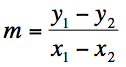
The radius has endpoints (–3,4) and the center of the circle (0,0), so its slope is –4/3.
The slope of the tangent line must be perpendicular to the slope of the radius, so the slope of the line is ¾.
The equation of the line is y – 4 = (3/4)(x – (–3))
Rearranging gives us: 3_x_ – 4_y_ = -25
The line must be perpendicular to the radius at the point (–3,4). The slope of the radius is given by
The radius has endpoints (–3,4) and the center of the circle (0,0), so its slope is –4/3.
The slope of the tangent line must be perpendicular to the slope of the radius, so the slope of the line is ¾.
The equation of the line is y – 4 = (3/4)(x – (–3))
Rearranging gives us: 3_x_ – 4_y_ = -25
Compare your answer with the correct one above
Give the equation, in slope-intercept form, of the line tangent to the circle of the equation

at the point  .
.
Give the equation, in slope-intercept form, of the line tangent to the circle of the equation
at the point
Rewrite the equation of the circle in standard form to find its center:


Complete the square:


The center is  .
.
A tangent to this circle at a given point is perpendicular to the radius to that point. The radius with endpoints  and
and  will have slope
 ,
,
so the tangent line has the opposite of the reciprocal of this, or  , as its slope.
The tangent line therefore has equation


Rewrite the equation of the circle in standard form to find its center:
Complete the square:
The center is
A tangent to this circle at a given point is perpendicular to the radius to that point. The radius with endpoints
so the tangent line has the opposite of the reciprocal of this, or
The tangent line therefore has equation
Compare your answer with the correct one above
Give the equation, in slope-intercept form, of the line tangent to the circle of the equation

at the point  .
.
Give the equation, in slope-intercept form, of the line tangent to the circle of the equation
at the point
The graph of the equation  is a circle with center
  .
.
A tangent to this circle at a given point is perpendicular to the radius to that point. The radius with endpoints  and
and  will have slope
 ,
,
so the tangent line has the opposite of the reciprocal of this, or  , as its slope.
The tangent line therefore has equation


The graph of the equation
A tangent to this circle at a given point is perpendicular to the radius to that point. The radius with endpoints
so the tangent line has the opposite of the reciprocal of this, or
The tangent line therefore has equation
Compare your answer with the correct one above
What is the equation of a tangent line to

at point  ?
?
What is the equation of a tangent line to
at point
To find an equation tangent to

we need to find the first derviative of this equation with respect to  to get the slope
  of the tangent line.
So,

due to power rule  .
.
First we need to find our slope by plugging our  into the derivative equation and solving.
Thus, the slope is

 .
.
To find the equation of a tangent line of a given point  we plug the point into
 .
.
Therefore our equation becomes,

Once we rearrange, the equation is

To find an equation tangent to
we need to find the first derviative of this equation with respect to
So,
due to power rule
First we need to find our slope by plugging our
Thus, the slope is
To find the equation of a tangent line of a given point
Therefore our equation becomes,
Once we rearrange, the equation is
Compare your answer with the correct one above
What is the equation of a tangent line to

at point
 ?
?
What is the equation of a tangent line to
at point
To find an equation tangent to

we need to find the first derviative of this equation with respect to  to get the slope
  of the tangent line.
So,

due to power rule  .
.
First we need to find our slope by plugging in our  into the derivative equation and solving.
Thus, the slope is

 .
.
To find the equation of a tangent line of a given point  , we plug the point into
 .
.
Therefore our equation is

Once we rearrange, the equation is

To find an equation tangent to
we need to find the first derviative of this equation with respect to
So,
due to power rule
First we need to find our slope by plugging in our
Thus, the slope is
To find the equation of a tangent line of a given point
Therefore our equation is
Once we rearrange, the equation is
Compare your answer with the correct one above