
Algebra - ACT Math
Card 0 of 11421
11/(x – 7) + 4/(7 – x) = ?
11/(x – 7) + 4/(7 – x) = ?
We must find a common denominator and here they changed the first fraction by removing a negative from the numerator and denominator, leaving –11/(7 – x). We add the numerators and keep the same denominator to find the answer.
We must find a common denominator and here they changed the first fraction by removing a negative from the numerator and denominator, leaving –11/(7 – x). We add the numerators and keep the same denominator to find the answer.
Compare your answer with the correct one above
Which of the following graphs does NOT represent a function?
Which of the following graphs does NOT represent a function?
This question relies on both the vertical-line test and the definition of a function. We need to use the vertical-line test to determine which of the graphs is not a function (i.e. the graph that has more than one output for a given input). The vertical-line test states that a graph represents a function when a vertical line can be drawn at every point in the graph and only intersect it at one point; thus, if a vertical line is drawn in a graph and it intersects that graph at more than one point, then the graph is not a function. The circle is the only answer choice that fails the vertical-line test, and so it is not a function.
This question relies on both the vertical-line test and the definition of a function. We need to use the vertical-line test to determine which of the graphs is not a function (i.e. the graph that has more than one output for a given input). The vertical-line test states that a graph represents a function when a vertical line can be drawn at every point in the graph and only intersect it at one point; thus, if a vertical line is drawn in a graph and it intersects that graph at more than one point, then the graph is not a function. The circle is the only answer choice that fails the vertical-line test, and so it is not a function.
Compare your answer with the correct one above
Suppose  .
.
To obtain the graph of  , shift the graph
  a distance of
  units .
Suppose
To obtain the graph of
There are four shifts of the graph y = f(x):
y = f(x) + c shifts the graph c units upwards.
y = f(x) – c shifts the graph c units downwards.
y = f(x + c) shifts the graph c units to the left.
y = f(x – c) shifts the graph c units to the right.
There are four shifts of the graph y = f(x):
y = f(x) + c shifts the graph c units upwards.
y = f(x) – c shifts the graph c units downwards.
y = f(x + c) shifts the graph c units to the left.
y = f(x – c) shifts the graph c units to the right.
Compare your answer with the correct one above
Which of the given functions is depicted below?
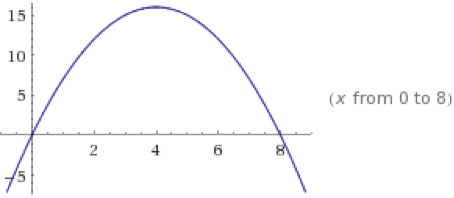
Which of the given functions is depicted below?
The graph has x-intercepts at x = 0 and x = 8. This indicates that 0 and 8 are roots of the function.
The function must take the form y = x(x - 8) in order for these roots to be true.
The parabola opens downward, indicating a negative leading coefficient. Expand the equation to get our answer.
y = -x(x - 8)
y = -x2 + 8x
y = 8x - x2
Therefore, the answer must be y = 8x - x2
The graph has x-intercepts at x = 0 and x = 8. This indicates that 0 and 8 are roots of the function.
The function must take the form y = x(x - 8) in order for these roots to be true.
The parabola opens downward, indicating a negative leading coefficient. Expand the equation to get our answer.
y = -x(x - 8)
y = -x2 + 8x
y = 8x - x2
Therefore, the answer must be y = 8x - x2
Compare your answer with the correct one above
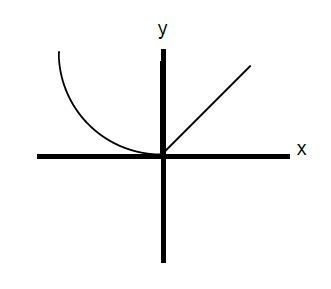
The figure above shows the graph of y = f(x). Which of the following is the graph of y = |f(x)|?
The figure above shows the graph of y = f(x). Which of the following is the graph of y = |f(x)|?
One of the properties of taking an absolute value of a function is that the values are all made positive. The values themselves do not change; only their signs do. In this graph, none of the y-values are negative, so none of them would change. Thus the two graphs should be identical.
One of the properties of taking an absolute value of a function is that the values are all made positive. The values themselves do not change; only their signs do. In this graph, none of the y-values are negative, so none of them would change. Thus the two graphs should be identical.
Compare your answer with the correct one above
Which of the following is a factor of the polynomial x_2 – 6_x + 5?
Which of the following is a factor of the polynomial x_2 – 6_x + 5?
Factor the polynomial by choosing values that when FOIL'ed will add to equal the middle coefficient, 3, and multiply to equal the constant, 1.
x_2 – 6_x + 5 = (x – 1)(x – 5)
Because only (x – 5) is one of the choices listed, we choose it.
Factor the polynomial by choosing values that when FOIL'ed will add to equal the middle coefficient, 3, and multiply to equal the constant, 1.
x_2 – 6_x + 5 = (x – 1)(x – 5)
Because only (x – 5) is one of the choices listed, we choose it.
Compare your answer with the correct one above
Given that x = 2 and y = 3, how much less is the value of 3_x_2 – 2_y_ than the value of 3_y_2 – 2_x_?
Given that x = 2 and y = 3, how much less is the value of 3_x_2 – 2_y_ than the value of 3_y_2 – 2_x_?
First, we solve each expression by plugging in the given values for x and y:
3(22) – 2(3) = 12 – 6 = 6
3(32) – 2(2) = 27 – 4 = 23
Then we find the difference between the first and second expressions’ values:
23 – 6 = 17
First, we solve each expression by plugging in the given values for x and y:
3(22) – 2(3) = 12 – 6 = 6
3(32) – 2(2) = 27 – 4 = 23
Then we find the difference between the first and second expressions’ values:
23 – 6 = 17
Compare your answer with the correct one above
Evaluate 4x2 + 6x – 17, when x = 3.
Evaluate 4x2 + 6x – 17, when x = 3.
Plug in 3 for x, giving you 36 + 18 – 17, which equals 37.
Plug in 3 for x, giving you 36 + 18 – 17, which equals 37.
Compare your answer with the correct one above
John has a motorcycle. He drives it to the store, which is 30 miles away. It takes him 30 minutes to drive there and 60 minutes to drive back, due to traffic. What was his average speed roundtrip in miles per hour?
John has a motorcycle. He drives it to the store, which is 30 miles away. It takes him 30 minutes to drive there and 60 minutes to drive back, due to traffic. What was his average speed roundtrip in miles per hour?
The whole trip is 60 miles, and it takes 90 minutes, which is 1.5 hours.
Miles per hour is 60/1.5 = 40 mph
The whole trip is 60 miles, and it takes 90 minutes, which is 1.5 hours.
Miles per hour is 60/1.5 = 40 mph
Compare your answer with the correct one above
If (xy/2) – 3_w_ = –9, what is the value of w in terms of x and y?
If (xy/2) – 3_w_ = –9, what is the value of w in terms of x and y?
–3_w_ = –9 – (xy/2)
w = 3 + (xy/6)
–3_w_ = –9 – (xy/2)
w = 3 + (xy/6)
Compare your answer with the correct one above
Evaluate 5_x_2 + 16_x_ + 7 when x = 7
Evaluate 5_x_2 + 16_x_ + 7 when x = 7
Plug in 7 for x and you get 5(49) + 16(7) + 7 = 364
Plug in 7 for x and you get 5(49) + 16(7) + 7 = 364
Compare your answer with the correct one above
Factor the polynomial: 2x2 + ab – 2b – ax2
Factor the polynomial: 2x2 + ab – 2b – ax2
2x2 + ab – 2b – ax2 = 2x2 – 2b – ax2 + ab
Rearrange terms
= (2x2 – 2b) + (- ax2 + ab) Group
= 2(x2 – b) + a(-x2 + b) Factor each group
= 2(x2 – b) – a(x2 – b) Factor out -a
= (x2 – b) (2 – a) Factor out x2 – b
2x2 + ab – 2b – ax2 = 2x2 – 2b – ax2 + ab
Rearrange terms
= (2x2 – 2b) + (- ax2 + ab) Group
= 2(x2 – b) + a(-x2 + b) Factor each group
= 2(x2 – b) – a(x2 – b) Factor out -a
= (x2 – b) (2 – a) Factor out x2 – b
Compare your answer with the correct one above
Which of the following expressions is a factor of this polynomial?

Which of the following expressions is a factor of this polynomial?
The polynomial factors into the following expression:

Therefore, the answer is 
The polynomial factors into the following expression:
Therefore, the answer is
Compare your answer with the correct one above
Solve for x: (x2 – x) / (x – 1) = 1
Solve for x: (x2 – x) / (x – 1) = 1
Begin by multiplying both sides by (x – 1):
x2 – x = x – 1
Solve as a quadratic equation: x2 – 2x + 1 = 0
Factor the left: (x – 1)(x – 1) = 0
Therefore, x = 1.
However, notice that in the original equation, a value of 1 for x would place a 0 in the denominator. Therefore, there is no solution.
Begin by multiplying both sides by (x – 1):
x2 – x = x – 1
Solve as a quadratic equation: x2 – 2x + 1 = 0
Factor the left: (x – 1)(x – 1) = 0
Therefore, x = 1.
However, notice that in the original equation, a value of 1 for x would place a 0 in the denominator. Therefore, there is no solution.
Compare your answer with the correct one above
Solve 3x2 + 10x = –3
Solve 3x2 + 10x = –3
Generally, quadratic equations have two answers.
First, the equations must be put in standard form: 3x2 + 10x + 3 = 0
Second, try to factor the quadratic; however, if that is not possible use the quadratic formula.
Third, check the answer by plugging the answers back into the original equation.
Generally, quadratic equations have two answers.
First, the equations must be put in standard form: 3x2 + 10x + 3 = 0
Second, try to factor the quadratic; however, if that is not possible use the quadratic formula.
Third, check the answer by plugging the answers back into the original equation.
Compare your answer with the correct one above
What is the value of m where:


What is the value of m where:
If n=4, then 64(4/12)=64(1/3)=4. Then, 4=m4(1+m)/(m+4). If 2 is substituted for m, then 4=24(1+2)/(2+4)=241/2=2√4=22=4.
If n=4, then 64(4/12)=64(1/3)=4. Then, 4=m4(1+m)/(m+4). If 2 is substituted for m, then 4=24(1+2)/(2+4)=241/2=2√4=22=4.
Compare your answer with the correct one above
For this question, the following trigonometric identities apply:
 ,
,


Simplify: 
For this question, the following trigonometric identities apply:
Simplify:
To begin a problem like this, you must first convert everything to  and
and  alone. This way, you can begin to cancel and combine to its most simplified form.
Since  and
and  , we insert those identities into the equation as follows.

From here we combine the numerator and denominators of each fraction together to easily see what we can combine and cancel.

Since there is a  in the numerator and the denominator, we can cancel them as they divide to equal 1. All we have left is
  , the answer.
To begin a problem like this, you must first convert everything to
Since
From here we combine the numerator and denominators of each fraction together to easily see what we can combine and cancel.
Since there is a
Compare your answer with the correct one above
Circle  has diameter
  , which intersects the circle at points
  and
and  . Given this information, which of the following is an accurate equation for circle
  ?
?
Circle
The basic formula for a circle in the coordinate plane is  , where
  is the center of the circle with radius
  .
.
We know that  , since that is the only way a diameter can pass through the circle and intercept an x-coordinate of
  at both ends.
  , on the other hand, may be seen as halfway between one y-coordinate and the other y-coordinate. Averaging the two, we get:
 , so
, so  becomes our
  . Since the diameter is
  units long, we know the radius is half that, so
  .
.
Thus, we have  .
.
The basic formula for a circle in the coordinate plane is
We know that
Thus, we have
Compare your answer with the correct one above
The population of a bird species is modeled by the following equation:
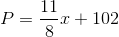 ,
,
where  represents the number of years from the present. How many years will it take the population to reach 130 birds (rounded to the nearest tenth)?
The population of a bird species is modeled by the following equation:
where
Plugging in 130 for P, the equation becomes 130 = (11/8)x + 102. Solving for x, we obtain x = 20.4 years.
Plugging in 130 for P, the equation becomes 130 = (11/8)x + 102. Solving for x, we obtain x = 20.4 years.
Compare your answer with the correct one above
If bx + c = e – ax, then what is x?
If bx + c = e – ax, then what is x?
To solve for x:
bx + c = e – ax
bx + ax = e – c
x(b+a) = e-c
x = (e-c) / (b+a)
To solve for x:
bx + c = e – ax
bx + ax = e – c
x(b+a) = e-c
x = (e-c) / (b+a)
Compare your answer with the correct one above