
Physical Science - 5th Grade Science
Card 1 of 372
True or False: Atoms are too small to be seen with the naked eye.
True or False: Atoms are too small to be seen with the naked eye.
Tap to reveal answer
Atoms are what make up all matter. They are the smallest particles of any element. They still have the same properties as the element they make up. An atom of aluminum still has the same melting point as an aluminum can. They are so tiny we cannot see their color, but if we zoomed in with a scanning tunneling microscope or electron microscope, we would see they would be the same color. We cannot see atoms with the naked eye. Trillions of atoms could fit inside the dot on top of the letter "i." The radius of an atom is less than one nanometer or a billionth of a meter.
Atoms are what make up all matter. They are the smallest particles of any element. They still have the same properties as the element they make up. An atom of aluminum still has the same melting point as an aluminum can. They are so tiny we cannot see their color, but if we zoomed in with a scanning tunneling microscope or electron microscope, we would see they would be the same color. We cannot see atoms with the naked eye. Trillions of atoms could fit inside the dot on top of the letter "i." The radius of an atom is less than one nanometer or a billionth of a meter.
← Didn't Know|Knew It →
What is the name of the scientific theory that recognizes that all matter is made of up parts that are too small to be seen without magnification?
What is the name of the scientific theory that recognizes that all matter is made of up parts that are too small to be seen without magnification?
Tap to reveal answer
Atomic theory is the name of the theory described in the question. Atoms are very tiny and cannot be seen without a microscope. They are made up of parts that determine what the atom is, how it acts, and its mass. Inside of atoms are protons, neutrons, and electrons.
Atomic theory is the name of the theory described in the question. Atoms are very tiny and cannot be seen without a microscope. They are made up of parts that determine what the atom is, how it acts, and its mass. Inside of atoms are protons, neutrons, and electrons.
← Didn't Know|Knew It →
Which property identifies water vapor as a gas?
Which property identifies water vapor as a gas?
Tap to reveal answer
Water vapor is a gas, and you may have heard the term when discussing the water cycle or evaporation. When thinking about the three states of matter that can describe a substance, it can be either a solid, liquid, or gas. These can be hot or cold by definition, colorless, light or heavy, but only one ca spread through their air with no definite shape; that is a gas. A gas has no shape and would spread throughout the air; if it is trapped in a container, it will continue to move about the container and not remain stationary.
Water vapor is a gas, and you may have heard the term when discussing the water cycle or evaporation. When thinking about the three states of matter that can describe a substance, it can be either a solid, liquid, or gas. These can be hot or cold by definition, colorless, light or heavy, but only one ca spread through their air with no definite shape; that is a gas. A gas has no shape and would spread throughout the air; if it is trapped in a container, it will continue to move about the container and not remain stationary.
← Didn't Know|Knew It →
Select the answer that is a physical change.
Select the answer that is a physical change.
Tap to reveal answer
A physical change is a change is a substance that does not change what the substance is. In contrast, in chemical change a new substance is formed.
Let's look at our options:
When wood is burned, the wood turns into ash. We can't get the piece of wood back once it's been burned; thus, wood burning is a chemical change.
When a cake is baked, the ingredients combine and turn into a cake once it's baked. Once we have a cake, we can't get the ingredients back; thus, baking a cake is a chemical change.
When a nail rusts, pieces of the metal nail have turned into rust. We can't get the original nail back; thus, a nail rusting is a chemical change.
Ice is made up of water, and when the ice melts we are left with a puddle of water. If we freeze the water, it will turn back into ice; thus, melting ice is a physical change.
A physical change is a change is a substance that does not change what the substance is. In contrast, in chemical change a new substance is formed.
Let's look at our options:
When wood is burned, the wood turns into ash. We can't get the piece of wood back once it's been burned; thus, wood burning is a chemical change.
When a cake is baked, the ingredients combine and turn into a cake once it's baked. Once we have a cake, we can't get the ingredients back; thus, baking a cake is a chemical change.
When a nail rusts, pieces of the metal nail have turned into rust. We can't get the original nail back; thus, a nail rusting is a chemical change.
Ice is made up of water, and when the ice melts we are left with a puddle of water. If we freeze the water, it will turn back into ice; thus, melting ice is a physical change.
← Didn't Know|Knew It →
Select the answer that is a physical change.
Select the answer that is a physical change.
Tap to reveal answer
A physical change is a change is a substance that does not change what the substance is. In contrast, in chemical change a new substance is formed.
Let's look at our options:
When wood is burned, the wood turns into ash. We can't get the piece of wood back once it's been burned; thus, wood burning is a chemical change.
When a cake is baked, the ingredients combine and turn into a cake once it's baked. Once we have a cake, we can't get the ingredients back; thus, baking a cake is a chemical change.
When a nail rusts, pieces of the metal nail have turned into rust. We can't get the original nail back; thus, a nail rusting is a chemical change.
Cutting a piece of wood does not change the wood, it's still a piece of wood, just smaller; thus, cutting a piece of wood is a physical change.
A physical change is a change is a substance that does not change what the substance is. In contrast, in chemical change a new substance is formed.
Let's look at our options:
When wood is burned, the wood turns into ash. We can't get the piece of wood back once it's been burned; thus, wood burning is a chemical change.
When a cake is baked, the ingredients combine and turn into a cake once it's baked. Once we have a cake, we can't get the ingredients back; thus, baking a cake is a chemical change.
When a nail rusts, pieces of the metal nail have turned into rust. We can't get the original nail back; thus, a nail rusting is a chemical change.
Cutting a piece of wood does not change the wood, it's still a piece of wood, just smaller; thus, cutting a piece of wood is a physical change.
← Didn't Know|Knew It →
Select the answer that is a chemical change.
Select the answer that is a chemical change.
Tap to reveal answer
A physical change is a change is a substance that does not change what the substance is. In contrast, in chemical change a new substance is formed.
Let's look at our options:
Ice is made up of water, and when the ice melts we are left with a puddle of water. If we freeze the water, it will turn back into ice; thus, melting ice is a physical change.
Cutting a piece of wood does not change the wood, it's still a piece of wood, just smaller; thus, cutting a piece of wood is a physical change.
Butter melting is similar to ice melting. When butter melts, it can be frozen back to butter; thus, butter melting is a physical change.
When wood is burned, the wood turns into ash. We can't get the piece of wood back once it's been burned; thus, wood burning is a chemical change.
A physical change is a change is a substance that does not change what the substance is. In contrast, in chemical change a new substance is formed.
Let's look at our options:
Ice is made up of water, and when the ice melts we are left with a puddle of water. If we freeze the water, it will turn back into ice; thus, melting ice is a physical change.
Cutting a piece of wood does not change the wood, it's still a piece of wood, just smaller; thus, cutting a piece of wood is a physical change.
Butter melting is similar to ice melting. When butter melts, it can be frozen back to butter; thus, butter melting is a physical change.
When wood is burned, the wood turns into ash. We can't get the piece of wood back once it's been burned; thus, wood burning is a chemical change.
← Didn't Know|Knew It →
Inside of each atom (as tiny as they are) are even smaller individual particles called protons, neutrons, and electrons. Which of these particles has a negative charge?
Inside of each atom (as tiny as they are) are even smaller individual particles called protons, neutrons, and electrons. Which of these particles has a negative charge?
Tap to reveal answer
Electrons have a negative charge. The proton moves around the nucleus of an atom, which is in the center. The charge of an electron is opposite but equal to the charge of a proton. Atoms have the same number of electrons as protons. We cannot see these with our eyes, and even with a high-powered microscope, they are too tiny and too low in mass to see.
Electrons have a negative charge. The proton moves around the nucleus of an atom, which is in the center. The charge of an electron is opposite but equal to the charge of a proton. Atoms have the same number of electrons as protons. We cannot see these with our eyes, and even with a high-powered microscope, they are too tiny and too low in mass to see.
← Didn't Know|Knew It →
A meadow is an ecosystem where snakes and rabbits live. In which order does energy flow through this meadow ecosystem?
A meadow is an ecosystem where snakes and rabbits live. In which order does energy flow through this meadow ecosystem?
Tap to reveal answer
The energy in the meadow starts with the Sun. The Sun then provides energy to the grass through the process of photosynthesis. The rabbit eats the grass, and the rabbit absorbs its energy. Finally, the snake eats the rabbit, and it absorbs the rabbit's energy. Energy travels from the Sun and moves through the ecosystem with each consumer along the chain.
The energy in the meadow starts with the Sun. The Sun then provides energy to the grass through the process of photosynthesis. The rabbit eats the grass, and the rabbit absorbs its energy. Finally, the snake eats the rabbit, and it absorbs the rabbit's energy. Energy travels from the Sun and moves through the ecosystem with each consumer along the chain.
← Didn't Know|Knew It →
Which of the following statements is true?
Which of the following statements is true?
Tap to reveal answer
Gravity is a force that pulls objects downward, so when you jump up in the air you'll always come back down. Gravity doesn't mean that nothing can ever go up: trees can grow up into the sky, sand can blow into the air - but gravity keeps them from floating away.
Gravity is a force that pulls objects downward, so when you jump up in the air you'll always come back down. Gravity doesn't mean that nothing can ever go up: trees can grow up into the sky, sand can blow into the air - but gravity keeps them from floating away.
← Didn't Know|Knew It →
What are atoms?
What are atoms?
Tap to reveal answer
Atoms are what make up all matter. They are the smallest particles of any element. They still have the same properties as the element they make up. An atom of aluminum still has the same melting point as an aluminum can. They are so tiny we cannot see their color but if we zoomed in with a scanning tunneling microscope or electron microscope we would see they would be the same color.
Atoms are what make up all matter. They are the smallest particles of any element. They still have the same properties as the element they make up. An atom of aluminum still has the same melting point as an aluminum can. They are so tiny we cannot see their color but if we zoomed in with a scanning tunneling microscope or electron microscope we would see they would be the same color.
← Didn't Know|Knew It →
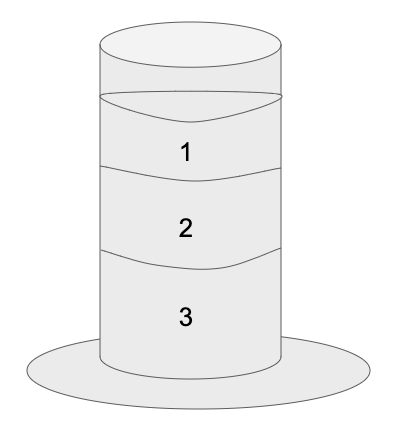
There are three different liquids layered in the graduated cylinder pictured. If we know that vegetable oil is more dense than water but less dense than honey, which of the liquids is most likely vegetable oil?
There are three different liquids layered in the graduated cylinder pictured. If we know that vegetable oil is more dense than water but less dense than honey, which of the liquids is most likely vegetable oil?
Tap to reveal answer
The answer is liquid number 2. Density is a measure of the amount of "stuff" in a given volume. More dense objects sink and less dense objects float.
The answer is liquid number 2. Density is a measure of the amount of "stuff" in a given volume. More dense objects sink and less dense objects float.
← Didn't Know|Knew It →
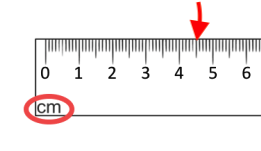
How many millimeters are being measured at the point where the red arrow is shown?
How many millimeters are being measured at the point where the red arrow is shown?
Tap to reveal answer
The answer is 45 because there are 10 millimeters in a centimeter and the ruler is measuring 4.5 centimeters.
The answer is 45 because there are 10 millimeters in a centimeter and the ruler is measuring 4.5 centimeters.
← Didn't Know|Knew It →
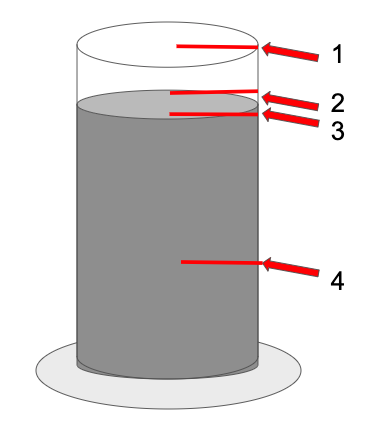
At which number should the volume of this liquid be measured?
At which number should the volume of this liquid be measured?
Tap to reveal answer
The answer is "at number 3" because you measure volume at the meniscus.
The answer is "at number 3" because you measure volume at the meniscus.
← Didn't Know|Knew It →
A student has three jars of powdered chemicals that are not labeled. One is salt, one is sugar, and the last one is baking soda. To figure out which is which, the student pours vinegar over each of them and one of them starts to bubble! What is the substance that reacts with vinegar?
A student has three jars of powdered chemicals that are not labeled. One is salt, one is sugar, and the last one is baking soda. To figure out which is which, the student pours vinegar over each of them and one of them starts to bubble! What is the substance that reacts with vinegar?
Tap to reveal answer
The answer is baking soda. Baking soda is a common household product that is a base. Vinegar is an acid. Acids and bases react chemically when combined.
The answer is baking soda. Baking soda is a common household product that is a base. Vinegar is an acid. Acids and bases react chemically when combined.
← Didn't Know|Knew It →

This is a block of aluminum. Which of the following is NOT a property of this object?
This is a block of aluminum. Which of the following is NOT a property of this object?
Tap to reveal answer
The answer is "it can be used to make other things." This is not a property of matter. Some common properties of matter are: color, luster (how shiny it is), texture, inertia, mass, weight, volume, density and specific gravity.
The answer is "it can be used to make other things." This is not a property of matter. Some common properties of matter are: color, luster (how shiny it is), texture, inertia, mass, weight, volume, density and specific gravity.
← Didn't Know|Knew It →
Which of the following is an observable property of matter?
Which of the following is an observable property of matter?
Tap to reveal answer
The answer is "all of these." This is not a property of matter. Some common properties of matter are: color, luster (how shiny it is), texture, inertia, mass, weight, volume, density and specific gravity.
The answer is "all of these." This is not a property of matter. Some common properties of matter are: color, luster (how shiny it is), texture, inertia, mass, weight, volume, density and specific gravity.
← Didn't Know|Knew It →
Jerome is given a list of properties of a mystery substance. The list says:
- The mystery substance exists as a solid at room temperature
- The mystery substance is shiny
- The mystery substance can be bent with your hand
- The mystery substance is about 1 centimeter long.
Which of these is most likely Jerome's mystery substance?
Jerome is given a list of properties of a mystery substance. The list says:
- The mystery substance exists as a solid at room temperature
- The mystery substance is shiny
- The mystery substance can be bent with your hand
- The mystery substance is about 1 centimeter long.
Which of these is most likely Jerome's mystery substance?
Tap to reveal answer
The answer is a staple, because a staple has all of the properties listed. An ice cube does not exist as a solid at room temperature. A wagon is not 1 cm long and cannot be bent with your hand. A pair of scissors is also not a centimeter long.
The answer is a staple, because a staple has all of the properties listed. An ice cube does not exist as a solid at room temperature. A wagon is not 1 cm long and cannot be bent with your hand. A pair of scissors is also not a centimeter long.
← Didn't Know|Knew It →
Which of the following are substances?
Which of the following are substances?
Tap to reveal answer
The answer is "all of these."
A substance is anything that takes up space and has mass. Substances can exist in solid, liquid, and gas form. When you mix two substances and you might or might not create something new, and it all depends on what two substances you are mixing. Ripping, tearing, smashing, stirring, squishing, and changing the shape of a substance by mixing it with another is called a physical change. Chemical changes occur when a new, third substance is created by combining two substances. Signs of a chemical change include, release of heat, bubbles, a color change, and smells!
The answer is "all of these."
A substance is anything that takes up space and has mass. Substances can exist in solid, liquid, and gas form. When you mix two substances and you might or might not create something new, and it all depends on what two substances you are mixing. Ripping, tearing, smashing, stirring, squishing, and changing the shape of a substance by mixing it with another is called a physical change. Chemical changes occur when a new, third substance is created by combining two substances. Signs of a chemical change include, release of heat, bubbles, a color change, and smells!
← Didn't Know|Knew It →
What happens when you mix two substances?
What happens when you mix two substances?
Tap to reveal answer
A substance is anything that takes up space and has mass. Substances can exist in solid, liquid, and gas form. When you mix two substances and you might or might not create something new, and it all depends on what two substances you are mixing. Ripping, tearing, smashing, stirring, squishing, and changing the shape of a substance by mixing it with another is called a physical change. Chemical changes occur when a new, third substance is created by combining two substances. Signs of a chemical change include, release of heat, bubbles, a color change, and smells!
A substance is anything that takes up space and has mass. Substances can exist in solid, liquid, and gas form. When you mix two substances and you might or might not create something new, and it all depends on what two substances you are mixing. Ripping, tearing, smashing, stirring, squishing, and changing the shape of a substance by mixing it with another is called a physical change. Chemical changes occur when a new, third substance is created by combining two substances. Signs of a chemical change include, release of heat, bubbles, a color change, and smells!
← Didn't Know|Knew It →
Sydnie is making a sand castle on the beach. She mixes water with her sand to make sure it's wet enough to mold into the shapes she wants. Is Sydnie making a new substance when she mixes sand and water? How do you know?
Sydnie is making a sand castle on the beach. She mixes water with her sand to make sure it's wet enough to mold into the shapes she wants. Is Sydnie making a new substance when she mixes sand and water? How do you know?
Tap to reveal answer
The answer is "No, Sydnie is not making a new substance because only the shape of the sand and water changes."
A substance is anything that takes up space and has mass. Substances can exist in solid, liquid, and gas form. When you mix two substances and you might or might not create something new, and it all depends on what two substances you are mixing. Ripping, tearing, smashing, stirring, squishing, and changing the shape of a substance by mixing it with another is called a physical change. Chemical changes occur when a new, third substance is created by combining two substances. Signs of a chemical change include, release of heat, bubbles, a color change, and smells!
The answer is "No, Sydnie is not making a new substance because only the shape of the sand and water changes."
A substance is anything that takes up space and has mass. Substances can exist in solid, liquid, and gas form. When you mix two substances and you might or might not create something new, and it all depends on what two substances you are mixing. Ripping, tearing, smashing, stirring, squishing, and changing the shape of a substance by mixing it with another is called a physical change. Chemical changes occur when a new, third substance is created by combining two substances. Signs of a chemical change include, release of heat, bubbles, a color change, and smells!
← Didn't Know|Knew It →